Puttur: Boy dies after choking on cashew nuts

Puttur: In a tragic incident that occurred on Wednesday, a child who was eating cashew nuts at his residence reportedly choked on the cashew nuts resulting in his death at Saalmara Uramal in Puttur.
The deceased child has been identified as Saalmara resident Isaq’s 3.5-year-old son. The child was reportedly eating cashew nuts in his house when the cashew got lodged in his throat causing him to become asphyxiated. The choking child was immediately taken to the hospital in Puttur and later admitted to a hospital in Mangaluru. Unfortunately, the little boy did not survive the ordeal, it is learned.
Let the Truth be known. If you read VB and like VB, please be a VB Supporter and Help us deliver the Truth to one and all.
Bidar: Representative of Supreme Leader of Iran visits Shaheen Knowledge City
_vb_10.jpeg)
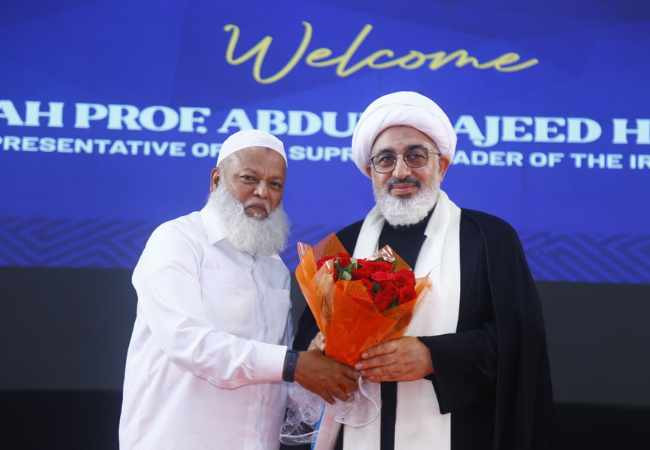
Bidar: Ayatullah Professor Abdul Majeed Hakim Elahi, the Representative of the Supreme Leader of Iran in India during his visit to Shaheen Knowledge City on Monday visited the Shaheen Group of Institutions.
Dr. Abdul Qadeer, Chairman of Shaheen Group of Institutions welcomed Professor Abdul Majeed Hakim Elahi.
Speaking on the occasion, Dr. Qadeer highlighted the historic and civilisational relationship between India and Iran and the centuries-old cultural, educational, and academic exchanges between the two nations.
Furthermore, he emphasized that both countries share deep-rooted ties in knowledge, language, and scientific traditions, which continue to strengthen cooperation even today.
During his visit, Ayatullah Hakim Elahi addressed a large gathering of students and faculty at Shaheen PU College.
Addressing the gathering, Ayatullah Hakim Elahi spoke on the importance of science, technology, and development, stressing that nations progress through innovation, research, and strong educational institutions.
He also encouraged students to aim for excellence in emerging fields such as biotechnology, space science, cyber technology, and nanotechnology.
During the visit, discussions were also held on future academic collaborations between Indian institutions and leading universities in Iran, particularly in advanced scientific and technological sectors.
Ayatullah Hakim Elahi also commended the remarkable contribution of the Shaheen Group of Institutions in transforming the lives of students, especially those from underprivileged and Madrasa backgrounds, by providing quality education and opportunities in professional fields.
As part of his visit, Ayatullah Hakim Elahi also toured the historic Mahmud Gawan Madrasa and commended its legacy as a centre of learning.