Real anti-nationalism is when you start blindly believing govt in the name of patriotism: Kanhaiya
He was addressing in Mangaluru at B.V Kakkilaya birth anniversary event
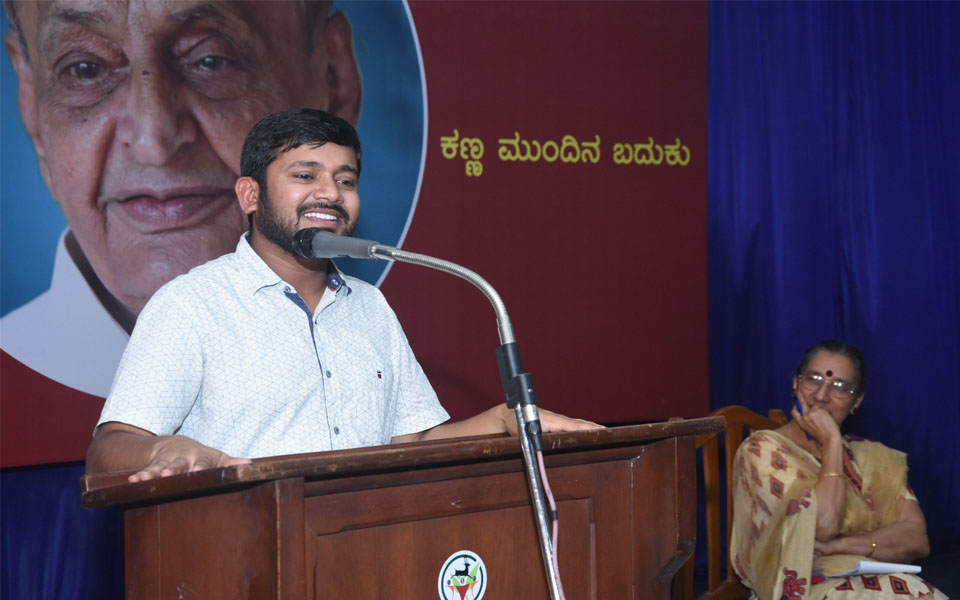
Mangaluru: JNU Scholar Dr. Kanhaiya Kumar on Saturday stressed on the need of youth reading and understanding the history and about freedom movement and fighters.
Speaking in Mangaluru at an event organised to mark centenary birth anniversary of veteran freedom fighter B.V Kakkilaya, Kanhaiya said "today's youth doesn't know much about freedom fighters and the history of their own respective villages, District or States. Whereas the need is to know, read and understand the history of not just our own District, village and state but also of others too".
Commenting on the development of the country in the last 70 years, since the independence, Kanhaiya blamed the parents for not letting their kids enter politics and added that it hindered the pace of the development of the country after independence.
"The biggest hindrance has been that the youth are not allowed to question things. Our system does not allow us to know what are our rights. The children in the country are not allowed to choose subjects of their interest but instead they are turned into machines by training them only to be able to survive future market. So, although the youth of the country go out to vote they don't realise the value of their votes and have not achieved political maturity" Kanhaiya added.
He further noted that one doesn't need to be pessimistic. "Although the youth today is experiencing lack of political knowledge and maturity this is largely due to the history of our nation," he added while urging the youth to work towards a better future of the country.
"BJP is the reason why we need to stand for secularism, BJP is the reason why the importance of democracy needs to be taught in the country. The BJP has caused several political questions that the youth needs to question them about," Kanhaiya said.
"B.V Kakkilaya was called anti-national by the British because he protested for the rights of people and for the freedom of this country. Even today, people fighting for the rights of people are arrested and labelled as anti-national, the only difference is that it is not the british who does it now but our own police and government. We need to stand united and start questioning everything that is wrong, we need to start people's movement in this country".
"Our Prime Minister uses religion as shield whenever he is questioned about the economic failure during his tenure. We don't need to worry about the current scenario of our country we just need to create awareness among the people about the history and facts" Kanhaiya added.
"The real anti-national are those who blindly believe and follow the government in the name of patriotism. The real patriotism is when you question the powerful people about the wrongs they are doing to the country. This should start at our homes, educational institutions should follow this, workplaces, public and platforms should follow this".
Talking about his decision to enter politics Kanhaiya said that joining JNU inspired him to join politics.
Answering a question by a student about why he doesn't say 'Jai Shri Ram' and his idea about a unified nation, Kanhaiya replied, "One can say anything, the constitution gives us the right, I will say 'Jai Samvidhan' (hail the constitution). I am proud of my country and I love my country. At the same time I am also proud of our beautiful and diverse culture where people of several beliefs and religion co-exist," Kanhaiya said while replying to the second question.

Let the Truth be known. If you read VB and like VB, please be a VB Supporter and Help us deliver the Truth to one and all.
Jharkhand: 2 killed, 5 injured after being run over by truck

Garhwa/Hazaribag (PTI): Two persons were killed and five others injured after being allegedly run over by a truck in Jharkhand's Hazaribag district on Thursday evening, police said.
The deceased were standing near a roadside puncture repair shop in Charhi when the accident happened, they said.
The injured persons were admitted to the Sheikh Bhikhari Medical College and Hospital, they added.
"The identity of the deceased is yet to be ascertained," said a police officer.
In another accident in Garhwa, two men in their mid-20s died after being hit by a speeding tractor, police said.
The accident happened in the Mahuliya panchayat in the Garhwa police station area in the early hours, they said.
"Rahul Chaudhary (26) and Nandlal Ram (26) were standing near their motorcycle on the roadside. A speeding tractor coming from the opposite direction hit them. Rahul died on the spot, while Nandlal succumbed to the injuries while being taken to the Sadar Hospital," said a police officer.
"Immediately after the mishap, the tractor driver abandoned the vehicle and fled. The tractor has been seized, and raids are underway to apprehend the absconding driver," he said.