Renowned researcher, author Dr. Shamsul Islam, to deliver BV Kakkilaya Inspired Oration 2023
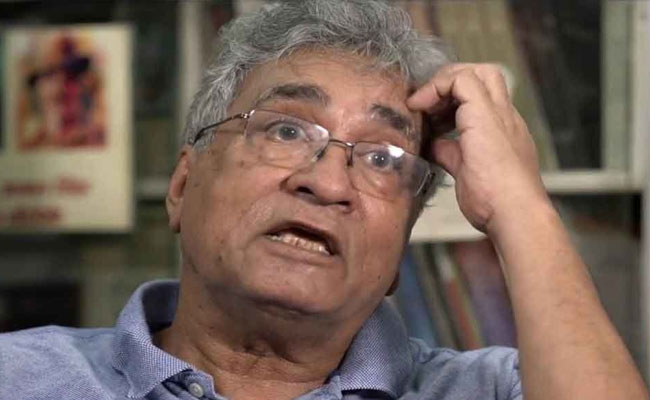
Mangaluru: Renowned researcher, author, and former Associate Professor of Political Science at the University of Delhi, Dr. Shamsul Islam, is scheduled to deliver the BV Kakkilaya Inspired Oration for 2023. The oration, titled "Joint Martyrdoms, Joint Heritage of 1857 War of Independence," will take place on Saturday, September 9, 2023, at 10 a.m. at Ravindra Kalabhavana, University College, Mangaluru.
The annual BV Kakkilaya Inspired Orations serve as a tribute to the life and contributions of Sri BV Kakkilaya (1919-2012). Kakkilaya was a freedom fighter, a leader in the Karnataka unification movement, a prominent figure in the Communist Party of India and All India Trade Union Congress, a member of the first Rajya Sabha, and the Karnataka State Assembly.
He was also an award-winning writer and thinker. The oration aims to promote alternative thoughts and approaches to address the challenges faced by the underprivileged masses in India. The event is organized by Hosatu Monthly, Bangalore, MS Krishnan Trust, Bangalore, and Samadarshi Vedike, Mangalore, in collaboration with the Department of History, University College, Mangaluru.
During the event, Dr. Shamsul Islam's book, "The Untold Amazing Stories of 1857," will be released in its Kannada translation, titled "Bharatada Modala Swatantrya Sangrama 1857 - Helade Ulida Adbhuta Kathegalu." The book is translated by Dr. B.R. Manjunath and published by Navakarnataka Publications. Dr. Jayaraj Amin, Vice Chancellor of Mangalore University, will have the honor of unveiling the translated work.
Additionally, the event will feature the publication of the names of 128 martyrs from Karnataka, who hailed from diverse backgrounds including various castes, religions, sects, and socio-economic strata. These martyrs gave their lives during the 1857-58 anti-British revolts. Dr. Shamsul Islam compiled this list from national archives, and the occasion will be marked with tributes to these brave individuals.
The public is warmly welcomed to attend this significant event.
Let the Truth be known. If you read VB and like VB, please be a VB Supporter and Help us deliver the Truth to one and all.
Mamata alleges BJP disrupted her Bhabanipur rally, Suvendu claims 'she's nervous'
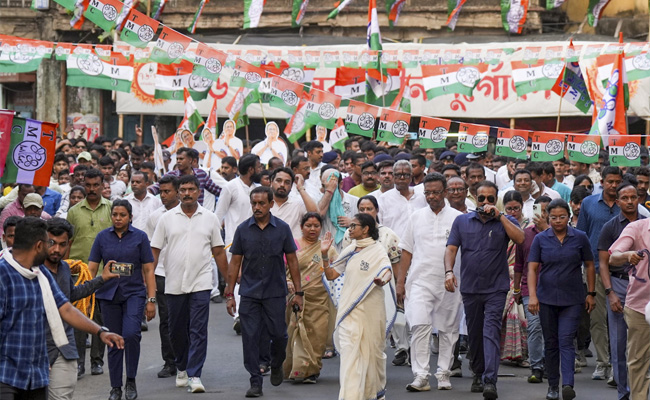
Kolkata (PTI): Chief Minister Mamata Banerjee cut short her speech at a rally in her Bhabanipur constituency, alleging that the BJP was deliberately playing loud music from a nearby public meeting.
A peeved Banerjee said despite having the required permission of the Election Commission, her rally in Chakraberia was disrupted by the BJP, "who want to capture Bengal by intimidation and threat".
"It is not possible for me to go ahead with this meeting. If they can do such a thing in my constituency, imagine how undemocratic the BJP is. If they behave like this, I have to take legal action," she said.
"This is an insult, humiliation. BJP is stepping on our toes to instigate trouble. Not possible to address the gathering in this situation. I am leaving the stage. Please vote for me in your protest," she added.
Banerjee was then seen calling someone over and venting her grievances.
Before leaving the stage, she said, "I will hold a rally tomorrow at the same spot."
TMC supporters then rushed towards the BJP rally, which was later addressed by Leader of the Opposition Suvendu Adhikari, but security personnel intervened and prevented the situation from escalating.
TMC workers later staged a demonstration outside the local police station and filed a complaint, alleging that the BJP violated the model code of conduct.
A senior TMC leader said another complaint will also be lodged with the Election Commission.
Asked about Banerjee's allegations, Adhikari told reporters after the rally he held nearby, "Her reaction shows she is nervous about the imminent loss."
"There was no violence, no obstruction in her meeting and her behaviour shows her nervousness. On May 4, people of Bhabanipur will celebrate the victory of the BJP," he claimed, alleging that the TMC also tried to disrupt his meeting by playing loud music.
South Kolkata's Bhabanipur, one of the battleground seats in the West Bengal elections, will vote in the second phase on April 29.