Senior journalist, music critic A. Eswaraiah passes away
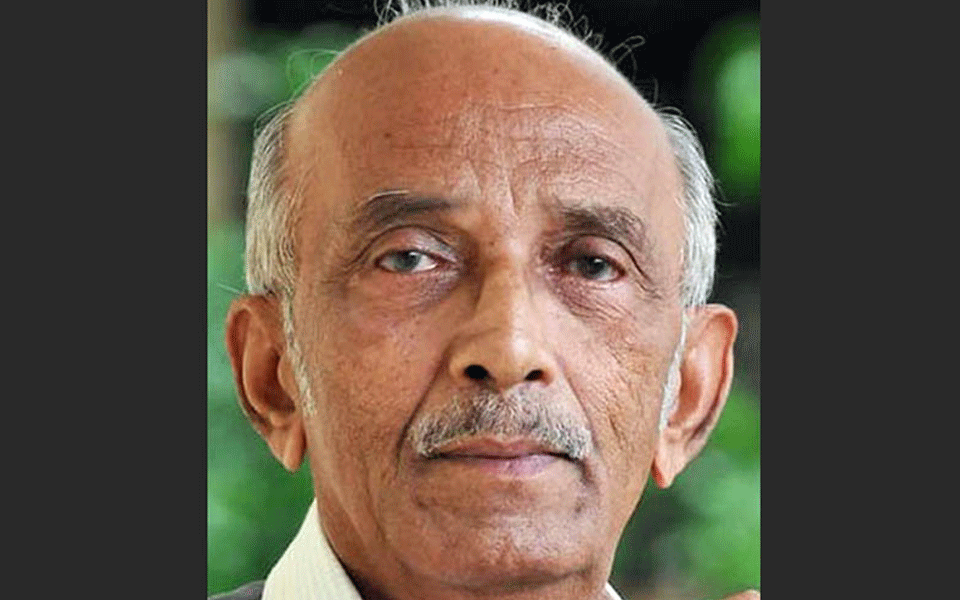
Udupi, Dec 30: Senior journalist and critic of music and photography A Eswaraiah on Sunday passed away at his residence at Lakshmindra Nagar in the city. He was 78. He is survived by wife, son and two daughters.
He had worked as editor of literary magazine ‘Tushara’ for more than two decades and he introduced hundreds of young and talented writers and litterateurs through his magazine. He has first introduced novels, short stories and poems of various writers through ‘Tushara’ and ‘Karvalo’ of Poornachandra Tejaswi was the best example.
Through his magazine, he has started a new column ‘photo article’ in order to give importance to best photos. This has encouraged writer Poornachandra Tejaswi in exposing the photography talent. He has special knowledge about photography and he was writing column about photography. But he was not happy about the excess usage of digital camera and mobile phone cameras as it has ‘killed’ creativity.
He was born to landlord and Patel of Ananthapura, Ananthapura Narayanaiah on August 12, 1940. After being graduated from MGM College of Udupi in English language, he entered journalism and worked till his retirement as the editor.
During his primary education, he had studied music and could able to play flute and other instruments. He was a multifaceted personality. Besides being a good journalist and giving priority to music, yakshagana and fine art forms, he was also a good photographer. Not only as a writer and short story writer, but Eswaraiah also talented in criticism. His column ‘Sarasa’, being written in ‘Tushara’ got much popularity and it came out in the form of book.
As a music lover, he established ‘Ragadhwani’ organization in Udupi and became the editor of a monthly magazine on music. He has got Karnataka State Media Academy award, State-level Sandesha award, Polya Yakshagana award, Vyasa Sahitya award, Moodabidri Nudisiri award and others. Sources said that his cremation would be held on Monday morning.
Let the Truth be known. If you read VB and like VB, please be a VB Supporter and Help us deliver the Truth to one and all.
Power tariffs under BESCOM to rise from May 1

Bengaluru (PTI): Power bills for consumers under the Bangalore Electricity Supply Company Limited (BESCOM) will go up from May 1, following an order issued by the Karnataka Electricity Regulatory Commission (KERC) on Friday.
The hike comes after KERC allowed the BESCOM to recover a revenue deficit of Rs 2,068 crore incurred in 2024-25, from the consumers.
As a result, for every unit of electricity consumed in 2024-25, the customers will be charged an additional 56 paise, it said.
"BESCOM shall calculate, for each of the active consumers of FY2024-25 the amount to be recovered based on their actual energy consumption during FY2024-25. Such amount shall be recovered during FY 2026-27 in equal monthly instalments, to be called as 'FY25 True up Charges', commencing from the first meter reading date falling on or after 1 May 2026 and concluding with the reading date ending on 30 April 2027," the order said.
"It is further ordered that BESCOM shall maintain a separate head of account, allocated for the purpose, to record the adjustment of the said amount to ensure full recovery of the deficit," it added.
Similarly Chamundeshwari Electricity Supply Corporation Limited (CESC) has also recorded a revenue deficit of Rs 121.71 crore and can collect an additional 15 paisa per unit for consumption in 2024-25, official sources said.