Some PG classes to be discontinued: Mangalore University Vice-Chancellor P.L. Dharma
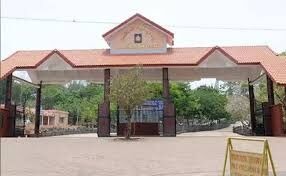
Mangaluru: Mangalore University will discontinue some postgraduate (PG) classes in its constituent colleges from the next academic year, Vice-Chancellor Prof. P.L. Dharma has announced.
Speaking to the media, he stated that due to a shortage of experienced faculty, it has become difficult to continue certain PG classes. As a result, these classes will be discontinued, and students must directly apply to Mangalore University instead of its constituent colleges.
Challenges in managing constituent colleges
The university currently manages four constituent colleges—Sandhya College, Mangalagangotri, Bannadka, and Nelyadi. However, maintaining these colleges has become challenging due to a shortage of permanent lecturers. While guest lecturers have been handling classes efficiently, the need for experienced senior faculty remains. The university has requested the government to convert these constituent colleges into government colleges.
Plan to utilise unused international hostel building
The university is considering using the unused international hostel building within its campus through public-private partnerships. With several private medical and engineering colleges in the city, discussions are underway to explore the possibility of allocating the building for their use after obtaining government approval.
Pending contractor payments
The university owes approximately ₹40 crore to contractors for various construction projects, including the hostel building. Due to financial constraints, payments will be made in phases, the vice-chancellor said.
Dispute over panchayat tax
Responding to a query about unpaid taxes to the local gram panchayat, Prof. Dharma stated that the Vishwamangala Trust, located within the university campus, has also been taxed. Since the trust operates independently of the university, discussions are ongoing with panchayat officials to exempt the international hostel and another unused building from taxation. Once a resolution is reached, pending taxes will be paid in installments.
Mangalore University secures 13 patents
The university has obtained 13 patents and aims to enhance its focus on continuous education, examinations, and research, the vice-chancellor added.
Let the Truth be known. If you read VB and like VB, please be a VB Supporter and Help us deliver the Truth to one and all.
Belagavi youth’s murder case projected as road accident, cracked in Uttara Kannada; Three arrested

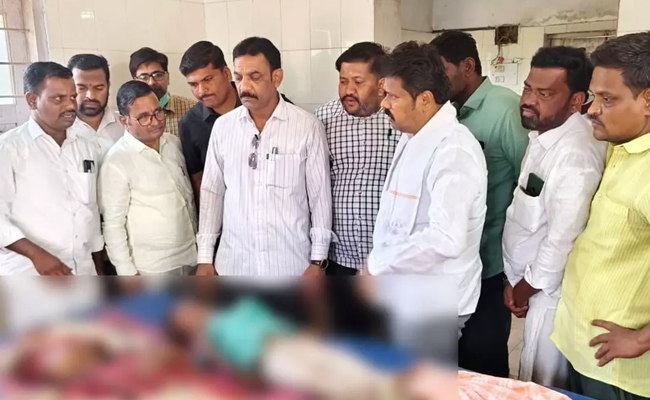
Karwar: Uttara Kannada police have cracked a murder case in which a Belagavi youth was killed and his body burnt inside a car to make it appear like a road accident.
Addressing a press meet in the city, Superintendent of Police Deepan M.N. said three accused from Old Hubballi have been arrested in connection with the case. The crime was a pre-planned act driven by personal enmity, he said.
The case came to light on April 8 morning when a car (KA-04/MJ-8996) was found completely burnt in a roadside ditch near Talekumbri bus stand in Yellapur. Only charred human remains were found inside the vehicle. Initially, it was suspected to be an accident caused by overspeeding, and a case was registered at Yellapur police station based on a complaint filed by the deceased’s father, Jagannath Dhapale.
However, the father later expressed suspicion that his son’s death was not accidental, prompting a detailed investigation.
Taking the matter seriously, two special teams were formed under the leadership of Yellapur Inspector Ramesh Hanapur. On analysing technical evidence and CCTV footage, police found that it was a planned murder.
The accused have been identified as Abdul Raheem Basheer Ahmed Mujawar (32), Maulasab Bavahan Wada (36) and Dadapeer alias Aftab Mehboob Saab Balasangi (22), all chicken traders from Old Hubballi.
Police have seized the car used in the crime along with two scooters. The accused have been remanded to judicial custody.
Investigations revealed that the accused killed Nitesh Dhapale due to personal enmity and later set the car on fire along with the body to project it as an accident.
SP Deepan M.N. appreciated the efforts of Inspector Ramesh Hanapur, PSIs Rajashekhar Vandali and Siddappa Gudi, and the entire team for solving the complex case.