This election will be fought to save constitution of the country: Siddaramaiah
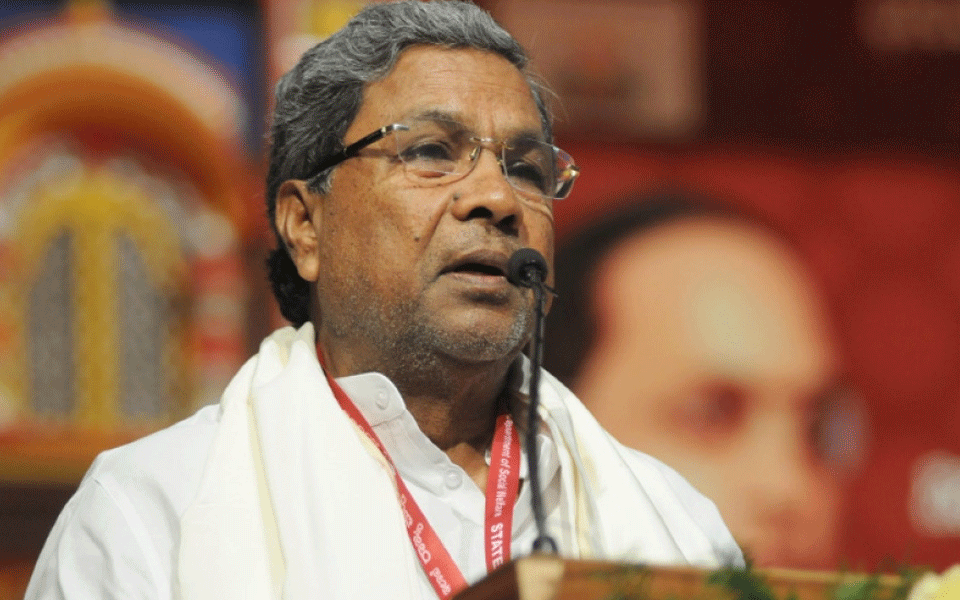
Udupi, 10 March: Former Karnataka Chief Minister Siddaramaiah on Sunday while addressing party activists in Udupi added the upcoming elections are being fought for the cause of survival of Constitution and Truth. He insisted people to vote carefully without falling for the false promises of BJP like previous election.
He was addressing a number of party activists in rally in a ‘Parivarthana Samavesha’ event at the Royal Gardens in Kalsangka here in the city.
“A government’s job is to build the nation and not to divide and break it. What Narendra Modi government has done in last 55 months is it has divided the nation, apart from that they did nothing credible” Siddaramaiah said.
“When I was the CM of the state, I fulfilled about 165 promises during my term which were part of our manifesto before election. I am ready for debate on this issue on any platform. Is the BJP or Modi ready for a debate on their achievements?” Siddaramaiah questioned.
“Prime Minister Dr. Manmohan Singh during the UPA government had issued loan of Rs 72,000 crore to farmers of the country. I waived and paid Rs 8165 crore of 22,250 farmers in the state. Narendra Modi’s ache din only came for Adani, Ambani, Nirav Modi, Choski and Mallya, not farmers, Dalits and poor people” he added
“Before elections, Modi said he will be their guardian and the watchman of the country. But after the election people realised that “Chowkidar hi chor hai’ (Watchman himself is the thief)” he said taking a dig at Modi’s ‘Chowidar’ remark.
“Modi visited the state recently twice, he again made promises but did not speak about the promises he made previously which he could not fulfill. Neither he spoke about developmental work done during his term in the state”.
"In his five years tenure, he should’ve created about 10 crore jobs as he had promised to create two crore jobs annually. But the statistics reflect only 27 lakh jobs were created in his tenure. So the youth of the country has to think before voting them. Modi is not able to protect their interest. Their interest can only be protected by Congress and Rahul Gandhi now” he noted.
Taking a further dig at Modi, he said “India has not seen a prime minister who lies more than Narendra Modi. There are chaos in the country due to his false promises. Nobody in this government is concerned and bothered about poor, farmers, Dalits, Women and minorities”.
If the Congress comes to the Women's Reservation Bill
Showering praise on Congress President Rahul Gandhi Siddaramaiah said that Rahul is a simple person who is honestly concerned about the poor, women and farmers. “Speaking in Haveri Yesterday Rahul said that Congress will implement 33-seat women reservation bill if voted to power. Siddaramaiah also said that the Congress and allies will get majority in the next Lok Sabha polls and that Rahul Gandhi will be the prime minister.
Let the Truth be known. If you read VB and like VB, please be a VB Supporter and Help us deliver the Truth to one and all.
Belagavi youth’s murder case projected as road accident, cracked in Uttara Kannada; Three arrested

Karwar: Uttara Kannada police have cracked a murder case in which a Belagavi youth was killed and his body burnt inside a car to make it appear like a road accident.
Addressing a press meet in the city, Superintendent of Police Deepan M.N. said three accused from Old Hubballi have been arrested in connection with the case. The crime was a pre-planned act driven by personal enmity, he said.
The case came to light on April 8 morning when a car (KA-04/MJ-8996) was found completely burnt in a roadside ditch near Talekumbri bus stand in Yellapur. Only charred human remains were found inside the vehicle. Initially, it was suspected to be an accident caused by overspeeding, and a case was registered at Yellapur police station based on a complaint filed by the deceased’s father, Jagannath Dhapale.
However, the father later expressed suspicion that his son’s death was not accidental, prompting a detailed investigation.
Taking the matter seriously, two special teams were formed under the leadership of Yellapur Inspector Ramesh Hanapur. On analysing technical evidence and CCTV footage, police found that it was a planned murder.
The accused have been identified as Abdul Raheem Basheer Ahmed Mujawar (32), Maulasab Bavahan Wada (36) and Dadapeer alias Aftab Mehboob Saab Balasangi (22), all chicken traders from Old Hubballi.
Police have seized the car used in the crime along with two scooters. The accused have been remanded to judicial custody.
Investigations revealed that the accused killed Nitesh Dhapale due to personal enmity and later set the car on fire along with the body to project it as an accident.
SP Deepan M.N. appreciated the efforts of Inspector Ramesh Hanapur, PSIs Rajashekhar Vandali and Siddappa Gudi, and the entire team for solving the complex case.