Those behind 3 murders in DK district will be arrested, punished soon: DGP Praveen Sood
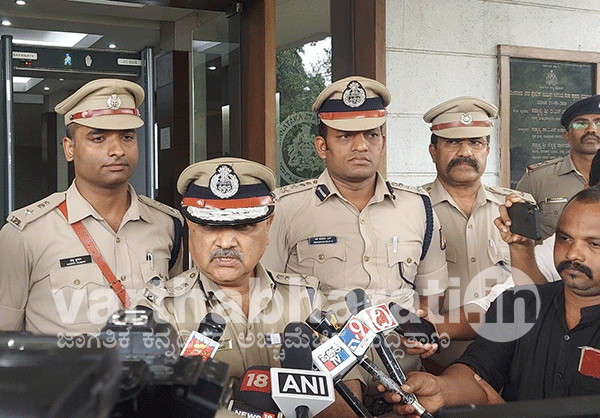
Mangaluru, Aug 1: Karnataka Director General of Police Praveen Sood on Monday assured that those involved and behind three murders in Dakshina Kannada district in the last ten days would be arrested and punished soon irrespective of their organisational or ideological background.
The DGP, who reviewed the developments and investigation with top officials, also called on people to cooperate with the police by coming forward and sharing information, if any, regarding the murders.
"Three murders have taken place in ten days: The first is the Masood case in which eight people were arrested and sent to judicial custody. Second, the Praveen murder case in which two were arrested and further inquiry is on. We will nab the killers and strictly punish them. Third is the Fazil case wherein there has been definite progress, a car used for the crime and its owner have been found," Sood said.
Speaking to reporters here, he said, based on the arrests made and investigation so far, further arrests, if any, would be made, and also measures would be taken to see to it that such incidents don't get repeated and there is peace in the region.
"...I assure the people that all those behind the three cases, also whichever organisation or ideology is behind them, we will not leave them. We will take strict action against them," he added.
A 32-year old zilla Bharatiya Yuva Morcha committee member Praveen Nettar was hacked to death by unidentified motorbike-borne assailants on the night of July 26 at Bellare in Sullia taluk in Dakshina Kannada district, which had sparked outrage.
Two persons with suspected links with the Popular Front of India (PFI) were arrested by the Karnataka police in connection with the murder on July 28.
Masood (18) was murdered in Bellare before Nettar's killing; Mohammed Fazil (23) was hacked to death at Surathkal Mangaluru city outskirts after it.
At this stage, more than finding a link between cases, the priority of the police is to physically catch hold of the murderers and to interrogate them, Sood said, adding that once the investigation is over, it would be mentioned in the charge sheet whether there were any links to other cases.
"At this preliminary stage, it will be wrong to say there were links based on mere speculation and it is not good for society by unnecessarily linking two deaths, as it will further vitiate the atmosphere. Whether there is link or not murder is a murder...neither police nor the dead body has any religion," he added.
Naturally, there is an atmosphere of fear because of the three murders, the DGP said. Officials have taken several measures in this regard, and that he, too, has held meetings with ADGP, Commissioner, also Deputy Commissioner and Superintendent of Police, Dakshina Kannada, in this regard.
"Increasing patrolling and in border areas, having strong checkpost, and effective human intelligence is important. Also enhancing the police staff in Dakshina Kannada is necessary and steps are being taken in this regard," he said.
Noting that for any incident there would be an eyewitness or someone who is aware of it, Sood urged the citizens to come forward and cooperate with the police with regard to the cases.
"Police have the responsibility to nab the culprits, but it is not the duty of police alone, it should be a combined effort. Irrespective of religious background, we should join hands to maintain peace," he added.
Let the Truth be known. If you read VB and like VB, please be a VB Supporter and Help us deliver the Truth to one and all.
Mercury likely to touch 44 deg C in Delhi; IMD issues alert for heatwave-like conditions
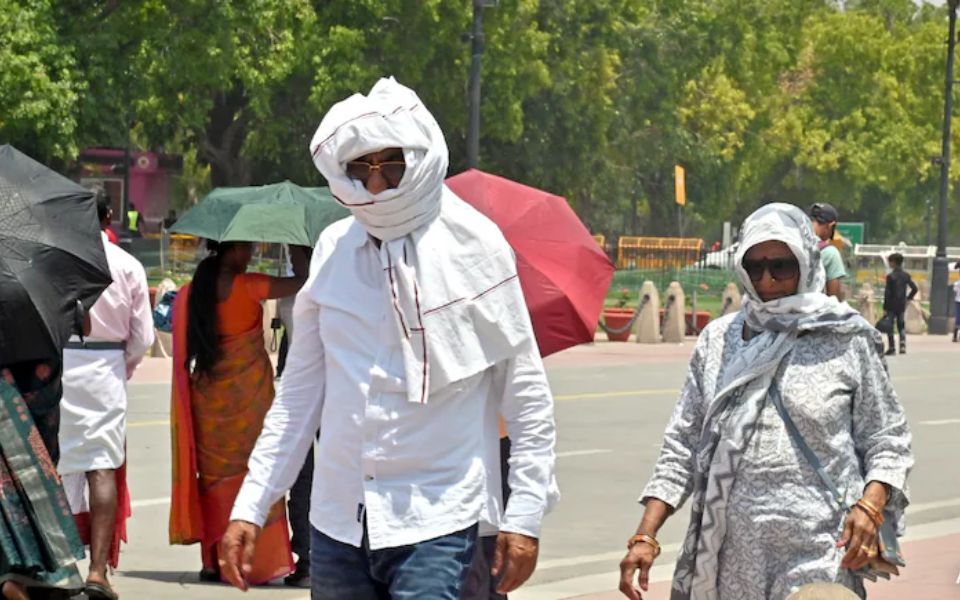
New Delhi (PTI): Delhi recorded a minimum temperature of 26.2 degrees Celsius on Sunday, 2.4 notches below the seasonal average, according to the India Meteorological Department.
The weather department has forecast partly cloudy sky with an orange alert for heatwave-like conditions at isolated places by the evening.
The maximum temperature is expected to reach around 44 degrees Celsius on Sunday, the IMD said.
The relative humidity in the capital was recorded at 43 per cent at 8.30 am.
The air quality was 'poor' at 9 am, with an Air Quality Index (AQI) reading of 223, Central Pollution Control Board (CPCB) data showed.
According to the CPCB, an AQI between zero and 50 is considered 'good', 51 and 100 'satisfactory', 101 and 200 'moderate', 201 and 300 'poor', 301 and 400 'very poor', and 401 and 500 'severe'.