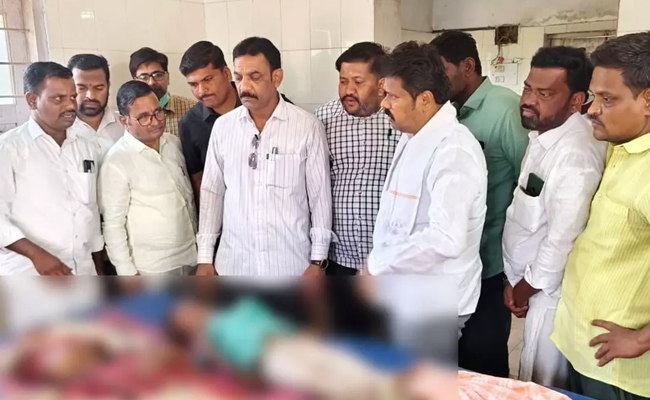
Udupi: Jaya Karnataka district unit announces it will boycott Lok Sabha Elections

Udupi, 12 Mar: Jaya Karnataka’s Udupi district committee has announced that they along with all their members and others will boycott the upcoming Lok Sabha elections. The decision comes as the organisation believes neither state government nor the Central government have resolved the issue of sand mining in the district.
Addressing the gathering of its members outside Udupi war memorial, Jaya Karnataka District President Sathish Poojary Saligrama said that the state and central governments failed to resolve issue of sand mining despite several protests in the district. He alleged poor families have availed loans from banks to construct homes but were struggling to build home with scarcity of sand in the district.
“Both Central and State governments are failing to be fair to the district in various ways. Why should we vote for them? During the elections they come and seek our votes. Both MP and the MLA have failed to fulfill our demands. So we have decided to boycott this Lok Sabha election” he said.
“Udupi-Chikmagalur MP Shobha Karandlaje has not worked in the district for five years. If she is contesting the election as an candidate we will not support her at any cost. She completely ignored our district and did not even respond to case of seven missing fishermen, the murders and the sand problems” Satish Poojary added while also adding that their fight was against the legislators and not against a particular party.
Karunakar Poojary, office bearers Ganesh Raj Saralabettu, Annappa Kulal Hebri, Harish Shetty Uchila, Mahesh Kotian Uppoor, Sudhakar Rao Barkur, Ratnakar Mogaveera Havanje, Vivek Kalmadi, Mahesh Manipal, Srinivas Shetty Tonsey are present during the event.


Let the Truth be known. If you read VB and like VB, please be a VB Supporter and Help us deliver the Truth to one and all.
Belagavi youth’s murder case projected as road accident, cracked in Uttara Kannada; Three arrested
Karwar: Uttara Kannada police have cracked a murder case in which a Belagavi youth was killed and his body burnt inside a car to make it appear like a road accident.
Addressing a press meet in the city, Superintendent of Police Deepan M.N. said three accused from Old Hubballi have been arrested in connection with the case. The crime was a pre-planned act driven by personal enmity, he said.
The case came to light on April 8 morning when a car (KA-04/MJ-8996) was found completely burnt in a roadside ditch near Talekumbri bus stand in Yellapur. Only charred human remains were found inside the vehicle. Initially, it was suspected to be an accident caused by overspeeding, and a case was registered at Yellapur police station based on a complaint filed by the deceased’s father, Jagannath Dhapale.
However, the father later expressed suspicion that his son’s death was not accidental, prompting a detailed investigation.
Taking the matter seriously, two special teams were formed under the leadership of Yellapur Inspector Ramesh Hanapur. On analysing technical evidence and CCTV footage, police found that it was a planned murder.
The accused have been identified as Abdul Raheem Basheer Ahmed Mujawar (32), Maulasab Bavahan Wada (36) and Dadapeer alias Aftab Mehboob Saab Balasangi (22), all chicken traders from Old Hubballi.
Police have seized the car used in the crime along with two scooters. The accused have been remanded to judicial custody.
Investigations revealed that the accused killed Nitesh Dhapale due to personal enmity and later set the car on fire along with the body to project it as an accident.
SP Deepan M.N. appreciated the efforts of Inspector Ramesh Hanapur, PSIs Rajashekhar Vandali and Siddappa Gudi, and the entire team for solving the complex case.