Udupi: M.Sc student killed in wall collapse
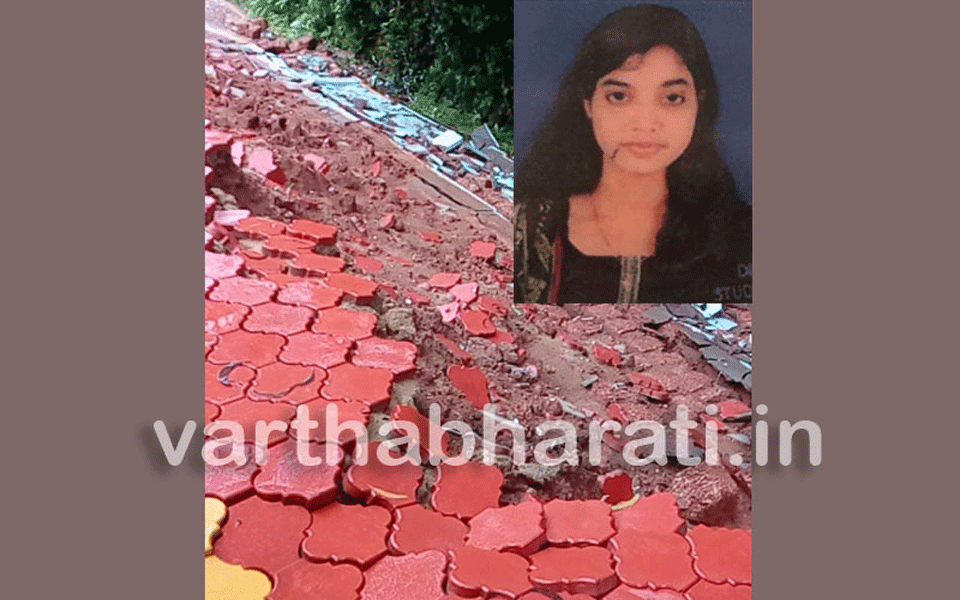
Udupi: A girl died on the spot when a compound wall collapsed on her in Byndoor.
The compound wall of the Nandikeshwara temple collapsed on an M.Sc student Dhanya. The victim was seriously injured and died on the spot.
A case has been registered at the Byndoor police station, and more information is yet to come.
Let the Truth be known. If you read VB and like VB, please be a VB Supporter and Help us deliver the Truth to one and all.
Nepal mountaineers worried amid fake rescue insurance scam
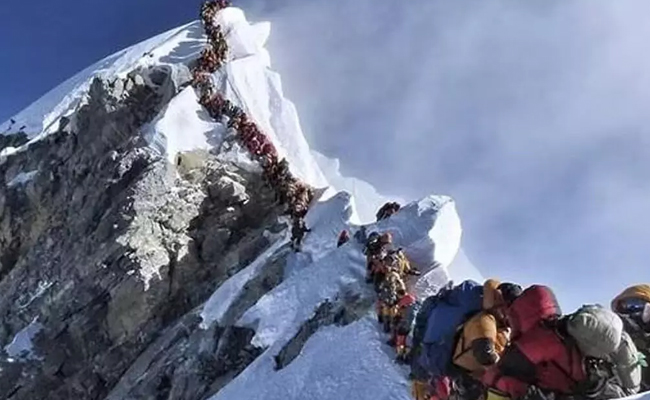
Kathmandu (PTI): Nepal's mountaineering community has expressed serious concern over a USD 20 million insurance scam, even as police on Friday dismissed as "misleading" media reports alleging that some foreign tourists were deliberately given poisonous food to facilitate fraudulent rescue operations.
As the spring climbing season for Mount Everest opened this week, Nepal Police's Central Investigation Bureau (CIB) said that ongoing investigations have not found any evidence to support allegations of food poisoning being used to facilitate fake rescue operations.
"We would like to state the fact that the investigation so far has not revealed any instance of toxic substances being adulterated in food," said the CIB, which conducted months-long investigation into the fake mountain rescue operations involving helicopter operators, trekking agencies and hospitals.
"Misleading and untrue news has been published in national and international media, as well as on social media platforms, based on unverified content," the Himalayan Times newspaper reported, citing a statement issued by the CIB.
The CIB has charged 32 people over the fake insurance scam. These people were freed after taking bail, said CIB spokesperson Shiva Kumar Shrestha. The CIB had filed a case at the Kathmandu District Court, which slapped fines on the 32 individuals.
However, the magnanimity of the fraud hangs over the country as the spring climbing season starts.
"We are conducting investigation regarding the fake rescue operation allegedly being conducted by some travel operators in the Everest region and if found guilty, action will be taken," said Director General of Nepal's Tourism Department Ramkrishna Lamichhane.
"Also, we are trying our best to make sure such fake rescue operations do not happen in the days to come," Lamichhane said.
The Nepal Mountaineering Association (NMA) came down heavily on the alleged practice, saying the mountaineering community as a whole does not encourage such activity.
In a press statement issued on Friday, the association said such allegations are "unimaginable" for expedition operators and stakeholders involved in Nepal's mountaineering sector. It stressed that Nepal has long maintained a strong global reputation as a safe and reliable destination for climbers.
The association called on the government to take strict action if any unethical or inhumane practices are proven, while cautioning that unverified reports could harm the country's image at the start of the peak spring climbing season.
“We discourage such fake rescues in the mountains and urge the government to take strong action against those found guilty,” said NMA president Phur Gelje Sherpa.
“No doubt, there may be a few bad persons who are doing these illegal things, but the mountaineering community as a whole doesn't encourage such activity,” he said while demanding that the government adopt a proper policy to prevent such illegal activity.
Dendi Sherpa, a three-time Everest summitter, said, “Because of the bad conduct of a few people, real climbers like us have to suffer.”
“This will very much have a negative impact on our climbing business. The government should be strict in implementing rules and regulations to control such illegal acts,” he told PTI.
Mount Everest, the world's highest peak at 8,848.86 metres, and scores of other Himalayan peaks continue to be a big draw for mountaineers and adventure lovers from the world over, year after year, since its first ascent in 1953.
Mountaineering, especially for Mt Everest, royalty fees and a large mountain community dependent on mountaineering and related tourism in the region, is a good revenue stream for the Himalayan nation.
Till 2025, more than 8,000 Nepalese and foreign climbers have successfully summited Mt Everest.
In January, Nepal police arrested six officials of tour operators and mountain rescue agencies for their involvement in the fake rescue scam that defrauded international insurance companies of nearly USD 20 million.
In some cases, trekkers with minor altitude-related discomfort were allegedly pressured into helicopter evacuations. In others, multiple patients were transported in a single flight but billed separately to different insurance companies at full cost.
According to the CIB investigators, the accused staged medical emergencies to justify costly helicopter evacuations, which were then falsely claimed from international travel insurance providers.
Fake rescues not only generate illegal profits but also damage Nepal's international reputation and could jeopardise insurance facilities in the country, the CIB had asserted then.
The CIB in January said that their investigation showed that Mountain Rescue Service Pvt Ltd conducted 1,248 rescues, of which 171 were allegedly fake, resulting in insurance claims exceeding USD 10.3 million.
Nepal Charter Service Pvt Ltd carried out 471 rescues, including 75 fake cases, claiming USD 8.2 million, while Everest Experience and Assistance Pvt Ltd conducted 601 rescues, with 71 fraudulent cases involving claims of USD 1.15 million.
In total, 317 fake rescues were detected out of 2,320 operations, leading to fraudulent insurance claims of nearly USD 20 million, the bureau said.