Uncontrolled digging could erase Dharmasthala mass burial evidence: Soil scientist warns SIT
Bengaluru: A soil scientist, who has studied tropical lateritic soils, has released a note in anonymity, warning the Special Investigation Team (SIT) probing alleged mass burials in Dharmasthala (1994–2014) that improper excavation could permanently destroy critical forensic evidence.
The scientist cautioned that in the coastal, high-rainfall environment of Dharmasthala, bones from older graves are often not visually present due to the region’s acidic laterite soil, which accelerates decomposition. “In these conditions, the visual absence of bones does not mean there was no burial,” the expert stressed. “Chemical and microscopic soil analysis may be the only way to detect older graves.”
According to the soil scientist, Dharmasthala’s lateritic soil has a pH of 4.5–6, is porous and rich in iron and aluminium oxides, and is subject to over 3,500 mm of annual rainfall. These factors together cause rapid bone mineral dissolution and collagen breakdown. “In as little as 15–20 years, complete skeletons can be reduced to just teeth, enamel shards, or micro-residues,” the scientist said.
Drawing on comparisons with Rwanda, Cambodia, Sri Lanka, and Srebrenica, the scientist estimated that:
- Graves less than 15 years old have a reasonable chance of yielding skeletons.
- Graves 15–20 years old may yield only partial skeletons and teeth.
- Burials older than 20 years often retain only chemical signatures and microscopic fragments.
“In Dharmasthala’s soil, the probability of finding a full skeleton after two decades is near zero,” the expert said.
‘JCBs will destroy what’s left’
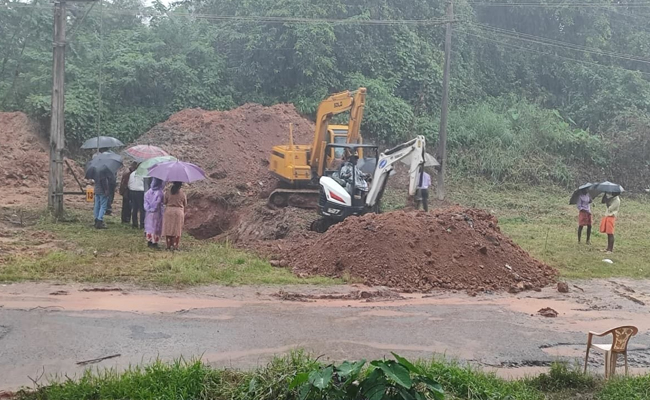
The soil scientist was particularly critical of the use of heavy machinery in the investigation. “Uncontrolled digging with JCBs can obliterate brittle bone fragments, erase burial stratigraphy, and mix burial soil with surrounding soil, diluting chemical signals,” he warned. “It’s equivalent to destroying the crime scene.”
The scientist emphasised that disturbed lateritic soil can quickly resemble undisturbed ground, making it almost impossible to detect graves later.
GPR as a map, not a microscope
The expert also noted that Ground Penetrating Radar (GPR) could play a limited role in the investigation. “GPR can help locate soil disturbances, but in wet, iron-rich lateritic soils, it cannot ‘see bones.’ For burials decades old, chemical analysis of soil is far more reliable,” he said.
Call for controlled forensic exhumation
The soil scientist urged the SIT to stop all mechanical digging and adopt a forensic protocol:
- Use GPR or other non-invasive methods to locate anomalies.
- Excavate in small, measured layers under forensic supervision.
- Collect soil samples for chemical and microscopic analysis.
- Sieve soil to recover micro bone fragments and teeth.
“Only a controlled, scientific approach will preserve what little evidence may remain in this environment,” the scientist said. “If these traces are destroyed, the truth about the alleged burials may never be proven.”
The SIT is investigating allegations of mass burials linked to the disappearance of individuals between 1994 and 2014 in Dharmasthala. No official response to the scientist’s concerns has been issued.
Let the Truth be known. If you read VB and like VB, please be a VB Supporter and Help us deliver the Truth to one and all.
Power tariffs under BESCOM to rise from May 1

Bengaluru (PTI): Power bills for consumers under the Bangalore Electricity Supply Company Limited (BESCOM) will go up from May 1, following an order issued by the Karnataka Electricity Regulatory Commission (KERC) on Friday.
The hike comes after KERC allowed the BESCOM to recover a revenue deficit of Rs 2,068 crore incurred in 2024-25, from the consumers.
As a result, for every unit of electricity consumed in 2024-25, the customers will be charged an additional 56 paise, it said.
"BESCOM shall calculate, for each of the active consumers of FY2024-25 the amount to be recovered based on their actual energy consumption during FY2024-25. Such amount shall be recovered during FY 2026-27 in equal monthly instalments, to be called as 'FY25 True up Charges', commencing from the first meter reading date falling on or after 1 May 2026 and concluding with the reading date ending on 30 April 2027," the order said.
"It is further ordered that BESCOM shall maintain a separate head of account, allocated for the purpose, to record the adjustment of the said amount to ensure full recovery of the deficit," it added.
Similarly Chamundeshwari Electricity Supply Corporation Limited (CESC) has also recorded a revenue deficit of Rs 121.71 crore and can collect an additional 15 paisa per unit for consumption in 2024-25, official sources said.