75 electric buses from Switch Mobility hit Bengaluru city roads
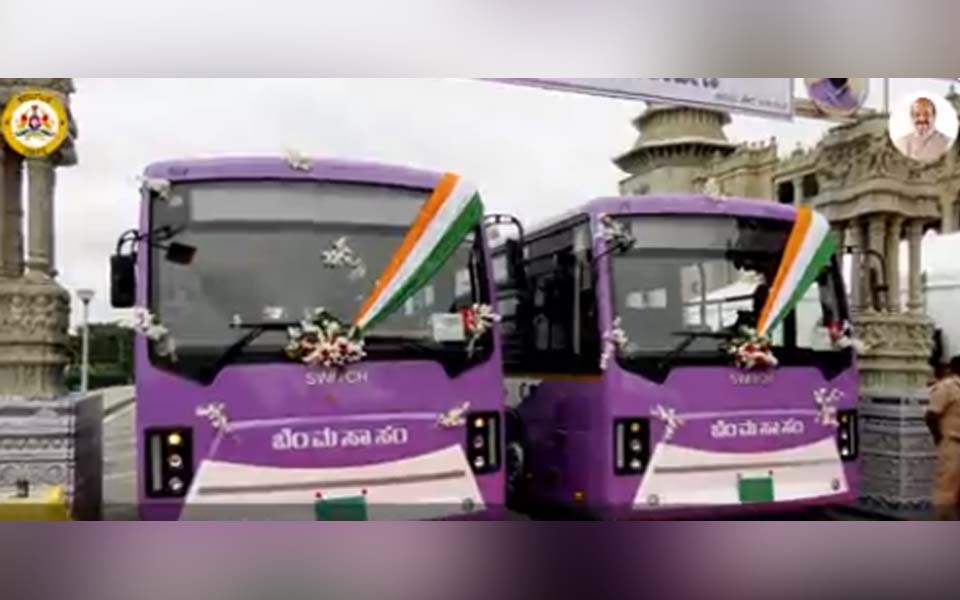
Bengaluru, Aug 14: Karnataka Chief Minister Basavaraj Bommai on Sunday flagged off 75 "Switch EiV 12 buses" to cater to the needs of the people in Bengaluru.
Switch Mobility Ltd's "new technologically advanced" electric buses are a part of the 300-strong electric bus order and would be inducted into the fleet of the Bengaluru Metropolitan Transport Corporation (BMTC).
Switch Mobility, the next-generation carbon-neutral electric bus and light commercial vehicle company, would supply, operate and maintain the 300 buses, the company said in a release.
"In order to cater to these needs, Switch India launched the Switch EiV 12 platform in June 2022 and today we are delighted to begin initial deliveries of our Switch EiV buses to BMTC as part of our 300-strong electric bus order," said Mahesh Babu, Chief Executive Officer, Switch India and Chief Operating Officer of Switch Mobility Ltd.
The buses would play a vital role in reducing carbon footprint in the city - a reduction of over 14,500 tonnes of CO2 per year equivalent to planting 87,000 trees, he said.
The buses are equipped with a new-generation, highly efficient, modular batteries with advanced lithium-ion NMC chemistry, specially formulated for the Indian market and climatic conditions, the company said.
The modular batteries increase the capacity per battery cell for the same weight enabling a higher range of kilometres.
ಇಂದು ವಿಧಾನಸೌಧದ ಮುಂಭಾಗದಲ್ಲಿ ಬೆಂಗಳೂರು ಮಹಾನಗರ ಸಾರಿಗೆ ಸಂಸ್ಥೆ ವತಿಯಿಂದ 75 ವಿದ್ಯುತ್ ಚಾಲಿತ ಬಸ್ ಗಳಗೆ ಹಸಿರು ನಿಶಾನೆ ತೋರಿಸುವ ಮೂಲಕ ಸಾರ್ವಜನಿಕ ಸೇವೆಗೆ ಸಮರ್ಪಿಸಲಾಯಿತು.#BMTCEVBus #EVBus #ElectrinicVehicle #BMTC #Bangalore pic.twitter.com/KKqgAOtTOA
— Basavaraj S Bommai (@BSBommai) August 14, 2022
Let the Truth be known. If you read VB and like VB, please be a VB Supporter and Help us deliver the Truth to one and all.
China confirms its support to Pakistan during four-day conflict with India

Beijing (PTI): China, for the first time, has confirmed that it provided on-site technical support to Pakistan during the four-day conflict with India last year, official media reports here said.
China's state broadcaster CCTV on Thursday aired an interview with Zhang Heng, an engineer from the Aviation Industry Corporation of China's (AVIC) Chengdu Aircraft Design and Research Institute, a key developer of China’s advanced fighter aircraft and unmanned aerial vehicle design.
Zhang had provided technical support to Pakistan during the four-day war last May, Hong Kong-based South China Morning Post reported, quoting CCTV.
Pakistan's air force operates a fleet of Chinese-made J-10CE jets, produced by an AVIC subsidiary.
"At the support base, we frequently heard the roar of fighter jets taking off and the constant wail of air-raid sirens. By late morning, in May, the temperature was already approaching 50 degrees Celsius (122 degrees Fahrenheit). It was a real ordeal for us, both mentally and physically,” Zhang said.
What drove his team was the "desire to do an even better job with on site support” and to ensure their equipment could “truly perform at its full combat potential”, Zhang told CCTV.
“That wasn’t just a recognition of the J10CE; it was also a testament to the deep bond we formed through working side by side, day in and day out,” he said.