9 dead in bus accident in Kerala

Palakkad (Ker) (PTI): Nine people, including five students, were killed after a private tourist bus hit a state-run KSRTC bus from behind at Vadakkenchery here, Kerala Road Transport Minister Antony Raju said on Thursday.
The minister said the accident occurred around 11.30 PM on Wednesday when the private bus, which was travelling at a high speed, while attempting to overtake a car, hit the rear end of a Kerala State Road Transport Corporation (KSRTC) bus.
"Both the buses went off the road as a result. Nine persons, including five students and a teacher, were killed in the accident," he told the media.
The minister also said that the preliminary view was that the accident occurred due to the high speed of the private bus and the negligence of its driver.
He said the KSRTC bus was going from Kottarakkara in Kerala to Coimbatore in Tamil Nadu and had 81 passengers, of whom three died in the accident.
The private bus was carrying 42 students and 5 teachers of Baselios Vidyanikethan Senior Secondary School in Ernakulam, who were on a pleasure trip.
State Local Self Government Minister M B Rajesh, who visited the hospital in Palakkad where the injured were admitted, told reporters that four of them were in serious condition, but the rest were fine.
Meanwhile, state Revenue Minister K Rajan told the media that everyone was in shock regarding what happened.
He said there will be an investigation to ascertain how and why the accident happened and strict measures would be needed to be put in place for preventing such incidents in the future.
Rajan said a cabinet meeting will be held to consider providing compensation to the families who lost loved ones in the accident and that counselling may have to be provided to the students who lost close friends and a teacher in the tragic incident.
One of the students told a TV channel that the private bus was going at a very high speed and then rammed into the rear right side of the KSRTC bus and then toppled over.
"There was blood everywhere. We do not know what has happened to some of our friends and teachers who were in bad shape," he said, breaking into tears.
Another student said that she was watching a film when the accident occurred and someone landed on top of her as the bus toppled over.
"Someone pulled me and another girl out from the bus. But the girl sitting close to me could not be pulled out until much later," she said.
Around 40 persons were injured in the accident, police said.
Tragic Road accident in Kerala as tourist bus carrying students collided with Government bus near Walayar - Vadakancheri region. 9 dead. pic.twitter.com/GQMB1AyVjb
— Pramod Madhav (@PramodMadhav6) October 6, 2022
Let the Truth be known. If you read VB and like VB, please be a VB Supporter and Help us deliver the Truth to one and all.
BJP kept up its tradition of giving power to corrupt, says Raut on WB CM; saffron party hits back
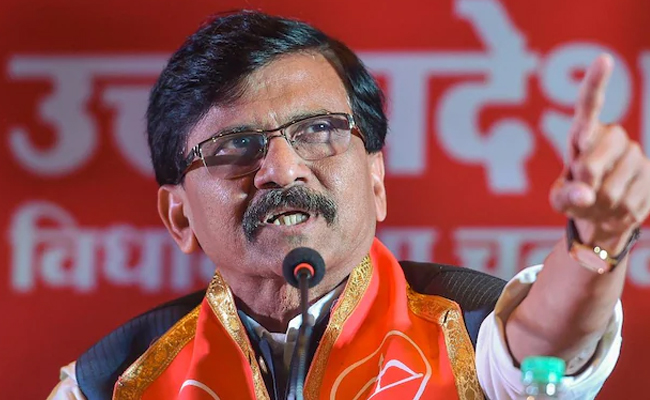
Mumbai (PTI): With Suvendu Adhikari taking oath as West Bengal Chief Minister, Shiv Sena (UBT) leader Sanjay Raut on Saturday hit out at the BJP, alleging that the saffron party kept up its tradition of giving power to corrupt people.
The BJP, however, hit back at the Sena (UBT) MP, saying that while allegations against Adhikari have not been proven, Raut himself had been to jail in connection with a case.
Talking to reporters, Raut said that in a sting operation in 2020, five Trinamool Congress (TMC) MPs, including Adhikari, were seen accepting money.
"After that, the Enforcement Directorate (ED) raided Adhikari (who was then with the TMC), following which he joined the BJP and now he is the CM," Raut said.
The stain on Adhikari is yet to be washed, Raut said.
"The BJP has kept up its tradition of giving power to corrupt people. It has to be lauded for this consistency," Raut said.
Adhikari on Saturday took oath as West Bengal's first BJP chief minister, marking a dramatic saffron turn in the state's political history.
The BJP secured 207 seats in the 294-member assembly in the recently concluded elections, ending the Trinamool Congress' 15-year rule and scripting its most significant electoral breakthrough in eastern India.
Reacting to the Sena (UB) leader's allegations, BJP spokesperson Navnath Ban said that while charges against Adhikari have not been proven, Raut has already spent time in jail.
"Suvendu Adhikari has not been found guilty, but Sanjay Raut has been to jail," he said.
Raut was arrested by the ED in August 2022 in connection with a money laundering case linked to the Mumbai Patra Chawl redevelopment project. He spent over three months in jail before being granted bail by a special court.
Ban also accused the erstwhile Maha Vikas Aghadi (MVA) government of indulging in corruption during the COVID-19 pandemic.
The BJP leader said cracks in the INDIA bloc were visible with the developments in Tamil Nadu involving the DMK and the Congress.
"Uddhav Thackeray should also be cautious as Congress will stab him as well in the back," he added.
In Tamil Nadu, after the Congress decided to ally with the Vijay-led Tamilaga Vettri Kazhagam (TVK) to form a government, the DMK has accused the grand old party of "backstabbing" the alliance at a crucial moment.