Act of imposing Hindi will be detrimental on regional languages: Siddaramaiah

Bagalkote: "The Central government's proposed National Education Policy will be detrimental to the regional languages. In a federal system, imposing the Hindi language is not a good decision", said former Chief Minister Siddaramaiah.
Inaugurating a Kannada medium award presentation programme, organised by the Kannada Development Authority to honour students who secured highest marks in Kannada in SSLC and PUC state and taluk level here on Sunday, Siddaramaiah said that " there is a need to express our commitment to protect our regional languages. The central government which has proposed a new National Educational Policy has invited objections and opinions from the states. I have filed my objections immediately. There is no question of accepting it", he said.
Kannada Development Authority has also opposed the move and the state government has also written to the central government against it. When he was the chief minister, he had taken action to protect the language. He had removed the Hindi name boards in Metro train leaving only Kannada and English languages. "Unfortunately, our courts are in favour of our language policy. When I was the CM, the Supreme Court had said that choosing a language medium is not the selection of the government, it's the selection of the parents. English medium schools and parents have got the benefit keeping this verdict and admitting their children", he said.
"When I was the CM, I have written to the center and chief ministers of all states when the Supreme Court has given the verdict. But none have shown interest. Getting education in the medium of the language of the land will benefit the students. International fame scientist Prof UR Rao also got his primary education in Kannada medium. Even I too have studied in Kannada medium school. We should have concerns and commitment towards our language. If needed, learn 100 languages. But primary education should be given in the mother tongue. Who will protect our mother tongue if not we", he asked.
"Our culture will be survived if our language is protected. Our life, our state will be survived. For no reason, we should not neglect our mother tongue", Siddaramaiah advocated.
Minister Shivanand Patil said that the Kannada Development Authority has been showing its commitment to Kannada land and language and water. The government was supporting its decision. Children could get better knowledge if they get education in the mother tongue, he said.
Needy of new language policy
Presiding over the programme, Authority chairman Prof SG Siddaramaiah said that there was a need to introduce a strong language policy in a federal system like India. Former CM Siddaramaiah had shown interest to protect the language. When he was the CM, he had taken steps to open closed government schools. He had made it compulsory Kannada language as a first or second language in central schools in the state. But the officials had to introspect over its implementation, he said.
SP president Bayakka Meri, district Kannada Sahitya Parishat president Srishaila Erappa Karishankari, Hampi Kannada University former vice Chancellor Mallika Ghanti, senior journalist Dinesh Amin Matru, DC Ramachandra, ZP CEO Gangubai Manakar and others were present.
Let the Truth be known. If you read VB and like VB, please be a VB Supporter and Help us deliver the Truth to one and all.
Justice Nagarathna calls for creation of judicial reforms commission to reduce pendency in courts
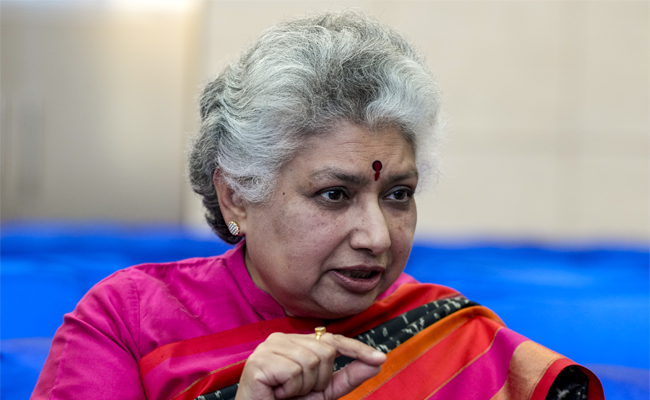
Bengaluru (PTI): Justice B V Nagarathna of the Supreme Court on Saturday called for the creation of a judicial reforms commission to reduce mounting pendency in the courts, saying systemic incentives across stakeholders were contributing to delays in justice delivery.
She was speaking at the Supreme Court Bar Association's (SCBA) first National Conference on the theme "Reimagining judicial governance: strengthening institutions for democratic justice" here.
Nagarathna, who was part of the panel session addressing "From Pendency to Prompt Justice: Rethinking Justice Delivery in Indian Courts," said, this reforms commission must have membership not only from the judiciary of the Supreme Court, the High Court, as well as the District judiciary, but also have members from the Bar, Attorney General, Solicitor General, and also certain members representing the Bar at the institutional level, such as the Bar President, and from the government side to enable an inter-institutional dialogue on reducing pendency.
She reflected that, from the point of view of various stakeholders, a litigant gains from the status quo, to proceed to prolong proceedings.
ALSO READ: A political legacy, but no win yet: Padmaja Venugopal''s new fight in Thrissur
"A lawyer or an advocate loves adjournments and postponement because he/she benefits from per appearance and extended timelines. A government department reduces bureaucratic risk by appealing rather than accepting defeat.
"A judge, and particularly a trial judge, is always acting with caution because he/she is confronted with appellate reversal, and therefore he/she prefers procedural caution rather than having an aggressive docket control. Each of these decisions is individually rational, but how does it help the system? It is only leading to systemic delay," she added.
In order to break this equilibrium, Justice Nagarathna said that what is required is institutional interventions through a judicial commission to reduce pendency, rather than merely exhorting better conduct from judges, adherence to procedural timelines, asking advocates not to seek adjournments, urging the government to reduce litigation, or expecting courts to function round the clock and judges not to take leave.
On pendency, the judge questioned the inclusion of defective filings in court statistics, suggesting that such cases should not be counted until they are procedurally ready for hearing.
She also underlined the role of the government as the "largest generator of litigation", noting that officials tend to file appeals to avoid scrutiny, even in cases where disputes could be settled earlier. This, she said, results in cases travelling through multiple judicial levels unnecessarily.
"The government publicly expresses concern about judicial backlog, while simultaneously feeding that backlog through relentless litigation," she observed.
Justice Nagarathna further claimed judicial capacity is constrained by inadequate public investment, including delays in appointment of judges, lack of infrastructure and insufficient use of technology.
Among the measures suggested, she called for improved case management, curbs on unnecessary adjournments, adoption of technology, prioritisation of cases, promotion of alternative dispute resolution mechanisms, and creation of specialised benches.
She also urged advocates to adhere to professional and ethical standards, litigants to avoid frivolous appeals, and the government to adopt a practical litigation policy and ensure timely funding and appointments in the judiciary.