Amit Shah hails Yediyurappa as leader who created a new path
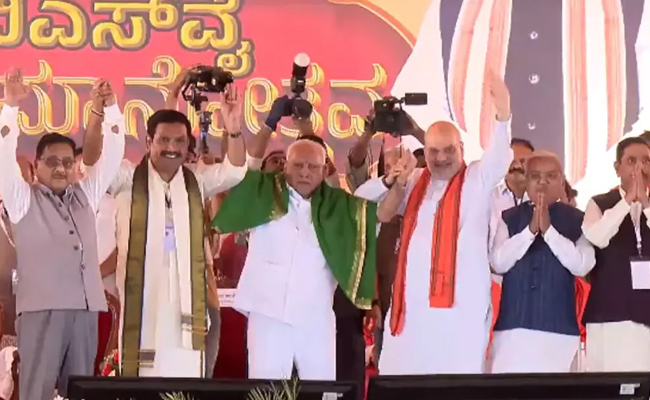
Chitradurga: Union Home Minister Amit Shah said the five decades of public life and political struggle of former Karnataka Chief Minister B. S. Yediyurappa serve as an inspiration for the younger generation.
Speaking at the ‘BSY Abhimanotsava’ held to honour Yediyurappa, Shah lauded his journey from a humble background to becoming one of Karnataka’s most influential political leaders.
During the event, Shah released two books titled ‘Kendavare-Kamala Aralida Kathe’ and ‘Sadana Shikari-Yediyurappanavara Gudugina Nudigalu’.
Shah said there are leaders who simply walk on existing roads and leaders who create new paths for others to follow, and described Yediyurappa as a leader who has shown a new direction.
“He came from an ordinary family. His willpower, the values of the Sangh and his patriotism guided him throughout his life,” Shah said.
He recalled that Yediyurappa travelled to villages on a bicycle when buses were unavailable and worked tirelessly to strengthen the BJP at the grassroots level.
Shah said Yediyurappa had walked thousands of kilometres and led several struggles in support of farmers, which earned him the reputation of being a farmer leader. He added that Yediyurappa had even undergone imprisonment during these movements.
Referring to political developments in West Bengal, Shah said the BJP Chief Minister took oath there on the same day that Karnataka was celebrating Yediyurappa’s 50 years in public life. He described it as the beginning of a new chapter in the land associated with Swami Vivekananda and Syama Prasad Mookerjee.
At the programme, former minister C. T. Ravi presented details of Yediyurappa’s 50 years of public service. Yediyurappa was felicitated at the event.
Also present were BJP national general secretary (organisation) B. L. Santhosh, several dignitaries and seers.
Let the Truth be known. If you read VB and like VB, please be a VB Supporter and Help us deliver the Truth to one and all.
Gujarat builds 870 MW battery power backup network to stabilise renewable energy grid
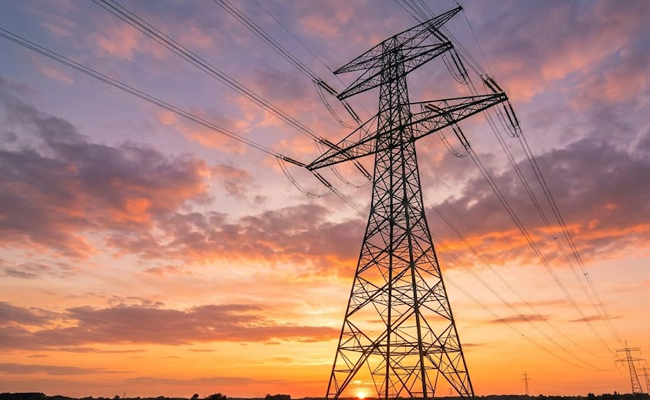
Gandhinagar (PTI): Gujarat has initiated battery storage systems at five locations in the state, with a total capacity of 870 MW, to maintain the stability of the renewable power grid, officials said on Saturday.
Battery Energy Storage Systems (BESS) are essential for storing electricity generated from solar and other renewable sources. They help manage additional load and maintain grid stability.
“Gujarat has initiated battery storage systems at five locations with a total capacity of 870 MW,” an official release stated.
The state has also registered 13 projects across Ahmedabad, Gandhinagar, Banaskantha, Patan and Kutch districts to set up additional battery storage systems, it said.
Modhera in Gujarat, India’s first solar village, has launched the country’s first BESS integrated with a solar power plant, it said.
"Under the leadership of Chief Minister Bhupendra Patel, the state has continued to advance in this direction and has strengthened its position among the leading states driving battery storage systems in India,” the release said.
Recently, a battery storage system was commissioned at Charal in the Sanand taluka of Ahmedabad, it said.
Four systems are operational at Modhera in Mehsana and Lakhpat in Kutch. The state government has also included advanced energy storage systems as a key component in the Gujarat Integrated Renewable Energy Policy, 2025, the release said.
Accordingly, standalone battery storage projects, works linked with new renewable energy installations, and those integrated with existing renewable energy systems are being approved, it said.
Once the Standard Operating Procedure is approved, registrations for battery storage will open for commercial and industrial users, it said, adding that the move will allow them to set up battery storage alongside their solar or wind projects.
The state government is developing battery storage systems across Gujarat, with companies being invited in through a competitive bidding process.
GETCO (Gujarat Energy Transmission Corporation) and power distribution companies strategically identify locations for battery storage systems based on grid capacity and operational requirements, the release said.
Power generation from solar and other renewable sources fluctuates throughout the day. Excess energy generated during peak hours can be stored and supplied later during periods of high demand, especially in the evening when solar output declines. Battery storage systems help reduce stress on the grid and improve grid stability, it added.