
Amit Shah would have been 'scrap dealer' if there wasn't Ambedkar's Constitution, claims CM
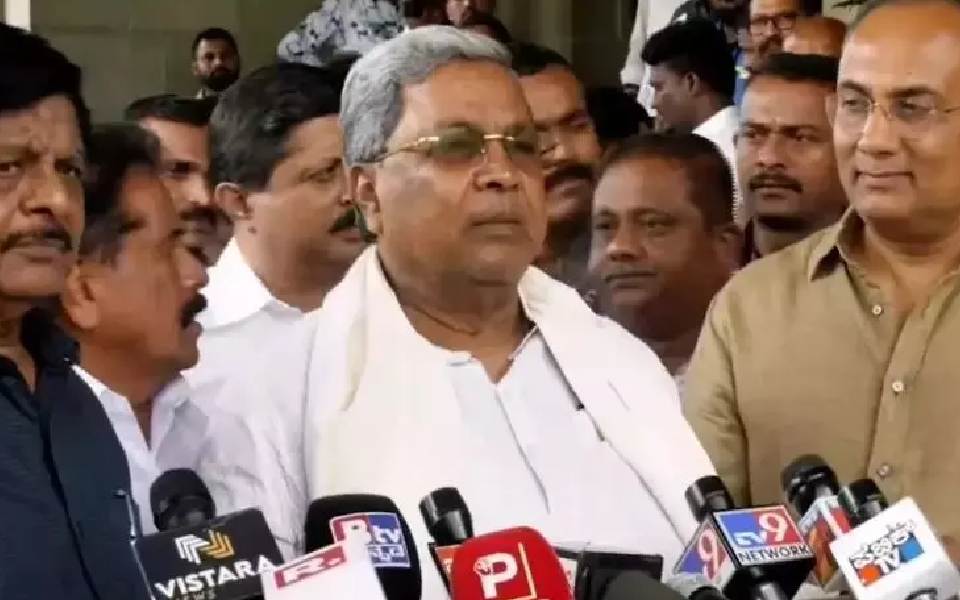
Belagavi (Karnataka) Dec 19: Stepping up the attack against Union Minister Amit Shah for his comments on B R Ambedkar in Parliament, senior Congress leader and Karnataka Chief Minister Siddaramaiah on Thursday claimed that Shah would have been a "Gujari" (scrap dealer) if there wasn't Ambedkar's Constitution.
The chief minister further said that if Rajya Sabha Chairman Jagdeep Dhankhar was really functioning under the Constitution, he should have immediately suspended Shah from the House.
Reading out a detailed statement in the assembly amid din by both BJP and the Congress MLAs over the issue, Siddaramaiah said the entire country has heard the "derogatory" words spoken by the Home Minister about Babasaheb Ambedkar.
During a debate on the Constitution in Rajya Sabha on Tuesday, Shah said, "Abhi ek fashion ho gaya hai - Ambedkar, Ambedkar, Ambedkar, Ambedkar, Ambedkar, Ambedkar. Itna naam agar bhagwan ka lete to saat janmon tak swarg mil jata (It has become a fashion to say Ambedkar, Ambedkar, Ambedkar, Ambedkar, Ambedkar, Ambedkar'. If they had taken God's name so many times, they would have got a place in heaven)."
Stating that there is nothing surprising in the words spoken by Shah, Siddaramaiah said what was in the minds of the BJP and Sangh Parivar leaders has come out in the open.
"First of all, I congratulate you (Amit Shah) for openly and courageously revealing the innermost opinion of the Bharatiya Janata Party about Babasaheb Ambedkar before the country and for finally telling the truth in your lifetime," he said.
He said that if there was no Constitution, Shah would have been a "scrap dealer" in his village and not the Home Minister of the country.
Shah on Wednesday accused the Congress of twisting facts and distorting his comments on B R Ambedkar in the Rajya Sabha, asserting that its malicious campaign after the discussion on Constitution "established" the opposition party as being "anti-Ambedkar and anti-reservation". The Union minister also accused the Congress of adopting the tactic of "misrepresenting and distorting" statements.
Siddaramaiah also took a dig at Dhankhar for not taking action against Shah, saying if the Rajya Sabha Chairman was really functioning under the Constitution, he should have immediately suspended the Union minister from the House after his remarks.
The Karnataka chief minister alleged that the main reason behind BJP and Sangh Parivar's hatred for Ambedkar was the Constitution.
"Until this written Constitution came into force, the Indian society had the Manusmriti, which made caste and gender discrimination a law. Babasaheb Ambedkar, who hoped for freedom, equality and fraternity, not only gave the Constitution, but he also burned the unwritten Constitution Manusmriti that was in force until then," the CM said.
He noted that on December 25, 1927, Ambedkar publicly burned the Manusmriti and 22 years later, he created a new Constitution.
Siddaramaiah charged that the hatred of the BJP and the RSS for Ambedkar was not new.
According to him, the details of the statements made by RSS leaders, including its founder Keshav Baliram Hedgewar, his successor Madhav Sadashiv Golwalkar and Hindutva ideologue Vinayak Damodar Savarkar against the Constitution are in the pages of history.
Babasaheb Ambedkar dedicated the Constitution to the country on November 30, 1949. Four days later, the RSS mouthpiece 'Organiser' wrote an editorial against the Constitution, he pointed out.
Siddaramaiah also read out a portion of the article: "There is no Indianness in the Constitution written by Ambedkar'¦. Even today, the laws mentioned in the Manusmriti are respected by the world. None of this counts for the Pandit who wrote the Constitution.''
"The RSS editorial had written against the Constitution, mocking Babasaheb as a ''Pandit''. The RSS is defending this editorial even today," the CM alleged.
"Golwalkar had also opposed Ambedkar and the Constitution in his book, 'Bunch of Thought', which is considered the Constitution of the RSS", he said.
Golwalkar wrote that after the Vedas, the most sacred book for the Hindu nation - Manusmriti, which has been the basis of our culture, traditions and customs since time immemorial, Siddaramaiah said.
Neither the BJP nor the RSS has so far rejected the "RSS editorial" that opposed the Constitution and Ambedkar, nor the views of Golwalkar and Savarkar, he said.
Siddaramaiah said Ambedkar was not an annoyance, but an eternal memory.
"As long as we breathe, as long as the Sun and Moon exist on this Earth, the memory of Ambedkar will be there. The more you insult him, the more he will bounce back and rise, and he will light up our path of progress," he underlined.
The CM also reiterated that if Ambedkar was not there, he and Congress president Mallikarjun Kharge would not have occupied high positions. Instead, he would have had to stay in his village grazing cattle and sheep, he added.
The CM said it was on the expected lines that Shah blamed the opposition for twisting his statement.
"Prime Minister Narendra Modi too came to the defense of his close friend and made a long statement. All this was expected," Siddaramaiah told the Assembly.
The Congress MLAs put out photos of Ambedkar on their tables, while the BJP displayed posters in the assembly, accusing Siddaramaiah of being anti-Hindu. Both sides raised slogans against each other.
The commotion led to the adjournment of the House twice by Speaker U T Khader.
Let the Truth be known. If you read VB and like VB, please be a VB Supporter and Help us deliver the Truth to one and all.
Nashik court sends ‘godman’ Kharat to seven-day judicial custody in third rape case
_vb_49.jpeg)
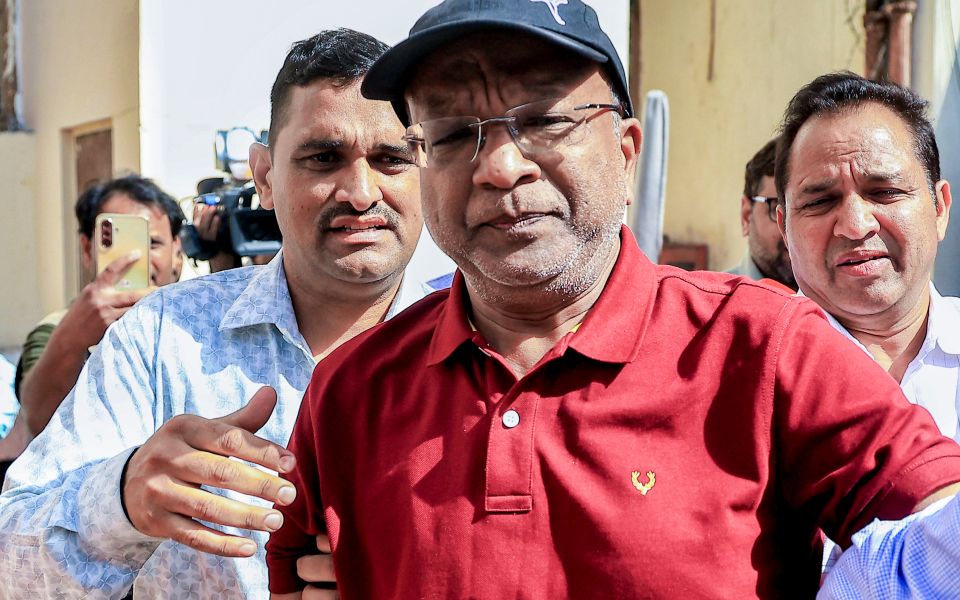
Nashik (PTI): A court in Maharashtra's Nashik on Monday remanded self-styled godman Ashok Kharat to judicial custody till April 20 in a third case of rape against him for allegedly sexually exploiting a pregnant woman.
The special investigation team (SIT) produced Kharat for a virtual hearing in the court of Chief Judicial Magistrate B N Ichpurani as his police custody in the case ended on Monday.
The SIT presented the remand report and sought judicial custody for Kharat, a former merchant navy officer. The court then remanded him to a seven-day judicial custody till April 20.
In the third case, Kharat, who was first arrested in mid-March, is accused of sexually exploiting a seven-month pregnant woman, the wife of his office staffer.
According to the complaint lodged by the victim's husband, the accused sexually assaulted the survivor on multiple occasions, including in his office in Nashik, between November 2023 and December 2025.
Kharat also conducted a ritual with the pregnant woman at a temple in Mirgaon village of Sinnar taluka of the district, it said.
Although the victim informed her husband about her plight, he did not believe her. But when he heard about complaints of Kharat's misbehaviour with other women, he planted a spy camera in the astrologer's office to find out the truth and recorded his acts.
The employee later handed over to the police a pen drive containing objectionable videos of the 'godman'.
Kharat faces nearly a dozen cases, eight of them related to sexual assaults.
The SIT, meanwhile, has filed an application in the court demanding Kharat's custody in another case. As the court granted them the necessary permission, the team will take the accused's custody from the Nashik Road Central Jail.
Kharat will be produced in court again in the fourth case on Tuesday.
_vb_90.jpeg)
_vb_90.jpeg)