Amul-Nandini was made emotional issue due to polls, Amul entered K'taka during Cong regime: Nirmala
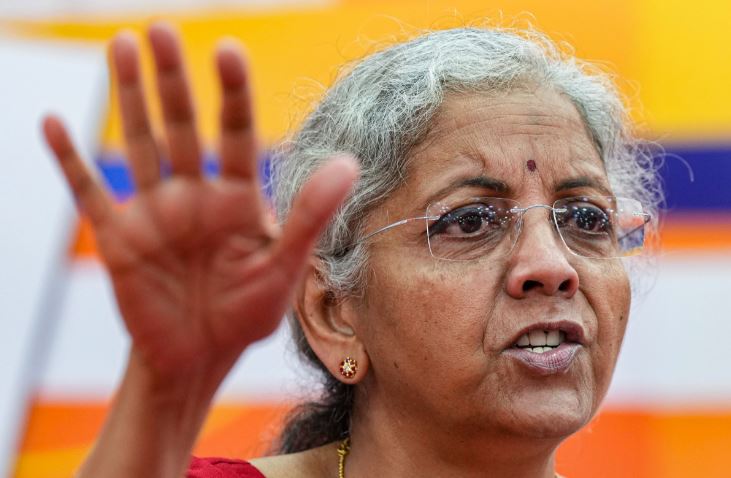
Bengaluru, Apr 23: To suddenly say Amul is being brought to Karnataka to kill Nandini is "brazen", Union Finance Minister Nirmala Sitharaman said on Sunday, as she alleged that the Gujarat-based dairy cooperative had entered the state when Congress was in power here.
The Karnataka Milk Federation (KMF) sells milk, curd and other dairy products under the brand name Nandini.
She said things were tweaked, twisted and made an emotional issue because it is election time in Karnataka, where Assembly polls would be held on May 10.
"In India's scheme of things, every state has its own milk cooperative. Karnataka's Nandini - whoever doesn't recognise it? Even now as I've come, I had Nandini milk, curd, peda... Of course in Delhi I'll buy Amul. I represent Karnataka (but) in Delhi, if Nandini isn't available, I'm mentally not a sanyasi to say I won't drink milk if Nandini isn't available. I still buy Amul. That's not being against Karnataka," Sitharaman said.
Strengthening Nandini and dairy farmers in Karnataka had never been a question, she said, adding that it would continue to happen. Nandini too sold its products in other states such as Kerala, Tamil Nadu, Telangana, Andhra Pradesh just like other state dairies' products are also available in Karnataka, she pointed out.
"Good competition I would say... The idea is therefore to strengthen India in every aspect. That's why India became the world's largest milk producer," she said.
The minister was responding to a question regarding the Amul-Nandini controversy, during the interaction with Thinkers Forum, Karnataka here.
Stating that to falsely and suddenly say Amul was being brought to kill Nandini was "brazen", she said. "Amul entered Karnataka when there was a Congress government here. I'm not sure I should name the Chief Minister at that time. The same respected former CM is now questioning Amul's entry. It was in his time Amul entered North Karnataka for marketing in those areas.
"This, strictly speaking, is tweaked, twisted and made an emotional issue because it is election time," she alleged, adding that "instead of building a healthy competition and a positive narrative" the issue was twisted, "and our farmers and women need not be brought into a political issue".
Karnataka's milk farmers need to be supported, Sitharaman said, giving credit to former Karnataka CM B S Yediyurappa's government for having raised the procurement price of milk for the first time. He gave Rs 2 more per litre. Later subsequent governments too did their bit.
"Again the current BJP government increased it to Rs 5. So, support to milk-giving farmers will continue," she said. Farmers and those engaged in animal husbandry are also given many other facilities by the Centre, she added.
Let the Truth be known. If you read VB and like VB, please be a VB Supporter and Help us deliver the Truth to one and all.
Two held in UP's Bijnor for contact with Pakistan linked Dubai handler
_vb_24.jpeg)
Bijnor (PTI): Two men were arrested in this Uttar Pradesh district on Friday for allegedly being in touch with a Pakistan-linked handler based in Dubai, police said.
Circle Officer, Najibabad, Anjani Kumar Chaturvedi said Uvaid Malik and Jalal Haider were arrested following inputs on their alleged links with Aqib, a resident of Meerut currently staying in Dubai.
According to police, Aqib had earlier come into the spotlight after a video surfaced on Instagram purportedly showing him displaying an AK-47 rifle and explosives.
During interrogation, the arrested men allegedly told police that Aqib used to incite youngsters against Hindus and encourage anti-national activities, the officer said, adding that detailed questioning of the accused is underway.
On April 6, Superintendent of Police (SP) Abhishek Jha said the video first surfaced in November last year. Aqib, a native of Sathla village in the Mawana area of Meerut, was allegedly seen in the video brandishing weapons.
Following the viral clip, a case was registered at the Nangal police station by sub-inspector Vinod Kumar. However, the then station house officer and investigating officer Satyendra Singh had recorded Aqib's statement and filed a final report, stating that the weapons seen in the video were toys, effectively giving him a clean chit.
Police said fresh developments have now revealed Aqib's suspicious links and the probe has been handed over to the Anti-Terrorist Squad (ATS).
The SP said action has been taken against the officials concerned, with the then SHO and investigating officer suspended and Circle Officer Nitesh Pratap Singh removed from his post.