Ankola Landslide: One truck located in Gangavali River, says Minister Krishna Byre Gowda
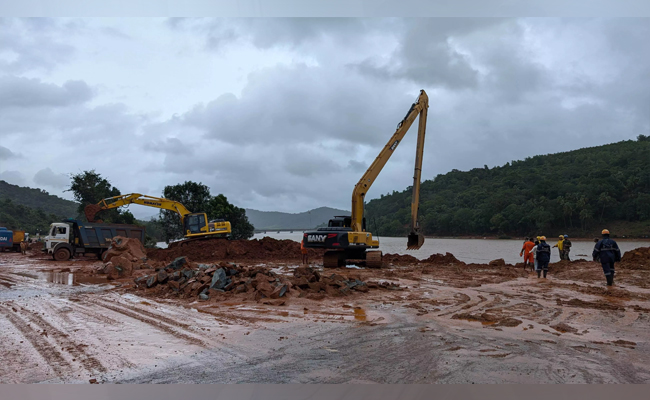
Bengaluru: Karnataka Revenue Minister Krishna Byre Gowda announced on Wednesday that a truck has been located in the Gangavali River amid the ongoing search for 3 victims who went missing after a landslide in Shirur on July 16. One among them is truck driver Arjun, a native of Kerala.
Minister Byre Gowda confirmed on X that a truck has been definitively identified in the river, and naval deep divers will soon attempt to anchor it. A long boom excavator is being used to dredge the river, while an advanced drone-based Intelligent Underground Buried Object Detection system has been deployed. The Coast Guard will conduct a helicopter search for any bodies in the water, he said.
Update on operation at Shiroor landslide.
— Krishna Byre Gowda (@krishnabgowda) July 24, 2024
One truck has been definitively located in the water and that the naval deep divers will attempt anchoring shortly.
The long arm boomer excavator will be used to dredge the river.
Advanced drone based Intelligent Underground Buried…
The search for the victims, now in its ninth day, intensified with the arrival of a long boom excavator at the Gangavali River, where a sonar signal had detected metal parts. The excavator will remove mud from a depth of 60 meters. Additionally, a state-of-the-art radio frequency scanner is set to aid in locating Arjun and two other missing individuals.
ALSO READ: Bihar woman found dead with throat slit in Bengaluru, police suspect murder
The Navy and disaster management forces are employing advanced technology, including sonar and radar, in the search operations. Former army officer M Indrabalan will also join the mission with sophisticated surveillance equipment. Four expert teams from the National Institute of Technology (NIT) in Surathkal have also arrived to assist.
The Karnataka government clarified that there was no delay in initiating the rescue mission for Arjun. The search began immediately after the complaint was received on the night of July 19, with operations starting on July 20. The Karnataka High Court has also been informed of the rescue effort.
The landslide, which occurred on National Highway 66, led to significant damage and injuries. Rescue operations commenced shortly after the incident, with efforts involving national and state disaster management forces, the fire services, the navy, and local authorities. The government had initially warned against moving the soil quickly to avoid triggering further landslides.
Let the Truth be known. If you read VB and like VB, please be a VB Supporter and Help us deliver the Truth to one and all.
SC to hear pleas for reviewing wages of priests, temple staff
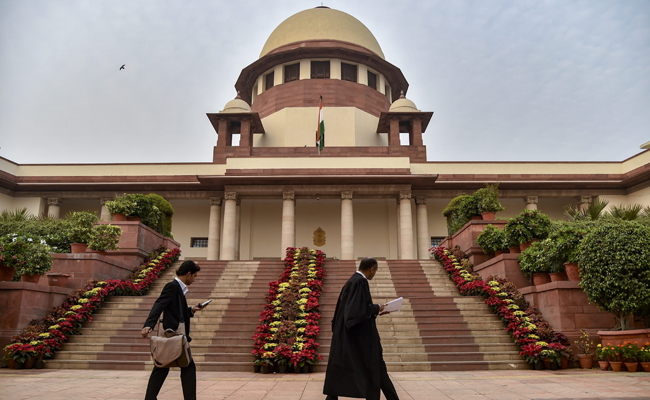
New Delhi (PTI): The Supreme Court is scheduled to hear on Monday a plea to constitute a judicial commission or an expert committee to review the wages and other benefits given to priests, 'sevadars' and temple staff in state-controlled temples.
A bench of Justices Vikram Nath and Sandeep Mehta is likely to hear the PIL filed by advocate Ashwini Upadhyay.
The plea, filed through advocate Ashwani Dubey, seeks directions to the Centre and states to constitute a judicial commission or an expert committee to review the remuneration and other benefits given to the priests and temple staff in state-controlled temples.
"Petitioner also seeks a declaration that priests and temple staff are employee' under Section 2(k) of the Code on Wages, 2019. Petitioner submits that once the State assumes the administrative, economic and financial control over temples, an employer-employee relationship arises and denial of dignified wages to priests and temple staff violates the right to livelihood guaranteed under Article 21," it said.
Upadhyay said the cause of action accrued on April 4, when he went to Varanasi to attend a public programme and after performing 'Rudrabhishek' in the Kashi Vishwanath temple, which is controlled by the state, he came to know that even the minimum wages to live with dignity are not given to the priests and temple staff.
"Recently, in Andhra Pradesh and Telangana, priests and temple staff organised a large-scale protest demanding the minimum wages. Priests and temple staff are not getting even the minimum wage prescribed by the State for unskilled and semi-skilled workers. This is a systemic exploitation. State is acting as a model employer through the endowments department, but violating the minimum wages Act and the directive principles of state policy (Article 43)," it said.
The plea further said the continued refusal to meet the minimum wages with the 2026 inflation-adjusted cost of living index has forced the petitioner to seek judicial intervention to prevent the further marginalisation of priests and temple staff.
Upadhyay further said the precarious nature of livelihood was starkly exposed on February 7, 2025, when a Tamil Nadu department issued a circular at the 'Dandayuthapani Swami Temple' in Madurai, strictly prohibiting priests from accepting 'dakshina' in 'aarti plates'.
"It is necessary to state that priests in such temples often receive no formal salary from the State and rely entirely on 'Dakshina'; the State's administrative order directly threatened them with starvation. Although withdrawn due to public outrage, the incident highlights the State's arbitrary power over the survival of the priests. This is also a bitter truth that States are controlling lakhs of temples but not a single mosque or church," the PIL claimed.
The petition, alternatively, sought direction to the Centre and states to take appropriate steps for the welfare of priests, sevadars and other temple staff in the spirit of the Allahabad High Court's earlier judgments.