'Anna Bhagya' and 'Gruha Jyothi' guarantees of Karnataka govt come into effect from Saturday
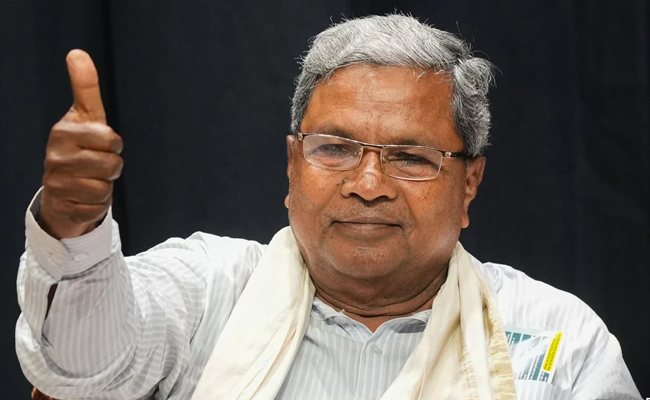
Bengaluru (PTI): Two more "guarantee" schemes of the Congress government in Karnataka -- cash for beneficiaries in lieu of the additional 5 kg of rice under 'Anna Bhagya' scheme, and 200 units of free electricity to households under 'Gruha Jyothi' scheme, has come into force effective from Saturday.
The government has already implemented one of its five poll guarantees, "Shakti", by providing free services for women in public transport buses.
Karnataka Chief Minister Siddaramaiah said payment of money to beneficiaries under Anna Bhagya scheme for this month is likely to begin after July 10; while the Gruha Jyothi scheme has come into effect from today and the electricity bill for the same for this month will come in beginning of August, as per the billing cycle.
"We have said July month's amount (under Anna Bhagya scheme) will be paid to beneficiaries in July itself, instead of rice. We had not said, we will pay it on July 1st itself...most likely we will start making the payments after July 10. This month's amount will be deposited into bank account of the beneficiaries within this month," Siddaramaiah said.
Speaking to reporters here, he said, "The Gruha Jyothi scheme will begin from today, so from this month it will be free (upto 200 units), but the bill will come in August."
Facing difficulty in procuring large quantities of rice required to fulfil its poll guarantee, the state government decided to pay cash to beneficiaries at the rate of Rs 34 per kilo, for the additional 5kg of rice under the free rice scheme, which is applicable to every member of a BPL household.
Food and Civil Supplies Minister K H Muniyappa said, amount will be transferred to the bank account of the beneficiaries in a week or 10 days.
"90 percent of beneficiaries have a bank account....5kgs per person means, the benificary will get Rs 170," he told reporters in Devanahalli.
Meanwhile, speaking to reporters in Chikkamagaluru regarding 'Gruha Jyothi' , Energy Minister K J George said, registration for the scheme is going on, and about 86.5 lakh consumers have registered.
"Free current (up to 200 units) is applicable from today itself and the bill to this effect will come in the beginning of August," he said.
The Minister said consumers who want to avail the benefit of Gruha Bhagya scheme will have to register online. To avail the benefit this month, one can apply till July 24 or 25, as bill for same will be generated in August.
One has to apply for the Gruha Jyothi Scheme on 'Seva Sindu' website or can apply through assisted mode also made available at Grama One, Karnataka One, Bangalore One centers.
The benefit is calculated based on average consumption for Financial Year 2022-23, plus 10 percent increase, but total amounting to less than 200 units.
The remaining two guarantees which the government is taking steps to implement soon are -- Rs 2,000 monthly assistance to the woman head of every family (Gruha Lakshmi); and Rs 3,000 every month for unemployed graduate youth and Rs 1,500 for unemployed diploma holders (Yuva Nidhi).
Let the Truth be known. If you read VB and like VB, please be a VB Supporter and Help us deliver the Truth to one and all.
MP: Woman, lover conspire to get husband killed; police looking for contract killer

Dhar (MP) (PTI): A 25-year-old woman and her lover have been arrested in the district for allegedly conspiring to kill her husband by hiring a contract killer, police said on Thursday.
The case was solved within 36 hours of the murder though the woman initially tried to mislead the police by claiming that robbers killed her husband, an official said.
Dev Krishna Purohit (28) was stabbed to death on the intervening night of Monday and Tuesday at his house in Gondikheda Charan village, about 60 km from here.
Superintendent of Police Mayank Awasthi told reporters that accused Priyanka Purohit (25) was married to Dev Krishna when she was around 15 years old. Priyanka moved to her matrimonial home after attaining adulthood but was unwilling to live with her husband, leading to frequent disputes between them.
During investigation, it emerged that she was in a relationship with Kamlesh (32), the SP said.
The duo allegedly hatched a plan to kill Dev Krishna and hired a man identified as Surendra for Rs 1 lakh do the job, he said
After Dev Krishna was killed, Priyanka told police that unidentified persons broke into the house, attacked her husband with a sharp weapon while holding her captive in another room, and fled with valuables.
But the inconsistencies in her statements raised suspicion, and eventually she confessed to hatching the murder conspiracy, the SP said.
While she and Kamlesh were arrested, police are looking for the contract killer, the official added.