Another cabinet reshuffle on the cards: KPCC Chief Dinesh Gundu Rao
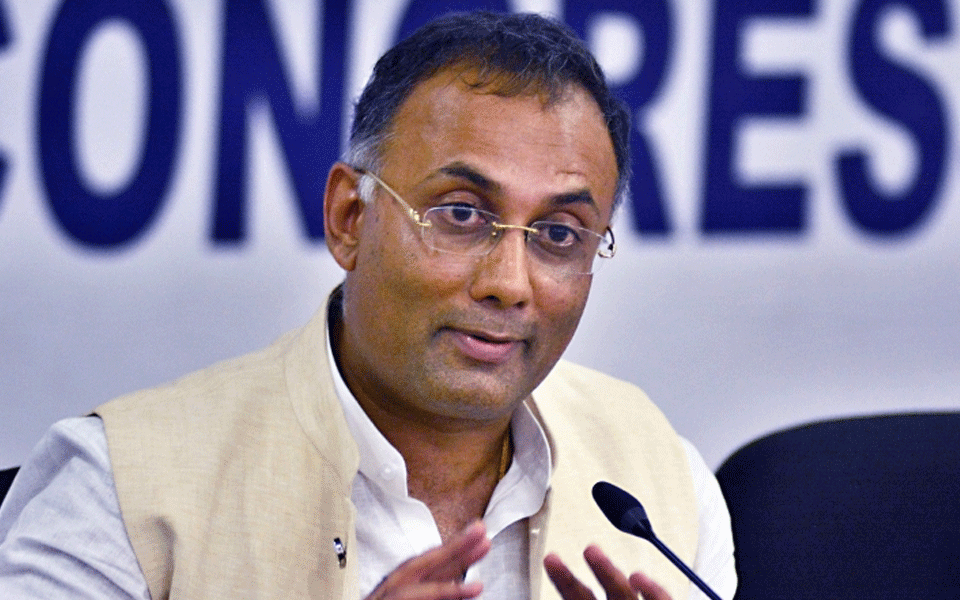
Bengaluru, Jun 15: Amid simmering discontent within the Congress in Karnataka over the induction of two Independent MLAs into the coalition government's ministry, the party's state unit chief Saturday said a "reshuffle will definitely happen", and several senior leaders will be "taken into confidence".
This comes a day after Chief Minister H D Kumaraswamy expanded his cabinet by inducting R Shankar and H Nagesh into the ministry, in an apparent move to give stability to his 13-month old wobbly JD(S)-Congress coalition government.
The two Independent legislators were inducted into the minister overlooking the claims of several senior leaders, particularly in Congress, who are sulking ever since they failed to make it to the ministry earlier.
Other than Siddaramaiah and top ministers, most of the Congress leaders and senior legislators such as H K Patil, B C Patil and Sudhakar who are ministerial aspirants, had skipped Friday's swearing-in ceremony, giving credence to reports of a growing discontent.
Karnataka Congress chief Dinesh Gundu Rao told reporters here, "Reshuffle will happen definitely... Most probably in about six to eight months the process of reshuffle will begin and many who have not got the opportunity, including several seniors, they will be taken into confidence."
"Evaluation of ministers' performance and representation will be looked into and decided (during the reshuffle)," he said.
Terming the induction of Independent MLAs into the state cabinet as "most unfortunate," B C Patil, the Congress MLA from Hirekeru, said that he is discussing future move with other legislators and friends.
Hitting out at the Congress state leadership, he said, "It looks like saving the government is more important than saving the party. If the party survives there will be government."
Pointing out that the Congress won only one seat in the recently concluded Lok Sabha polls, Patil said rather than legislators who worked for it, Independents who won against the party were being given berths.
"I'm unable to understand the logic behind it," he said, claiming that Congress Legislature Party (CLP) leader Siddaramaiah and Deputy Chief Minister G Parameshwara had given assurance that he would be made minister after the general elections.
Noting that Patil might have spoken out of "disappointment", state Agriculture Minister N H Shivashankar Reddy too said a cabinet reshuffle was on the cards.
"It has already been decided that after some time, sitting ministers should make way for new faces, during which he (Patil) may be accommodated," he said.
The cabinet expansion on Friday was seen as a move to ensuring that the two Independent lawmakers don't jump the ship once again and move to the BJP, affecting the stability of the government.
Shankar was inducted from the Congress' share and Nagesh from the JD(S) quota in the ministry. Under the coalition arrangement, out of the total 34 ministerial positions, Congress and JD(S) have 22 and 12 berths respectively.
Prior to the expansion, three posts were vacant-- two from JD(S) and one from Congress. There is still one post vacant in the JD(S) share.
Faced with a rout in the Lok Sabha polls and growing disgruntlement within, the coalition leaders, after a series of negotiations, had decided to fill vacant posts in the cabinet.
An increasing number of cabinet berth aspirants in the Congress is worrying the coalition leaders, as this may once again lead to disgruntlement and cause disturbance in the smooth functioning of the government.
Meanwhile, dismissing reports about his resignation as state Congress chief, Rao said, he has not written any letter to the party high command as being reported, and his continuation as the party's state unit chief is left for the Congress leadership to decide.
Rao was conspicuous by his absence at the cabinet expansion on Friday.
Let the Truth be known. If you read VB and like VB, please be a VB Supporter and Help us deliver the Truth to one and all.
Rajnath to top commanders: Outmaneuver adversaries with strategic surprise
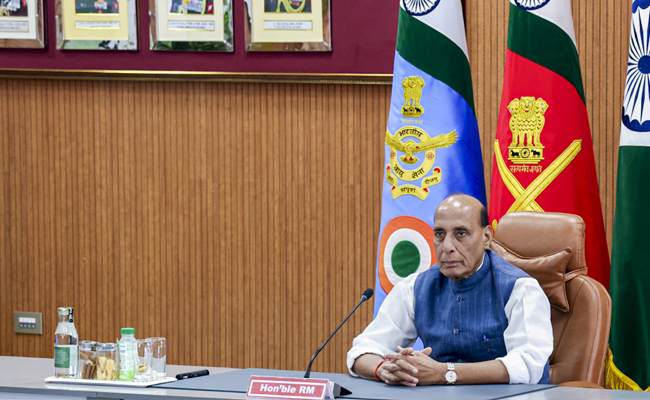
Jaipur/New Delhi (PTI): Defence Minister Rajnath Singh on Friday directed the top military commanders of the three services to integrate an "element of surprise" into modern warfare to outmaneuver India's adversaries and bolster strategic posture.
In his address at the joint commanders conference in Jaipur, Singh also described the Operation Sindoor as a testament to the "swift, precise, and joint response" of the Indian armed forces to safeguard national interests and called upon the military to remain ready to deal with any security challenges.
In their two-day deliberations, the commanders carried out a comprehensive review of the combat preparedness of the military in the wake of the evolving regional security situation.
Operation Sindoor was a demonstration of India's growing capabilities and a symbol of the nation's collective resolve and new military ethos, Singh said, a day after the first anniversary of Operation Sindoor.
He also unveiled a 'Joint Doctrine for Integrated Communication Architecture' that is aimed at strengthening doctrinal clarity, interoperability and integrated communications across the armed forces in future multidomain operations.
The joint commanders' conference, themed 'Military Capability in New Domains', brought together the top leadership of the defence ministry and the three services to deliberate on emerging security challenges and future readiness.
Comprehensive deliberations were held on future warfare, multidomain operations, technological transformation and joint capability development.
The conference witnessed extensive discussions on cognitive warfare, cyber resilience against evolving quantum and AI-enabled threats, military capability development in emerging domains, indigenous innovation and AI-enabled warfighting concepts.
It was attended by Chief of Defence Staff Gen Anil Chauhan, Chief of the Naval Staff Admiral Dinesh Kumar Tripathi, Chief of the Army Staff Gen Upendra Dwivedi, Chief of the Air Staff Air Chief Marshal AP Singh and Defence Secretary Rajesh Kumar Singh among others.
In his remarks, Singh asked the commanders to remain "future-ready" by learning from the operation as well as the current global security landscape.
He underscored the need to strengthen capabilities in artificial intelligence, autonomous systems, data analytics and secure communication networks to stay prepared in the rapidly evolving geopolitical security scenario. He emphasised that future conflicts will increasingly be shaped by hybrid threats, information dominance and operations conducted simultaneously across cyber, space, electromagnetic and cognitive domains, according to an official readout.
Highlighting the transformative impact of emerging technologies, Singh stressed on the importance of ensuring integrated national preparedness across all spectrums of conflict, it said.
Singh's remarks at the conference came a day after the first anniversary of Operation Sindoor.
The defence minister appreciated the progress achieved in enhancing jointness, integration and technological adoption across the three services, the readout noted.
Singh said that jointness constitutes a pivotal dimension within the transformative changes sweeping across the global defence sector.
"Future wars will not be won solely through weaponry, but through innovative thinking and enhanced synergy," he said.
The defence minister exhorted the commanders to cultivate the "element of surprise" to remain unpredictable to the nation's adversaries and secure a strategic edge in any given situation.
He, however, urged them to remain vigilant of the element of surprise of the enemy and always stay two steps ahead.
Singh also reiterated the Narendra Modi government's commitment to enhancing the capabilities of the defence forces through state-of-the-art weapons and platforms. He added that special focus is being laid on research in niche domains.
During the conference, he released a documentary film on Operation Sindoor.
The film reaffirms the nation's and defence forces' commitment to operational preparedness and decisive national response capabilities.
Demonstrations of advanced systems and platforms developed for intelligence fusion, operational planning and information management were also showcased during the conference reflecting growing integration of cutting-edge technologies into joint operational structures, according to the defence ministry.
The discussions will contribute significantly towards shaping India's future military transformation and integrated operational preparedness, it said.