Another forest official killed by wild elephant in Karnataka during mission, this time in Madikeri
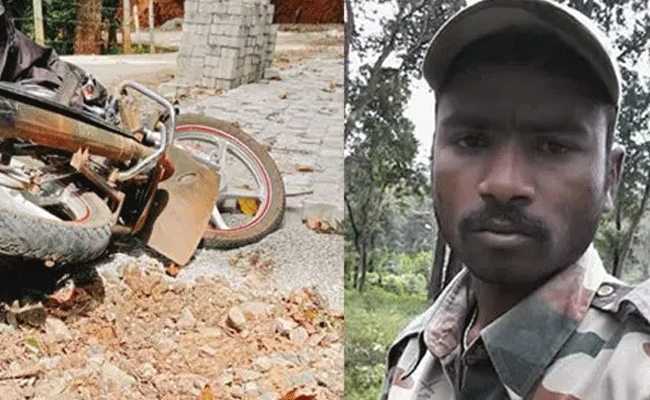
Madikeri: In a tragic incident, a forest department staff member was killed in a wild elephant attack while participating in an elephant-chasing mission conducted by the Rapid Response Team (RRT) in Kodagu, Karnataka.
The incident occurred in the early morning hours of Monday in the Kedakal area of Madikeri taluk. A local resident named Murugesh narrowly escaped a life-threatening encounter with a tusker while riding his bike. Although he managed to avoid the elephant's attack, he sustained minor injuries after falling from his bike while attempting to flee.
Following this incident, a team of 15 RRT members was dispatched to chase the wild elephants that had strayed into the estates of Kedakal, aiming to guide them back into the forest. The team diligently tracked the elephants and used firecrackers to disperse them.
However, one of the wild tuskers retaliated and launched an attack on the forest personnel. While most of the team members managed to escape, Girish, a 35-year-old staff member from the Kushalnagar range forest department, became the unfortunate victim. Despite carrying firecrackers in his pockets, Girish was unable to evade the elephant's relentless assault.
The forest personnel continued to deploy firecrackers in an attempt to scare away the aggressive tusker. Tragically, Girish sustained severe injuries during the attack and was immediately transported to the District Hospital in Madikeri for medical treatment. Unfortunately, he did not respond to the treatment provided and succumbed to his injuries.
Madikeri's Deputy Conservator of Forests (DCF), AT Poovaiah, confirmed the incident, stating that the forest staff were appropriately equipped for the mission, but the elephant ambushed them. Girish, who had been with the department for eight years, leaves behind a sister.
A post-mortem examination was conducted, and the incident was officially recorded at the Madikeri police station.
Let the Truth be known. If you read VB and like VB, please be a VB Supporter and Help us deliver the Truth to one and all.
3 held, hunt on for 4 accomplices after they kidnap, assault and urinate on man in Bhopal

Bhopal (PTI): Police have registered a case against seven persons and arrested three of them for allegedly kidnapping, assaulting and urinating on a 22-year-old man in Madhya Pradesh capital Bhopal, officials said on Thursday.
The incident occurred during the intervening night of April 26 and 27 in an area located under the Hanumanganj police station limits, an official said.
One of the accused urinated on the face of the victim and captured a video of the act, which was later circulated on social media to humiliate him, he said.
"A complaint in this connection was lodged by Jaswant Markam (22), a resident of Kamla Nagar, based on which a case was registered against seven persons under sections of Bharatiya Nyaya Sanhita (BNS) and police have arrested three of them, including one Prem Thapa," Bhopal Police Commissioner Sanjay Kumar said.
Three police teams have been formed and the remaining suspects will be apprehended soon, he said.
During the intervening night of Sunday and Monday, Markam was at the local bus stand with a friend when around 4 am, the accused took him away on the pretext of discussing something with him. They asked him about his neighbour and friend Aniket. When he refused to provide any information, they started assaulting him, the police said.
The accused then took him to a forest in Karond area, where he was stripped and severely thrashed, they said.
When the man began to lose consciousness, one of the accused urinated on his face and made a video of the act, which was circulated on social media to humiliate him and spread terror, according to the police.
The accused called Markam's friend around 5 am to inform him about his condition. The victim was subsequently admitted to a hospital, the officials said, adding that the viral video was also being investigated.
Responding to a query, Hanumanganj police station in-charge Awdhesh Bhadoria said if the victim was found to be from the tribal community, then relevant sections will be invoked against the accused.
At present, the police are probing the incident and search is on to arrest the remaining accused, he added.
In 2023, a man had urinated on a tribal youth in Sidhi district of Madhya Pradesh. A video of the incident had gone viral on social media platforms and created a controversy.