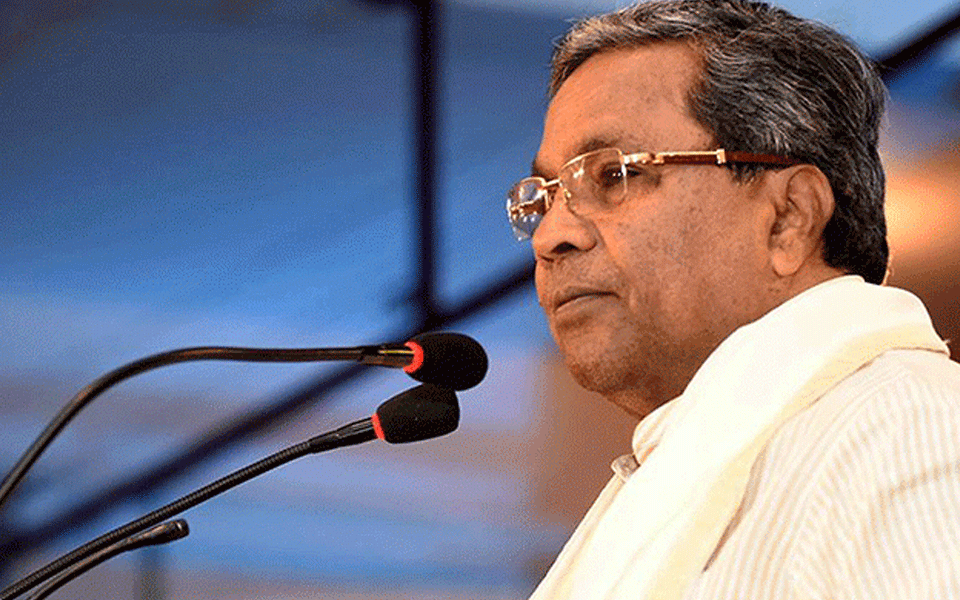
Bengaluru: Chief Minister Siddaramaiah recently challenged BJP's national leadership and Prime Minister Modi to appoint "an untainted person" as the BJP's chief ministerial candidate.

"I am glad PM @narendramodi is talking about corruption. I now invite him to #WalktheTalk . For a start can you 1. Appoint Lok Pal 2. Investigate #JudgeLoya 's death 3. Investigate the astronomical rise of #Jayshah 4. Appoint an untainted person as your CM candidate?," Siddaramaiah tweeted.

Dear Mr. #10PercentCM @siddaramaiah, I am equally glad that you have started this discussion. Before we head up North to Delhi, why don't you answer a few questions here: Why did you quash all the powers of #Lokayukta and make it a toothless body? #Dare2Answer," B.S. Yeddyurappa tweeted.

Yeddyurappa also raised Dy SP M K Ganapathy suicide case. Ganapathy had allegedly committed suicide last year accusing the then Home Minister George and two other senior IPS officers of harassing him. The state CID had given a clean chit to George and the two officials. But, the Supreme Court later ordered a CBI probe, following which a case was registered against George and the two IPS officers.

"Let me remind you of your 70 Lakh Hublot watch, which is believed to have been accepted as an official favor from a Biz-man in exchange for you approving projects violating all rules" Yeddyurappa tweeted.

Let the Truth be known. If you read VB and like VB, please be a VB Supporter and Help us deliver the Truth to one and all.


Chandigarh (PTI): A democracy does not invest in higher education so that its graduates may simply prosper, it does so to ensure that they govern themselves well, Chief Justice of India (CJI) Surya Kant said on Saturday.

"Every institution of public life -- the courts, the civil services, the schools, the hospitals, the local governance bodies --” all depend for their quality on the calibre of the people who choose to serve within them," the CJI said while addressing the 12th convocation ceremony of the Central University of Haryana in Mahendragarh.

Justice Kant said in barely 17 years, the university has earned national accreditation and recognition for its swift growth.

ALSO READ:  Two held for EV sales fraud in Karnataka

He told the gathering of students that the degrees conferred on them certify the knowledge they have acquired and they should be proud of it but at the same time, he emphasised that "what your degree does not certify, and no examination can measure -- how your character and judgment hold up once the structure of formal education is no longer around you. In my experience, this ultimately determines the trajectory of life".

The CJI said there are graduates of the most-celebrated institutions who have faltered under pressure, not because they lacked knowledge but because they were never tested by anything other than a school or college examination.

"And then there are professionals from institutions nobody has heard of, who rise with composure and seriousness, earning the confidence of every room they enter," he said.

So what is the distinguishing factor then, he asked the students.

"In my view, it has nothing to do with the talent one may display in the classroom and almost everything to do with upbringing.

"Those who grew up observing their families manage scarcity with dignity, who understood early on that the world does not rearrange itself for your convenience and who entered professional life already knowing that hard work is not just a phase but a permanent state, they carried something that no curriculum can teach. They carried a seriousness that was not performative but genuine," Justice Kant said.

Many of the students present on the occasion carry exactly this formation, he said.

"You grew up in homes where a university degree was not a given but a goal that the entire family organised itself around. The investment by your families was not made so that you could merely earn a comfortable living.

"It was made because they believed, even if they could not always articulate it, that an educated daughter or son would use what they learned to build something beyond themselves," the CJI said.

This belief is the bridge between "what your upbringing gave you and what the world is now entitled to expect from you", he told the students.

The CJI said it is often discussed what education provides to an individual.

It opens doors, boosts earning potential and enhances mobility, he said, adding that however, there is a fundamental question that a congregation at a central university should address.

"What does your education owe to the society that funded it? The resources that build these classrooms, the resources that paid your faculty and the resources that maintained the laboratories where you trained came from the public exchequer. Which means they were derived from citizens' earnings and taxes, many of whom will never set foot in a university themselves," he said.

"This fact creates an obligation. Not a sentimental one, but a structural one. A democracy does not invest in higher education so that its graduates may simply prosper. It invests so that they may govern themselves well...," Justice Kant said.

In the Ramayana, when Bharat was handed the throne of Ayodhya by his father's own decree, he chose to place Ram's "paduka" on the seat of power and govern from Nandigram as a trustee, not as a sovereign, he pointed out.

"This distinction between holding authority for yourself and holding it on behalf of others is what your obligation towards the public means," the CJI said.

He told the students that "wherever your careers take you, carry with you the awareness that our collective life depends on whether educated people choose to engage with the systems around them or simply benefit from them".

Giving the example of a "raider" in a Kabaddi game, the CJI told the students, "Watch the finest raiders carefully.... Their greatness is not in the distance they cover, but in the precision with which they judge the line between ambition and overreach.".

He told the students that as they advance in their chosen careers, they must carry the discipline their families have imparted, the endurance that this landscape has taught them and the straightforwardness that Haryana is known for.