Bangalore City University to be renamed after Dr. Manmohan Singh
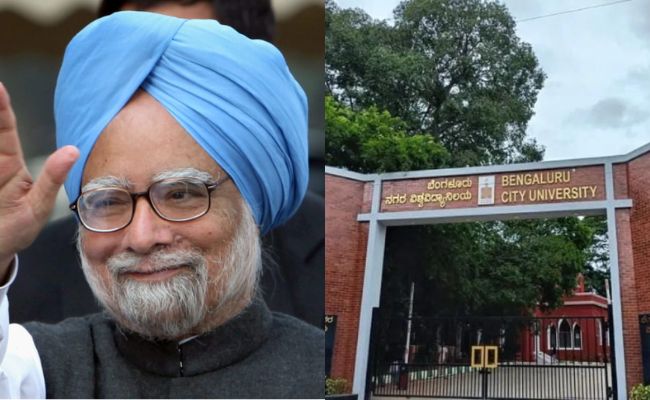
Bengaluru: The Karnataka government has announced that Bangalore City University will be renamed as Dr. Manmohan Singh Bangalore City University as part of efforts to develop it into a model institution. Chief Minister Siddaramaiah, who made the announcement while presenting the state budget, also revealed several key initiatives aimed at strengthening higher education in Karnataka.
In a significant push for educational reforms, the Chief Minister said that Government Arts College and Government RC College would be developed as constituent colleges of the university. He further announced a Rs. 2,500 crore project proposed over the next four years, with assistance from the World Bank, to enhance first-grade colleges across the state, establish Centres of Excellence, and boost research capacity.
To strengthen women’s higher education, the government had already upgraded 31 women’s colleges in the previous year. An additional Rs. 26 crore has been allocated for improving the infrastructure of 26 more colleges. In an effort to improve faculty availability, 2,000 vacant teaching positions in government first-grade colleges, engineering colleges, and polytechnics will be filled.
The budget also includes Rs. 275 crore to provide necessary infrastructure to government engineering colleges, polytechnics, and degree colleges, and Rs. 10 crore for equipping newly established polytechnics and engineering colleges with furniture, computers, and books.
A significant international academic collaboration was also announced. Through the Chevening Karnataka Masters Fellowship, female students from government degree colleges in Karnataka will have the opportunity to pursue a one-year postgraduate degree in prestigious universities in England.
To enhance practical knowledge and increase employability among students, the government will appoint ‘Professors of Practice’—industry professionals who will provide hands-on training and mentorship—at 16 government engineering colleges in the state. Additionally, Rs. 30 crore has been allocated to upgrade the Unified University & College Management System (UUCMS) software, which is used for managing higher educational institutions.
As part of the expansion of technical education, a unit college of Visvesvaraya Technological University (VTU) will be established in Chintamani taluk of Chikkaballapur district at a cost of Rs. 150 crore.
The government has also partnered with the Azim Premji Foundation to provide refresher training for all college education department teachers within the next three years. Furthermore, in collaboration with industries, the government will launch an internship program and special corporate training schemes to equip students with market-relevant skills and enhance their employability.
A special skill development program for 23,000 students will be organized by the Kalyana Karnataka Region Development Board (KKRDB) at a cost of Rs. 10 crore. Additionally, a Prof. Nanjunda Swamy Research Chair will be established at the University of Mysore to promote academic research and scholarship.
Let the Truth be known. If you read VB and like VB, please be a VB Supporter and Help us deliver the Truth to one and all.
Hijab decision taken out of fear of Karnataka Muslim convention, alleges Kumaraswamy
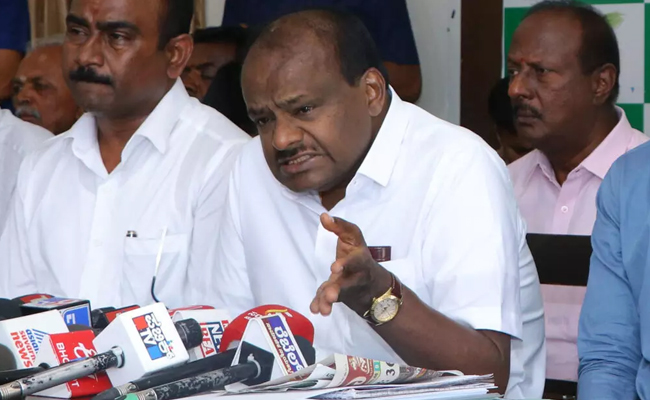
Bengaluru: Union Minister H. D. Kumaraswamy has alleged that the Karnataka government announced its decision on the hijab issue out of fear of the ‘Karnataka Muslim Convention’ scheduled to be held in Bengaluru on May 16 organized by Federation of Karnataka Muslim Organisations.
Addressing a press conference at the JD(S) state office, GP Bhavan, in Bengaluru on Thursday, Kumaraswamy said he respects all religions and has expressed his views on the issue on several public platforms in the past.
Questioning the timing of the government’s move, he said the Congress has been in power for three years and had taken no decision on the hijab issue during that period.
He alleged that the decision was taken only because the ‘Karnataka Muslim Convention’ is scheduled to be held at Town Hall in Bengaluru on May 16.
“If the government had the courage, it should have taken this decision immediately after coming to power. Why did it remain silent for three years?” he asked.
Kumaraswamy accused the Congress of making the announcement to appease a particular community.
He further said the matter is still pending before the courts and claimed that an interim order relating to the hijab issue remains in force.
According to him, issuing such an order before the legal proceedings are concluded amounts to disrespect towards the judiciary.
Kumaraswamy also alleged that the Congress brought the issue back into focus after the Davanagere by-election results.