Bengaluru: Primary and secondary education minister Suresh Kumar has directed officials to begin preparations to conduct the SSLC examination, which had been stalled due to the Corona lockdown.
The minister held a video conference with the deputy directors of public instruction (DDPI) of all districts on Monday. Students of all districts are eager to know the schedule of the examination. The officials should pay immediate attention to conducting the SSLC examination keeping in mind the social conditions, following the COVID-19 pandemic attack, necessary precautionary measures should be implemented at the examination centres., said the minister.
Suresh Kumar also gathered information regarding the preparations to be made in the districts as per local necessity, as, in the backdrop of the Corona attack, the districts in Karnataka have been segregated as red, orange, green and containment zones. Since maintaining social distance has been stressed upon in the current times, it is necessary to help students not distance themselves from one another emotionally or mentally. The preparations for examination should focus on this too, insisted the minister.
Speaking further, he said that students who would be answering the examination will have to be provided masks and sanitizer at the centres. The students should also be made to undergo thermal scan before answering. In case of a student showing symptoms of fever, the student should be provided a separate room to answer, the officials were told.
Sidelights:
- The Department of Public Instruction is already conducting revision classes in Chandana Vahini for students answering SSLC examination. Similar classes will begin for English medium students too
- Examination centres in containment zones will have to be shifted. Sub-centres will have to be opened. Every examination hall will have lesser than the usual 24 students. Also, every hall will have CCTV cameras installed and medical facilities provided. An action plan should be readied to implement this.
- The examination schedule should be declared. Special care should be given to necessary gap between subjects.
- An action plan should be prepared to permit students from other places to answer the examination in cities or towns where they currently are.
Let the Truth be known. If you read VB and like VB, please be a VB Supporter and Help us deliver the Truth to one and all.
Massive turnout in assembly polls across states, women voters outnumber men: EC data
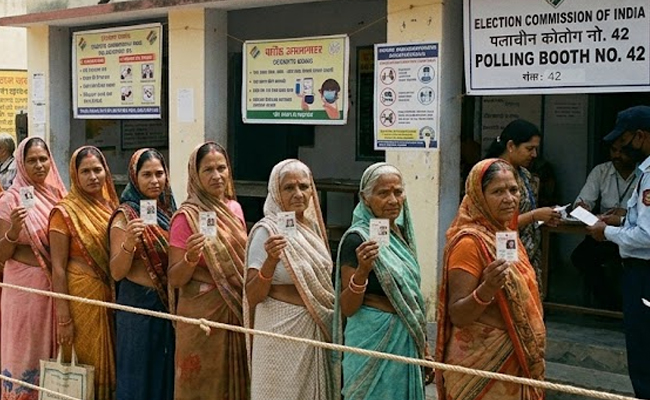
New Delhi (PTI): The recently-concluded assembly elections witnessed exceptionally high voter participation across states, with women voters outnumbering men in turnout percentages, according to Election Commission data.
West Bengal recorded the highest voter turnout among states, with 93.71 per cent polling in 293 constituencies where counting has been completed. The state saw over 6.38 crore votes cast, including postal ballots, against a total of more than 6.81 crore electors.
Women voters recorded a turnout of 93.8 per cent in the West Bengal Assembly polls, slightly higher than the 92.06 per cent participation among men.
The data for West Bengal does not include the figures for the Falta assembly constituency, which is scheduled for repolling.
Tamil Nadu registered an 85.01 per cent turnout, with nearly 4.8 crore votes polled from an electorate of 5.74 crore. Women voters recorded a turnout of 86.2 per cent, higher than the 83.77 per cent among men.
Assam also witnessed robust participation, with the final turnout touching 85.74 per cent. More than 2.15 crore votes were cast in the state, while female turnout at 86.53 per cent marginally exceeded the 84.95 per cent recorded among male voters.
Kerala registered a turnout of 78.11 per cent, with over 2.12 crore votes polled. Female voter participation stood at 81.17 per cent against 74.9 per cent among men.
Puducherry recorded a turnout of 89.82 per cent, with women voters again leading participation at 91.39 per cent. More than 8.5 lakh votes were polled in the Union territory.
Yet, women's representation among elected candidates remained modest.
Tamil Nadu elected 23 women MLAs (9.83 per cent) out of 234 members, West Bengal elected 37 women legislators (12.62 per cent) out of 293, while Kerala returned only 11 women MLAs (7.85 per cent) in the 140-member House.
Only two third-gender candidates contested the elections - one each from Tamil Nadu and Kerala, and both lost, forfeiting their deposits.
The elections also reflected extensive electoral mobilisation infrastructure. West Bengal had the highest number of polling stations at 85,092, followed by Tamil Nadu with 75,064 and Assam with 31,490.
In terms of candidates, Tamil Nadu saw the largest contest with 4,023 candidates in the fray across 234 constituencies, averaging 17 candidates per seat and peaking at 79 contestants in one constituency.
West Bengal pitted 2,920 candidates for 293 constituencies, while Kerala had the fewest contestants among the major states, with 883 candidates for 140 seats.
The data also showed relatively low NOTA votes across states. Tamil Nadu recorded the lowest NOTA share at 0.4 per cent of total votes polled, while Assam recorded the highest at 1.23 per cent. In West Bengal, 0.78 per cent of the total votes polled were NOTA, while it 0.77 per cent and 0.57 per cent of the electorate opted for None of the Above (NOTA) in Puducherry and Kerala, respectively.