Belagavi's 18 seats witness tough contest between Cong & BJP; MES may play spoilsport in few
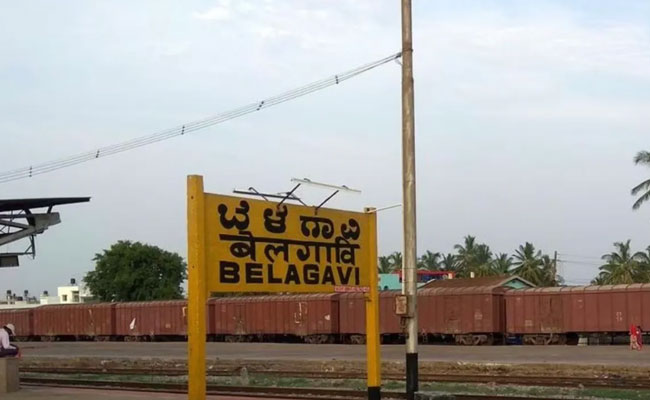
Belagavi (PTI): Belagavi district with second highest number of assembly seats after Bengaluru Urban -- is expected to witness tough contest between the BJP and Congress as Lingayat politics surmounts the local issues, but the Maharashtra Ekikaran Samiti (MES) could play spoilsport in a few seats as it wants to keep the border issue alive.
There are 18 assembly constituencies in the border district which is a Lingayat stronghold and has been a BJP bastion in the last two decades.
As in the last three elections, it is likely to be a straight contest between the BJP and Congress in most of the assembly seats barring five where the Shiv Sena-NCP supported MES -- a vocal proponent of the inclusion of Belagavi and other Marathi-speaking areas in Maharashtra -- has fielded local candidates.
The leadership vacuum in the Lingayat community after sidelining of stalwart leader B S Yediyurappa, demise of some prominent local Lingayat BJP leaders like Suresh Angadi and Umesh Katti and rising clout of politically influencial Jarkiholi family belonging to scheduled tribes community -- are expected to resonate among voters.
The exit of many disgruntled BJP leaders including three-time MLA and former Deputy Chief Minister Laxman Savadi from Belagavi, over denial of the ticket for the upcoming assembly election -- is likely to dent some votes here.
On the other hand, MES is trying hard to keep the border issue alive in Belagavi, which was part of the erstwhile Bombay Presidency and constitutes nearly 40 per cent Marathi-speaking population. The triangular fight could dent votes of national parties in five Marathi-speaking dominated constituencies.
Five of the constituencies in the district are dominated by Marathas, while Lingayats form a majority in most of the 13 remaining constituencies. There is a sizable population of OBCs and SCs/STs as well, with two seats reserved for these groups in the district.
In the district, where many elected representatives are sugar barons, three powerful political families -- the Jharkiholis, the Jolles and the Khattis -- enjoy electoral dominance.
From the Jharkiholi family, Ramesh Jarkiholi and Balachandra Jarkiholi are contesting on a BJP ticket from Gokak and Arabhavi assembly constituencies, respectively. Another member of the family, Satish Jarkihol is contesting on a Congress ticket from theYemkanmardi seat.
The Jarkiholi brothers are known to change parties. Ramesh Jarkiholi was a minister in the Congress-JD(S) coalition government before joining the BJP ranks. He was among the 17 MLAs who defected from the Congress and helped BJP to topple the Congress-JDS coalition government in 2019.
Ramesh's clout in the district is hard to ignore as he has ensured BJP ticket to his followers who defected from Congress, which has upset the traditional party leaders especially his political rival Laxman Savadi
Another prominent family are Jolles represented by the incumbent Muzrai (Religious and Charitable Endowments) minister Shashikala Jolle who is contesting on BJP ticket from Nippani constituency. Her husband Anna Saheb Jolle is the BJP Lok Sabha member from Chikkodi in Belagavi district.
From the Khatti family, Ramesh Khatti -- who represented the Chikkodi parliamentary constituency from 2009-2014 -- is contesting on a BJP ticket from the Chikkodi-Sadalga MLA seat this time, while his nephew Nikil Katti from Hukkeri assembly constituency after untimely demise of his father Umesh Khatti, who was an eight time MLA and six time minister.
After quitting BJP over denial of a ticket, Laxman Savadi is contesting on a Congress ticket from the Athani assembly seat to avenge his humiliation from the saffron party, especially Ramesh Jarkiholi. He has to face Mahesh Kumathalli, then in the Congress, now the BJP nominee
Ramesh has differences with some Congress leaders like Laxmi Hebbalkar who is contesting from Belagavi Rural seat. Both of them are contesting from different constituencies but are trying hard to defeat each other to settle personal grudges.
There are 39.01 lakh voters in the 18 assembly constituencies of Belagavi district. Out of which, 19,68,928 are male voters, 19,32,576 women and 141 registered as Others, as per the official data.
In the 2018 polls, the BJP won 10 and Congress 8 seats, which changed after the defections in 2019. Three Congress MLAs Ramesh Jarkiholi (Gokak), Mahesh Kumathalli (Athani) and Shrimanth Patil (Kagwad) resigned and joined the BJP.
Let the Truth be known. If you read VB and like VB, please be a VB Supporter and Help us deliver the Truth to one and all.
Real Madrid fines Valverde and Tchouaméni half a million euros each for altercation

Barcelona (AP): Real Madrid slapped players Federico Valverde and Aurélien Tchouaméni with half-a-million-euro ($588,000) fines on Friday for their altercation during practice.
The massive fines came a day after the midfielders tussled when the team trained. Valverde said in a post on social media on Thursday that no punches were thrown. But Valverde knocked his head on a table and he suffered a small cut that required a brief hospital visit.
On social media, Valverde initially called it a “meaningless fight” with a teammate and said “everything has been blown out of proportion."
His employers, however, considered it a significant enough breach of team discipline to nail both Valverde and Tchouaméni with fines that bite even the bank account of a top soccer player. The half-a-million euro penalties reflect the reputational damage the club was enduring in a chaotic end to a disappointing season.
In a statement, the 15-time European champion said its disciplinary action was concluded after both players expressed to the club “their complete remorse for what happened and apologized to one another.”
Madrid added they also apologized to their teammates, the coaching staff and club supporters, as well as showing their willingness to accept whatever disciplinary action the club deemed “opportune.”
Tchouaméni was back training with Madrid on Friday, two days before they play at Barcelona in a clasico. Madrid has to win otherwise Barcelona will be crowned La Liga champion.
After being notified of the fine, he posted a public apology to the club and its fans on social media.
“What happened this week in training is unacceptable,” Tchouaméni wrote. "I say this while thinking about the example we are expected to set for young people, whether in football or at school.
“Above all, I am sorry for the image we projected of the club.”
Valverde was not at practice due to the head knock.
Both players are set to play in the World Cup next month, with Tchouaméni playing for France and Valverde for Uruguay.
Chaotic end to a poor season
===================
The run-in between the players, who for seasons have played side by side in Madrid's midfield, came after they argued this week in previous training sessions. But tempers boiled over on Thursday. Spanish media was rife with reports that the players previously disagreed over the club's decision to let coach Xabi Alonso go after just months on the job.
It was not the only altercation involving Madrid players during training this week. Álvaro Carreras confirmed he was in a “minor” incident with a teammate. Spanish media said he and fellow defender Antonio Rüdiger got into a scuffle.
Álvaro Arbeloa, the coach who was promoted from Madrid's reserve team when Alonso was fired in January, will face tough questions on what went wrong inside the changing room when he gives a press conference on Saturday ahead of the clasico at Camp Nou.
Madrid is facing a second consecutive campaign without a major trophy amid rumors in the Spanish media that club president Florentino Pérez is considering bringing back Jose Mourinho to straighten out his underperforming team.