Bengaluru: Drug cases in Karnataka rise by 63% in just one year

Bengaluru: Karnataka has witnessed a sharp increase in cases registered under the Narcotic Drugs and Psychotropic Substances (NDPS) Act, with official data showing a steep 63% increase in just one year, The New Indian Express reported on Thursday.
According to data from the Karnataka State Police, while 4,187 NDPS cases were registered across the state in 2024, the number surged to 6,825 in 2025, highlighting the growing scale of the drug menace in the state.
The increase in the number of cases has raised serious concerns among law enforcement agencies, policymakers and public health experts, who warned that the trend reflected both expanding drug networks and rising substance abuse, particularly among youngsters.
Police officials said the rise in cases is partly due to intensified enforcement measures as well as increased availability of narcotic and psychotropic substances. Senior police officers attributed part of the rise to focused enforcement drives launched across the state.
Special teams have been formed to crack down on peddlers, especially in the Mysuru and Bengaluru city police commissionerate, after seizures of drugs worth crores of rupees in recent months. In Mysuru, a team from Mumbai police recently conducted a raid on a suspected drug manufacturing unit on the outskirts of the city. In another case, the Narcotics Control Bureau (NCB) confirmed the existence of an illegal drug manufacturing laboratory in the city last month.
Following these cases, police have heightened surveillance near educational institutions, IT corridors, transport hubs and urban hotspots, including industrials sheds.
“We have stepped up checks and intelligence-based operations, which has led to the detection of more cases. However, the numbers also indicate the growing penetration of drugs into society,” an officer said.
Experts said enforcement alone cannot explain the sharp rise in NDPS cases. De-addiction specialists and social workers pointed out that peer pressure and easy access to drugs as key reasons. Synthetic and psychotropic substances, which are easier to transport and conceal, have reportedly seen a notable rise.
While urban areas continue to account for a majority of NDPS cases, authorities said drug trafficking is gradually spreading to rural and semi-urban regions as well. Authorities said organised networks are expanding their reach, targeting vulnerable populations, including students and migrant workers.
Let the Truth be known. If you read VB and like VB, please be a VB Supporter and Help us deliver the Truth to one and all.
Explosive device kills 13, injures 38 on bus in southwestern Colombia as violence persists
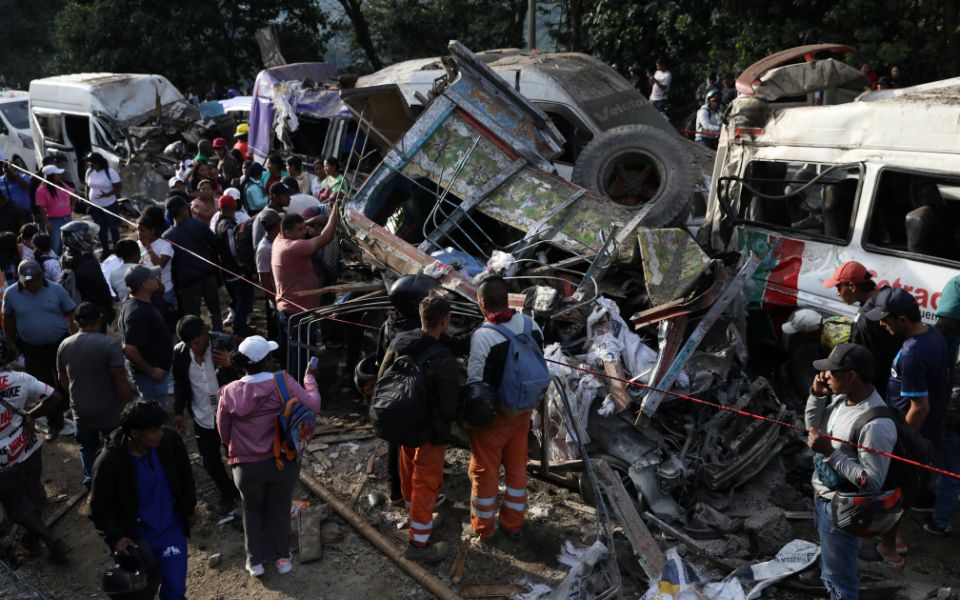
Bogota (Colombia) (PTI): An explosive device killed 13 people travelling on a bus in southwestern Colombia on Saturday, an attack the country's army chief described as a “terrorist act" that also left at least 38 injured as violence linked to drug trafficking in the region escalates.
Octavio Guzman, the governor of the region of Cauca, said on X that the device was set off while the bus was travelling along the Panamerican Highway in the municipality of Cajibio. Five children were among the injured, Cauca Health Secretary Carolina Camargo told Noticias Caracol, a TV news program.
Gen. Hugo Lopez, commander of Colombia's Armed Forces, told a news conference that it was a “terrorist act" and blamed the network of a man known as “Ivan Mordisco” — one of Colombia's most wanted figures — and the Jaime Martínez faction. Both are dissidents of the now-defunct Revolutionary Armed Forces of Colombia that operate in the region.
Neither Ivan Mordisco nor the Jaime Martínez faction abide by the peace agreement signed with the state in 2016.
Colombian President Gustavo Petro condemned the attack on X.
“Those who carried out the attack and killed seven civilians — and wounded 17 others — in Cajibío — many of them Indigenous people — are terrorists, fascists, and drug traffickers,” he wrote.
The attack is the latest in a spate of explosions that have attempted to target public infrastructure. At least 26 incidents have taken place in the past two days in southwestern Colombia, which Lopez said have only affected civilians.
They included a shooting at a police station in the rural area of Jamundi, and an attack on a Civil Aviation radar facility in El Tambo, where authorities took down three explosives-laden drones earlier on Saturday. No one was hurt.
On Friday, two vehicles rigged with explosives were detonated near military units in Cali and Palmira, causing material damage.
The escalation of violence in that region — a territory contested by illegal armed groups linked to drug trafficking — prompted the mobilisation of high-ranking officials on Saturday. Led by Defence Minister Pedro Sanchez, the delegation that includes regional governors and local authorities, was meeting in Palmira when the deadly explosion occurred.
“These criminals seek to instil fear, but we will respond with firmness,” Sanchez said on X.
Meanwhile, Francisca Toro, governor of Valle del Cauca, has called upon the national government to provide “immediate support.” In a message on X, Toro called for a reinforcement of public security forces, enhanced intelligence operations and “decisive actions” against crime in the face of a “terrorist-level escalation.”
According to authorities, Cauca and Valle del Cauca serve as a critical hub for illicit activities of illegal armed groups vying for control over sea and river access routes leading to the port of Buenaventura — a key transit point used to traffic drugs to Central America and Europe.
The government has also offered a reward of more than 1 million dollars for information leading to the capture of “Marlon,” who is identified as the leader of the region's dissident group. On Friday, local authorities offered more than USD 14,000 for information leading to the identification and location of those behind the attacks in Cali and Palmira.