Bengaluru techie run over by drunk driver after refusing to buy cigarette
Bengaluru: A 29-year-old techie lost his life and his friend narrowly survived after a drunk driver rammed his car into their two-wheeler following a petty argument. The shocking incident occurred near Kanakapura Main Road and was reportedly triggered by a trivial dispute over a cigarette.
The deceased, HN Sanjay, was a resident of Vajarahalli, while his friend Chetan Pujamath (30), who sustained injuries, lives in JP Nagar 7th Phase. Both were working professionals in the tech industry.
The accused, Pratheek (31), a BCom graduate and manager at a private firm, was returning home with his wife from a birthday party when he allegedly asked Sanjay and Chetan, who were having tea at a roadside stall, to get him a cigarette. An argument started when the request was denied, as reported by The New Indian Express on Sunday.
Others at the tea stall and Pratheek’s wife intervened to de-escalate the situation, and she eventually convinced him to return to the car. However, as Sanjay and Chetan were riding home shortly after, Pratheek, who was reportedly drunk, followed them and deliberately rammed his car into their bike.
“Chetan slid on the car’s bonnet and sustained minor injuries. But Sanjay fell along with the bike and banged his head against the shutters of a pharmacy and the pavement. He was admitted to a hospital, where he died on Tuesday,” TNIE report quoted the police as saying.
Initially booked for attempted murder, Pratheek now faces murder charges following Sanjay’s death. He has been remanded to judicial custody. Police have clarified that Pratheek’s wife was not involved in the incident.
Let the Truth be known. If you read VB and like VB, please be a VB Supporter and Help us deliver the Truth to one and all.
Road crash in UP leaves 10 dead
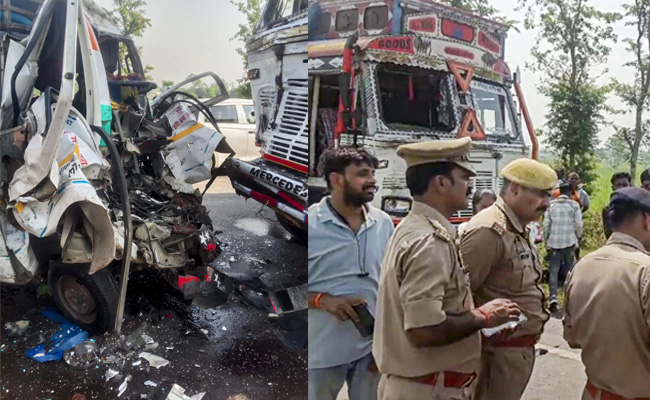
Lakhimpur Kheri (UP) (PTI): Ten people were killed when a van collided head-on with a truck on the Sisaiya-Lakhimpur national highway on Monday, police said.
The van was going to Sisaiya from Lakhimpur when the accident took place between Unchgaon and Bharehta villages.
Circle Officer of Dhaurahra, Shamsher Bahadur Singh, said all nine passengers travelling in the van and the driver were killed.
District Magistrate of Lakhimpur Kheri Anjani Kumar Singh told reporters that the van collided with a truck coming from the opposite direction, leading to nine casualties on the spot, while one succumbed to injuries at the district hospital.
Circle Officer, Dhaurahra, Shamsher Bahadur Singh told PTI, "Efforts are on to establish the identity of other deceased persons."
The seven of the deceased have been identified as Jaideep Singh (25), Pawan (23), Sohan (21), Ram Goyal (42), Sahajram (35), Pappu (18), all residents of Bahraich district and Adnan Khan (15), a resident of Lakhimpur Kheri district, police said.
Condoling the loss of lives in the accident, Uttar Pradesh Chief Minister Yogi Adityanath in a post on X, said, "The loss of life in the unfortunate road accident in Lakhimpur Kheri district is deeply distressing and heart-wrenching. My condolences are with the bereaved families."
"I have directed the local administration to provide prompt and adequate assistance to the injured and the victims. I pray to Lord Shri Ram to grant the departed souls a place at His divine feet and to bestow a speedy recovery upon the injured," Adityanath said on X.
Deputy Chief Minister Keshav Prasad Maurya and Brajesh Pathak too condoled the loss of lives in the accident.
"The loss of lives resulting from the road accident in Lakhimpur Kheri district is deeply tragic and heart-wrenching. My deepest condolences go out to the bereaved families," Maurya said.