Bengaluru: Two CID personnel arrested for allegedly deceiving people by offering govt. jobs

Bengaluru: The Vijayanagar Police have reportedly arrested two individuals on charges of fraud by promising people government jobs.
Anita BS and Ramachandra Bhatt, who were working as section superintendents in Bengaluru’s CID unit, have been arrested in this connection, informed the police.
The case came to light when Sunil, a resident of Kalyananagar in Chikkamagaluru, filed a complaint at the Vijayanagar police station.
According to Sunil's account, he was introduced to Ramachandra Bhat in 2021 through a friend. Bhat purportedly claimed to have connections with the Karnataka Public Service Commission (KPSC) and influential figures within the government, offering assurances of securing government jobs for interested individuals.
ALSO READ: JD(S) MLA H D Revanna released from prison in kidnapping case
Anita, who held the position of section superintendent at the CID unit in Bengaluru, allegedly collaborated with Bhat in this fraudulent scheme. Sunil was led to believe that he would be appointed as an Assistant Engineer in the Public Works Department (PWD) through KPSC. In return for this promise, Anita demanded a hefty sum of Rs. 40 lakh from Sunil, which he paid in installments in December 2021 and February 2022.
However, despite Sunil's payments, he did not receive the promised government job. When he demanded the return of his money, he was met with abuse and threats from the accused. This prompted Sunil to lodge a complaint with the Vijayanagar police, leading to the arrests of Anita BS and Ramachandra Bhatt.
Based on the victim’s complaint, a case was registered and the accused were arrested.
Meanwhile, the police have informed that the investigation has revealed that both the accused had deceived two more individuals in the same pattern and supposedly siphoned more than 1 crore from victims.
Let the Truth be known. If you read VB and like VB, please be a VB Supporter and Help us deliver the Truth to one and all.
V.D. Satheesan elected as new Chief Minister of Kerala
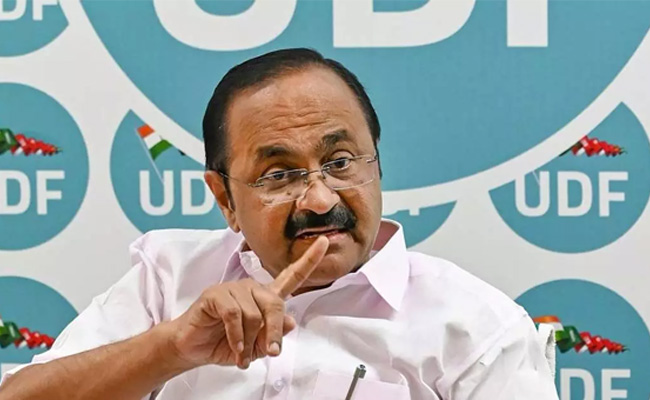
Thiruvananthapuram (PTI): Celebrations erupted across Kerala on Thursday after V D Satheesan was selected by the Congress High Command as the next Chief Minister of the state.
Satheesan was at the Contonment House in Thiruvananthapuram, the official residence of the Leader of the Opposition, when AICC leaders announced it in New Delhi.
Soon after the announcement, jubilant Satheesan supporters burst firecrackers and distributed sweets in several parts of the state.
Paravur in Ernakulam district, the Assembly constituency he has represented since 2001, witnessed large-scale celebrations.
Satheesan was widely seen as the frontrunner for the post, with UDF allies also backing his candidature during the selection process.
As the Leader of the Opposition in the outgoing Assembly, he led the UDF both inside and outside the House.
Apart from Satheesan, senior Congress leader Ramesh Chennithala and Congress MP K C Venugopal were also considered for the post.