Bengaluru's COVID-19 fatality rate lowest among major Indian cities: Health Minister
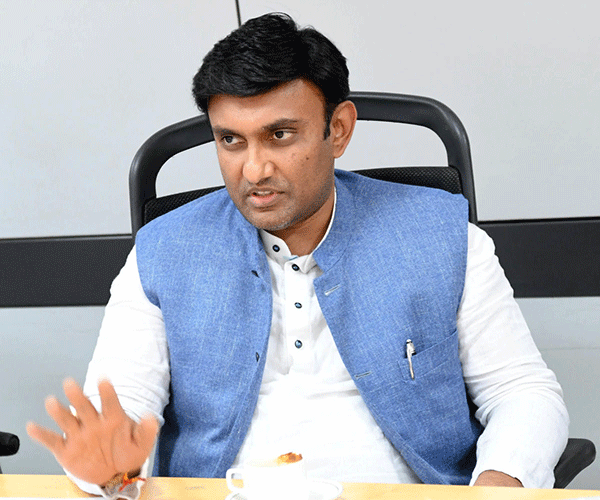
Bengaluru: Bengaluru's COVID-19 case fatality rate (1.1 percent) is the lowest among all major cities in the country, Karnataka Health Minister Sudhakar K said on Wednesday.
"With 3,36,880 recoveries and 17,707 active cases as on Tuesday, city's recovery rate stands at a healthy 93.94 percent and active rate stands at 4.93 percent", he tweeted.
On Tuesday, Karnataka reported 1,336 new cases of COVID- 19 and 16 related fatalities, taking the total number of infections to 8,64,140 and the death toll to 11,557 in the State.
Union Health Ministry on Wednesday reported a single-day rise of 38,617 new COVID-19 cases and 474 fatalities pushing India's virus caseload to 89.12 lakh and toll to 1.30 lakh.
Let the Truth be known. If you read VB and like VB, please be a VB Supporter and Help us deliver the Truth to one and all.
Allen, Raghuvanshi, Green power KKR to 29-run win over GT

Kolkata (PTI): Finn Allen blasted a 35-ball 93, while Angkrish Raghuvanshi hit an unbeaten 44-ball 82 as Kolkata Knight Riders kept their playoff hopes alive with a 29-run win over Gujarat Titans in the IPL match here on Saturday.
Sent in to bat, Allen went on a six-hitting spree, smashing 10 maximums and four boundaries to add 95 off 41 balls with Raghuvanshi (82).
Raghuvanshi then shared another 108 off 53 balls with Cameron Green (52 not out) to power KKR to a challenging 247 for 2.
In reply, GT could manage 218-4, riding on skipper Shubman Gill's 49-ball 85 and a 35-ball 57 from Jos Buttler. Opener Sai Sudarsan was retired hurt but returned to make a 28-ball 53 not out.
Sunil Narine (2/29) claimed two wickets and Saurabh Dubey snapped one for KKR.
For GT, Mohammed Siraj (1/50), Sai Kishore (1/38) were the wicket-takers.
Brief Score:
KKR: 247 for 2 in 20 overs (Finn Allen 93, Angkrish Raghuvanshi 82 not out, Camero Green 52 not out; Mohammed Siraj 1/50).
GT: 218 for 4 in 20 overs (Shubman Gill 85, Sunil Narine 2/29).