Bengaluru’s garment boom leaves toxic trail, 5000 tonnes of textile waste annually: Study
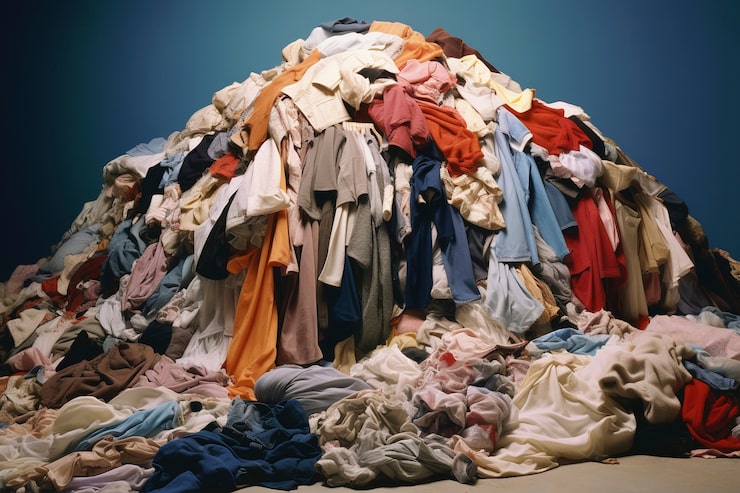
Bengaluru: Bengaluru, often hailed as the “garment capital” of India, is grappling with a mounting textile waste crisis, generating an estimated 5,000 tonnes of fabric waste each year, according to a new study by the Institute for Social and Economic Change (ISEC).
The study, cited by Deccan Herald on Sunday, highlights a growing environmental concern linked to Bengaluru’s thriving garment sector, as the city struggles to manage the overwhelming volume of discarded clothes and fabric scraps, underscoring the urgent need for a shift towards a circular economy.
Researchers S. Manasi, Channamma Kambara, and Mrinalini Goswami identified the absence of a centralised textile waste database as a governance gap. Although agencies like the Department of Handlooms and Textiles (DHT) and the Karnataka State Pollution Control Board (KSPCB) maintain fragmented records, their focus is limited to regulatory compliance rather than holistic waste management.
This approach has left a large portion of the issue unaddressed. While large export-oriented factories typically manage their textile waste more systematically, the same cannot be said for thousands of small-scale tailoring units and local shops. These smaller players often dispose of fabric scraps alongside regular trash, worsening the burden on an already strained waste system.
The ISEC study also traced the post-disposal journey of collected textile waste. Around 40% is sent to recycling hubs like Tiruppur and Panipat, while another 20% is downcycled locally into items such as mattresses and soft toys. However, these products have a short lifespan, usually under a decade, after which they are burned or end up in landfills, contributing to pollution.
One of the most alarming findings is the unsegregated mixing of hazardous industrial cotton waste with general garbage, leading to toxic emissions when the waste is burned. The study points out the high environmental cost of this linear model, noting that over 75% of waste is burnt, releasing toxic emissions.
Meanwhile, a large share of the labour involved in waste sorting is handled by informal sector workers, predominantly women. The report notes that these workers operate in unsafe conditions, lacking protective gear, basic facilities, and social support.
The report calls for a national textile waste management policy and the implementation of Extended Producer Responsibility (EPR) frameworks, which would hold manufacturers accountable for the lifecycle of their products.
Let the Truth be known. If you read VB and like VB, please be a VB Supporter and Help us deliver the Truth to one and all.
Real Madrid fines Valverde and Tchouaméni half a million euros each for altercation

Barcelona (AP): Real Madrid slapped players Federico Valverde and Aurélien Tchouaméni with half-a-million-euro ($588,000) fines on Friday for their altercation during practice.
The massive fines came a day after the midfielders tussled when the team trained. Valverde said in a post on social media on Thursday that no punches were thrown. But Valverde knocked his head on a table and he suffered a small cut that required a brief hospital visit.
On social media, Valverde initially called it a “meaningless fight” with a teammate and said “everything has been blown out of proportion."
His employers, however, considered it a significant enough breach of team discipline to nail both Valverde and Tchouaméni with fines that bite even the bank account of a top soccer player. The half-a-million euro penalties reflect the reputational damage the club was enduring in a chaotic end to a disappointing season.
In a statement, the 15-time European champion said its disciplinary action was concluded after both players expressed to the club “their complete remorse for what happened and apologized to one another.”
Madrid added they also apologized to their teammates, the coaching staff and club supporters, as well as showing their willingness to accept whatever disciplinary action the club deemed “opportune.”
Tchouaméni was back training with Madrid on Friday, two days before they play at Barcelona in a clasico. Madrid has to win otherwise Barcelona will be crowned La Liga champion.
After being notified of the fine, he posted a public apology to the club and its fans on social media.
“What happened this week in training is unacceptable,” Tchouaméni wrote. "I say this while thinking about the example we are expected to set for young people, whether in football or at school.
“Above all, I am sorry for the image we projected of the club.”
Valverde was not at practice due to the head knock.
Both players are set to play in the World Cup next month, with Tchouaméni playing for France and Valverde for Uruguay.
Chaotic end to a poor season
===================
The run-in between the players, who for seasons have played side by side in Madrid's midfield, came after they argued this week in previous training sessions. But tempers boiled over on Thursday. Spanish media was rife with reports that the players previously disagreed over the club's decision to let coach Xabi Alonso go after just months on the job.
It was not the only altercation involving Madrid players during training this week. Álvaro Carreras confirmed he was in a “minor” incident with a teammate. Spanish media said he and fellow defender Antonio Rüdiger got into a scuffle.
Álvaro Arbeloa, the coach who was promoted from Madrid's reserve team when Alonso was fired in January, will face tough questions on what went wrong inside the changing room when he gives a press conference on Saturday ahead of the clasico at Camp Nou.
Madrid is facing a second consecutive campaign without a major trophy amid rumors in the Spanish media that club president Florentino Pérez is considering bringing back Jose Mourinho to straighten out his underperforming team.