Bengaluru's The Naturalist School offers India's first structured certified naturalist course
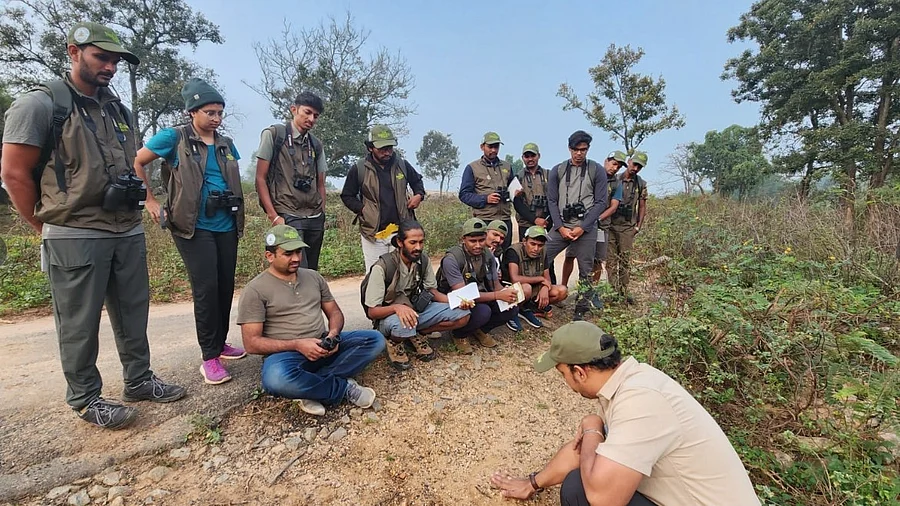
Bengaluru (PTI): For nearly a decade, Siddesh Shekar (33) has been learning how to be a naturalist on the job, from private wildlife tour operators to national parks like the Jim Corbett National Park.
But the three-and-half months he spent learning for Certified Naturalist (CNAT) Course, first structured programme in India -- which is certified by the government, and offers formal certification for nature guides, wildlife interpreters, and eco-tourism professionals -- Shekar said he learnt to look beyond tiger tourism.
“We picked up a lot of cognitive skills, and learnt about everything -- birds, reptiles and mammals -- during the course of three-and-half months,” said Shekar to PTI.
While historically, people like Charles Darwin are tagged as naturalists, modern-day naturalists would include scientists, park rangers, and nature educators, who contribute to our understanding and conservation of the natural world.
Shekar, for instance, wants to become an ethical tourism professional, designing his own tours across the national parks of India.
He was one of the first batch students of the course being offered by Bengaluru-based The Naturalist School, a social enterprise.
The course is designed to create meaningful career pathways in the growing fields of conservation, nature education, and sustainable tourism, said Prakruthi Subramanya, Program Director at The Naturalist School.
“The naturalists have largely been operating from a very informal space. Usually, they are motivated by a passion for wildlife. Sometimes, local youth living in and around forests would double as naturalists,” said Subramanya.
Shekar recalled how as a young boy, he fell in love with wildlife after watching David Attenborough documentaries and wanted to do something with nature for a living.
“It helped that I was living near Mysuru Zoo, and that my mom, who was from Coorg, was a science teacher. I ended up having this fascination for forests, particularly for the biodiversity of Western Ghats,” said Shekar, who is working as a nature guide at the government-owned Jungle Lodges and Resorts, Kabini, perched at the edge of Nagarhole forest in Karnataka.
It was around 2021-22 that the CNAT Course was accredited by the National Council for Vocational Education and Training (NCVET) and aligned with the Skill India Mission, offering a formal pathway into the growing sectors of conservation education and sustainable tourism.
“Before then, Skill India Mission had many courses for chefs and housekeeping, but none for nature guide and nature interpretation,” added Subramanya.
The third batch of the course will begin their three-and-half month (750-hour) long journey into being a naturalist from July 19 at Bannerghatta Nature Camp, Jungle Lodges and Resorts in Bengaluru.
The course, with a fee of Rs 1.5 lakh, is based on experiential learning, said Subramanya.
“Among other things, they will also learn how to communicate to a layperson. Much of it is pegged on building curiosity and storytelling. We have also collaborated with the Red Cross to give them a detailed first-aid course,” said Subramanya.
The students will stay at Bannerghatta Nature Camp for four weeks initially and then again two weeks towards the end of the course.
“They are expected to attend online classes for four weeks, working on assigned projects. There will also be on-the-job training – they will intern in one of the nature camps,” added Subramanya.
Let the Truth be known. If you read VB and like VB, please be a VB Supporter and Help us deliver the Truth to one and all.
Two arrested in K'taka for assaulting minors, uploading CSAM content

Bengaluru (PTI): Two men were arrested for allegedly sexually assaulting two minor girls, recording the acts on mobile phones and uploading the videos online as child sexual abuse material, police said on Thursday.
The accused have been identified as Kiran Kumar (29), hailing from Chitradurga district, and Aditya M K (20), hailing from Shivamogga district, they said.
A probe was initiated after information was received from the NCRP portal regarding a suspected instance of creation of Child Sexual Abuse Material (CSAM) for online dissemination, police said.
Accordingly, a case was registered at Kaggalipura Police Station under relevant sections of the IT Act on May 10, they added.
Investigation revealed that two minor girl victims were exploited and videos were created and uploaded to the internet. The child victims have subsequently recorded their statements as per procedure and further necessary legal steps have been taken, Pronab Mohanty Director General of Police, Cyber Command, said in a statement.
Based on the statements of the victims, the accused persons, who allegedly assaulted the minors, recorded the acts on mobile phones and uploaded the videos online, were arrested, he said.
Following the probe, sections 65(2) (rape) and 70 (gangrape) of the Bharatiya Nyaya Sanhita, along with relevant sections of the POCSO Act, have been added to the FIR, police said.
Officials collected relevant information and on May 12, arrested the accused persons and seized three mobile phones belonging to them, in which the videos had allegedly been recorded, he said.
The accused were later produced before the court and taken into police custody for further investigation, he added.
According to him, in CSAM cases, police usually apprehend offenders who have downloaded such content or have kept them in their possession after obtaining them from elsewhere, usually the internet.
"The present case is one of the very few instances where content creators and uploaders have been apprehended," Mohanty added.