BJP activist's murder: CM Bommai expresses confidence about nabbing killers at the earliest
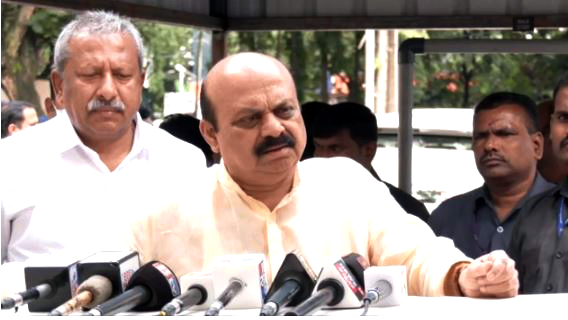
Bengaluru, Aug 1: Karnataka Chief Minister Basavaraj Bommai on Monday said investigation is on in connection with the murder of a BJP youth wing leader in Dakshina Kannada district last week, which had sparked outrage, as he expressed confidence about nabbing the culprits at the earliest.
He said the case will be officially handed over to the National Investigation Agency (NIA) soon and added, however its officials have already started gathering preliminary information.
"Police have been given a free hand and the investigation is progressing in the case, at the earliest killers will be found," Bommai said.
Speaking to reporters here, he said, in two to three days the case will be officially handed over to the NIA.
"The Unlawful Activities (Prevention) Act has to be invoked, that process is on, technical and paper works are being done, at the earliest it will be handed over. NIA has been informed informally and few of its officials are already gathering preliminary information from Kerala and Mangaluru," he added.
A 32-year old zilla Bharatiya Yuva Morcha committee member Praveen Nettar was hacked to death by unidentified motorbike-borne assailants on July 26 night at Bellare in Sullia taluk in Dakshina Kannada district, which had sparked outrage.
Two persons with suspected links with the Popular Front of India (PFI) were arrested by Karnataka police in connection with the murder on July 28.
Amid criticism against him for skipping from visiting the houses of Masood (18) who was murdered in Bellare recently and Mohammed Fazil (23) who was hacked to death at Surathkal recently, when he called on the family of murdered BJP leader Praveen Nettar, Bommai said, "I will surely visit in the days to come."
JD(S) leader H D Kumaraswamy and a delegation of Congress leaders have visited the houses of all the three deceased.
The Chief Minister who is visiting Koppal district on Monday said, he will review and do a spot infection for the development of 'Anjanadri betta' (Anjanadri hill), considered to be the birthplace of Lord Hanuman, for which the government has already announced Rs 100 crore, and will be attending various other programmes.
"For now we will begin the work to provide facilities to tourists at Anjanadri betta, there is some land acquisition that needs to be done, we will do it and then begin the major works," he said.
The Chief Minister said he will be holding two key meetings, one-to take stock of the situation and gather information regarding damages caused due to recent rains in the state, and the second regarding monkeypox with the Health Minister and department officials, to decide on precautionary measures that need to be taken.
Bommai also said that the BJP is planning regional and district-wise conventions of the party in the days to come.
These conventions are part of BJP's preparations in the run-up to the 2023 Assembly polls.
Let the Truth be known. If you read VB and like VB, please be a VB Supporter and Help us deliver the Truth to one and all.
Vijay unable to prove majority, not invited for CM oath ceremony: Sources
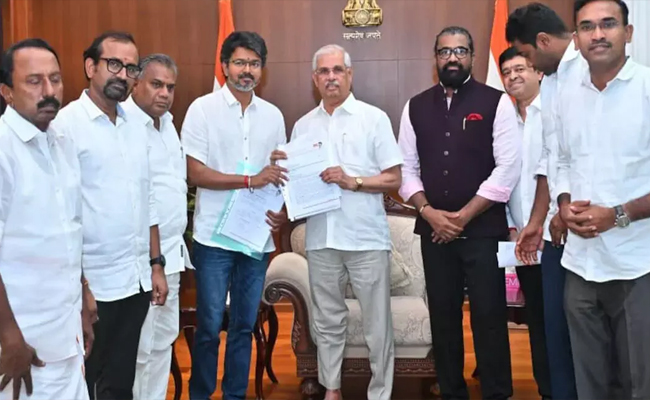
Chennai: Actor-politician Vijay has reportedly not been invited to take oath as Chief Minister of Tamil Nadu after failing to demonstrate support from the required number of MLAs, sources in Raj Bhavan said.
According to media reports that quoted sources in the office of R.N. Ravi Arlekar, Vijay could not prove the backing of 118 legislators, the majority mark in the 234-member Tamil Nadu Assembly.
Despite last-minute efforts to secure support from the Viduthalai Chiruthaigal Katchi (VCK), Amma Makkal Munnetra Kazagam (AMMK), and an IUML legislator, Vijay reportedly managed support from only 116 MLAs, falling short by two members.
Sources said Vijay failed to submit letters of support from the VCK and the Indian Union Muslim League (IUML).
Later, the IUML issued a statement clarifying that it was not part of the TVK-led alliance.
Meanwhile, AMMK leader T.T.V. Dhinakaran is also said to have informed the Governor that his party would support the All India Anna Dravida Munnetra Kazhagam (AIADMK) instead.
Earlier in the evening, Vijay had met Governor Arlekar and staked claim to form the government, stating that he enjoyed the support of 118 MLAs.