BJP calls for state-wide protest against state government on Nov. 21
Allegation of sugarcane dues, insult to woman
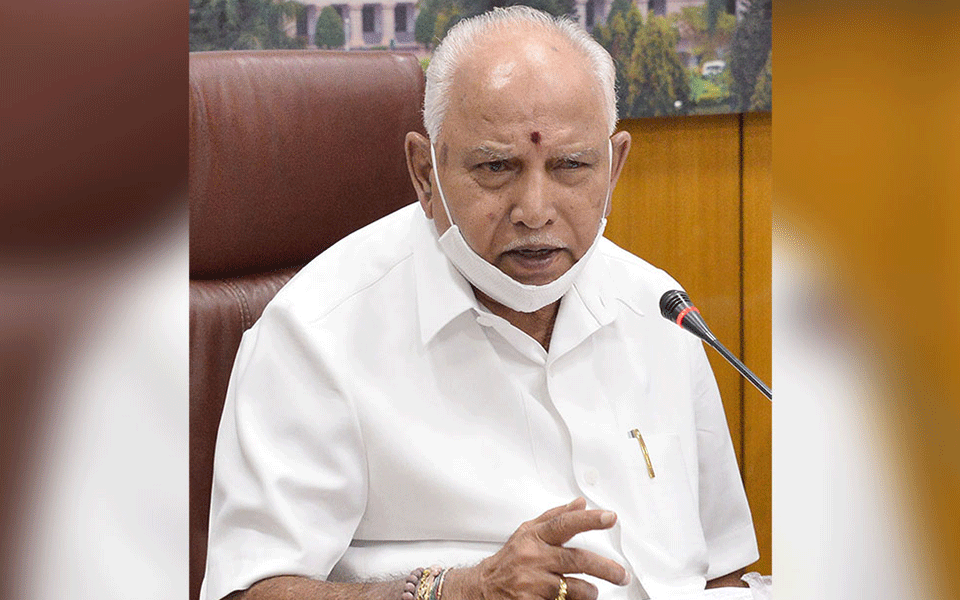
Bengaluru, November 20: The BJP has called for a state-wide protest against the state government accusing it of insulting a farmer woman and demanding clearance of sugarcane dues and support price on November 21.
Speaking to reporters at the party office at Malleshwaram here on Tuesday, BJP state president BS Yeddyurappa said that Chief Minister HD Kumaraswamy was responsible for the sugarcane farmers to come on the streets. They would not have protested if the state government announced the suitable price to the sugarcane. Chief Minister Kumaraswamy’s statement on a farmer woman was not acceptable. The farmer woman termed Kumaraswamy as unfit to become a chief minister. What was wrong in it? But the Chief Minister has tried to justify his statement, he alleged.
Official opposition party
“We have been working as an official opposition party in the state. Who put pressure on me when I reduced the interest rate on farm loans during our coalition government? Both Deve Gowda and Kumaraswamy had questioned me about reducing the interest rate”, Yeddyurappa said.
In the next Belagavi Session, all issues including the farmers issue would be discussed. A farmers rally would be conducted in Belagavi during the Session to draw the attention of the government. Total 100 taluks were drought affected. But the concerned ministers have not visited the affected taluks. The BJP has been collecting information about it and raise this issue in the Winter Session, he said.
‘Whoever may be, take action’
Even if the sugar factories owned by the BJP leaders have dues to farmers or leaders of any political parties have owned the sugar factories, dues should be cleared immediately. The government should take immediate action. The Chief Minister should take action to clear the dues.
-
BS Yeddyurappa, BJP State President
Let the Truth be known. If you read VB and like VB, please be a VB Supporter and Help us deliver the Truth to one and all.
Vartha Bharati–Sankalp predictions align closely with Karnataka bypoll results
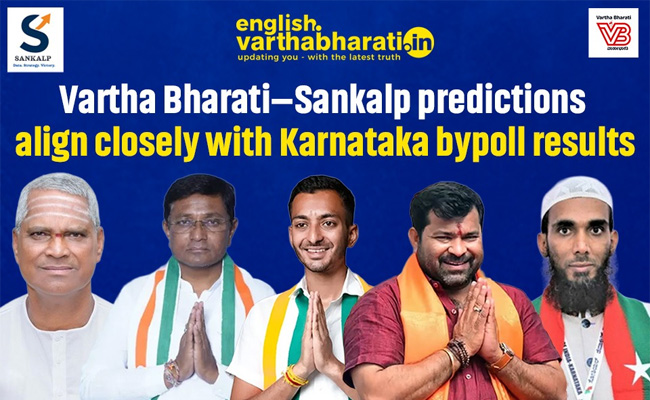
Bengaluru: The Vartha Bharati–Sankalp election analysis has shown a high level of accuracy in predicting the outcome of the recent Karnataka Assembly by-elections held in May 2026, correctly calling winners in both constituencies and closely estimating vote share trends.
The by-elections were held in Bagalkot and Davanagere South, drawing significant political attention as both seats were seen as key tests for the ruling Congress and opposition BJP.
According to the analysis, Vartha Bharati–Sankalp had made three major projections ahead of the results the winning party, vote share percentages, and margin of victory.
In both constituencies, the platform accurately predicted that the Congress would emerge victorious. The outcome matched the projections, with Congress candidates winning in Bagalkot and Davanagere South.
In terms of vote share, the predictions were largely in line with the final results. In Bagalkot, the BJP’s vote share was forecast in the range of 40 to 46 per cent, while the actual figure stood at 42.9 per cent. The Congress vote share, however, exceeded expectations, with the party securing 55.4 per cent against a projected range of 43 to 48 per cent.
The margin of victory in Bagalkot turned out to be significantly higher than anticipated. While the projection had placed the margin between 2,000 and 3,500 votes, the final margin was around 22,332 votes.
In Davanagere South, the predictions also remained largely accurate. The Congress vote share was projected between 43 and 51 per cent, and the final figure stood at 43.9 per cent. The BJP was expected to secure between 42 and 50 per cent but ended with 40.3 per cent.
The analysis had also identified the role of SDPI as a potential spoiler in the constituency. While its vote share was estimated around 6 per cent, the party eventually secured around 12 per cent of the vote.
The margin of victory in Davanagere South was predicted to be between 1,500 and 2,600 votes. The actual margin was higher at around 5,708 votes, though the contest remained relatively close as anticipated.
Overall, the performance of Vartha Bharati–Sankalp stood out for correctly identifying the winning parties in both seats and maintaining close accuracy in vote share estimates, with only limited deviations in specific cases.