
BJP holds agitation demanding Minister Priyank Kharge's resignation over contractor's suicide
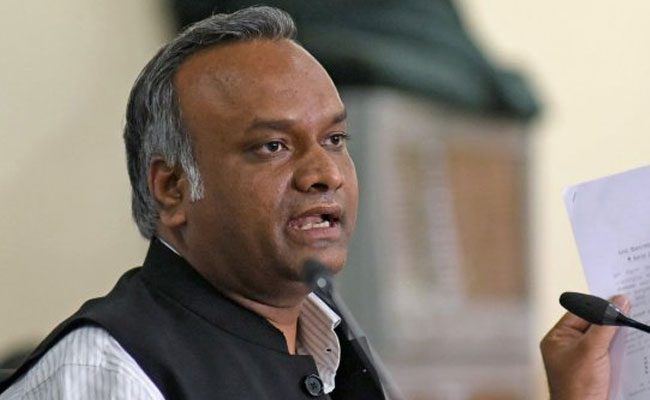
Kalaburagi (Karnataka) (PTI): The BJP on Saturday staged a protest here demanding the resignation of Minister Priyank Kharge in connection with the suicide of a Bidar-based civil contractor.
BJP State President B Y Vijayendra, Leader of Opposition in Karnataka Legislative Assembly R Ashoka, Legislative Council Leader of Opposition Chalavadi Narayanaswamy led the protest.
The saffron party leaders gathered at Jagat Circle in large numbers holding placards, raising slogans against the Minister amid tight security presence.
As the BJP planned lay siege to Kharge's residence, the Minister decided to counter them in a unique way. Police personnel were also seen deployed outside the residence as a precautionary measure to avoid any untoward incident.
"We have ordered tender coconuts, coffee, tea, bottled drinking water for the BJP leaders who will get tired after the protest," a Kharge supporter told PTI.
Reacting to the protest, Kharge told reporters that neither he nor the government will succumb to the opposition's demand and pressure tactics.
He said there are several cases against the BJP leaders, including a case under the POCSO Act against former Chief Minister B S Yediyurappa.
Yediyurappa is the father of BJP state chief B Y Vijayendra and Shivamogga MP B Y Raghavendra.
Mounting pressure on the ruling Congress in Karnataka, the BJP has reiterated its demand for a CBI inquiry into the contractor's suicide and resignation of Kharge.
Civil contractor Sachin Panchal on December 26 allegedly died by suicide by lying before a moving train in Bidar district.
In his suicide note, he accused Priyank Kharge’s close aide Raju Kapanur of compelling him to take the drastic step. He alleged that he was receiving death threats to pay rupees one crore to Kapanur who rejected the charges.
Priyank Kharge too said he had no role in the case as the suicide note did not name him. He also demanded an inquiry into the case to bring out the truth.
Let the Truth be known. If you read VB and like VB, please be a VB Supporter and Help us deliver the Truth to one and all.
Iran-US talks in Islamabad held via indirect, direct channels: sources
_vb_31.jpeg)
Islamabad (PTI): The Iran-US peace talks were conducted first indirectly through Pakistan and later through direct negotiations between the two sides, official sources said on Sunday.
Pakistan remained involved at every stage of the process, with the talks beginning with separate meetings of the US and Iranian delegations with Prime Minister Shehbaz Sharif on Saturday.
This was followed by an exchange of messages between the two sides through Pakistani interlocutors, the sources said.
The Iranian delegation was led by Parliament Speaker Mohammad Baqir Galibaf, while the US team was headed by Vice President JD Vance.
According to sources, the negotiations then moved to direct talks between the visiting delegations, which continued for about two-and-a-half hours in the presence of Pakistani officials.
In the next phase, a one-hour break was taken and technical aspects of the demands presented by the two sides were discussed at the expert level. The exchange of messages on technical aspects continued until late at night.
However, by Sunday morning, it became clear that the differences could not be bridged, leading US Vice President JD Vance to announce at a brief press conference that the talks ended without a deal.
The sources said Pakistan remains hopeful of further rounds of talks, though no date or venue has been finalised so far.
The Pakistani government had earlier said it would continue to play its role as a mediator and expressed hope that the talks would prove to be a step towards resolving the dispute.
The Iranian delegation had arrived in Islamabad on Friday night, while the US team arrived on Saturday morning.
The US side also included President Donald Trump’s son-in-law Jared Kushner and Middle East envoy Steve Witkoff, while Iran was also represented by Foreign Minister Abbas Araghchi and other senior leaders.
The two sides travelled to Islamabad, days after Iran and the US announced a two-week ceasefire on April 8. It was the first direct, high-level engagement between Iran and the US since the 1979 Islamic Revolution.
The failure to arrive at an agreement following the face-to-face negotiations between the two sides raised doubts over the effectiveness of their fragile two-week ceasefire as well as the prospect of reopening the Strait of Hormuz to stabilise the global energy market.
_vb_89.jpeg)
_vb_30.jpeg)
_vb_76.jpeg)