BJP, JD(S) hold all-night dharna in Karnataka Legislature over MUDA 'scam'
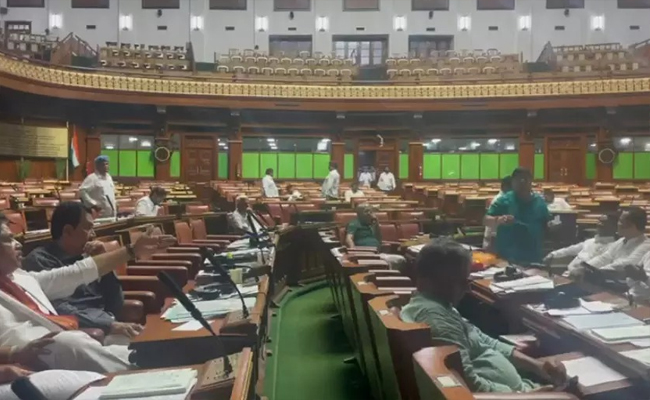
Bengaluru (PTI): The opposition BJP and JD(S) held an all-night dharna in both Houses of the Karnataka Legislature demanding a discussion on the alleged fraudulent allotment of sites to land losers by Mysuru Urban Development Authority (MUDA), which involves plots given to Chief Minister Siddaramaiah's wife.
The BJP and JD(S) legislators spent the night in the Assembly and Council.
As part of the protest, they held demonstrations holding placards, and raised slogans -- in the form of "bhajans" -- against the Congress government, Siddaramaiah and Speaker U T Khader for not allowing a discussion.
The legislators including Leader of Opposition in the Assembly R Ashoka, and BJP state President and MLA B Y Vijayendra later slept in the Assembly premises.
Similar scenes were seen at the Legislative Council too.
The opposition parties said they would continue their protest on the issue in both the Houses on Thursday too.
Claiming that the needle of suspicion in the MUDA "scam" is pointing towards the family of the "most important person" of the state, the opposition on Wednesday demanded that the discussion be allowed on the issue.
They also alleged a political motive behind formation of the inquiry commission to probe the alleged irregularities, and said it was aimed at denying the House an opportunity to debate the issue.
However, their plans to corner CM Siddaramaiah and his government with a discussion under adjournment motion in both Houses suffered a setback with Assembly Speaker Khader and Council Chairperson Basavaraj Horatti rejecting their notice, citing rules.
In protest, the BJP, joined by its alliance partner JD (S), announced that they would stage "day-and-night" dharna in the Legislative Assembly and Council demanding a discussion on the issue.
It is alleged that compensatory sites were allotted to Siddaramaiah's wife Parvathi in an upmarket area in Mysuru, which had higher property value as compared to the location of her land which had been "acquired" by the MUDA.
Several supporters of Siddaramaiah too have allegedly "benefitted this way," BJP leaders alleged.
The MUDA had allotted plots to Parvathi under a 50:50 ratio scheme in lieu of 3.16 acres of her land, where MUDA developed a residential layout.
The controversial scheme envisages allotting 50 per cent of developed land to the land loser in lieu of undeveloped land acquired for forming layouts.
Let the Truth be known. If you read VB and like VB, please be a VB Supporter and Help us deliver the Truth to one and all.
Bridge portion collapses on Jammu outskirts; 3-4 labourers feared trapped, 1 rescued
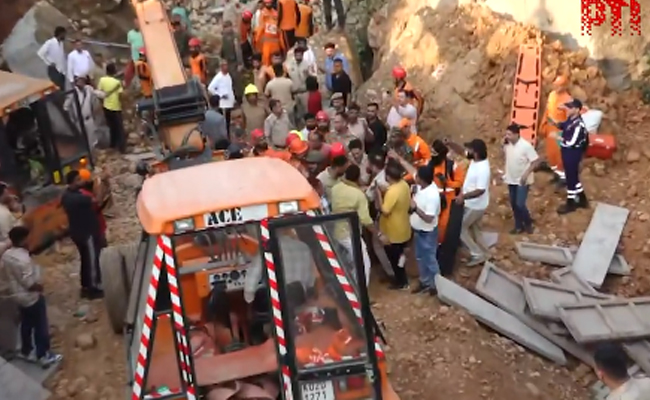
Jammu (PTI): A portion of a small bridge collapsed in the Bantalab area on the outskirts of Jammu city on Friday, trapping at least three to four labourers under the debris, while one injured worker was rescued, official sources said.
Authorities have closed the road link following the collapse of the portion of the bridge.
The incident occurred when labourers were carrying out repair work on a retaining wall near the bridge that was damaged in last year's flash floods, the sources said.
According to the sources, a section of the bridge suddenly gave way, burying workers engaged at the site under the rubble.
Police, Army and State Disaster Response Force (SDRF) teams launched rescue operations to extricate those buried under the debris. They pulled out one injured labourer and shifted him to a hospital, the sources said.
Family members of the labourers present at the site said around six workers engaged at the site at the time of the incident came under the debris when the structure collapsed. The family members said while two of the labourers managed to escape, four got trapped.
The sources said those trapped included the husband of a woman labourer, a mason, an unmarried labourer and a relative of the contractor.
There was no official confirmation on the exact number of persons trapped under the debris till the filing of this report.
The rescue operations are ongoing.