BJP stages demo against K'taka Minister's statement on cow slaughter and power tariff hike
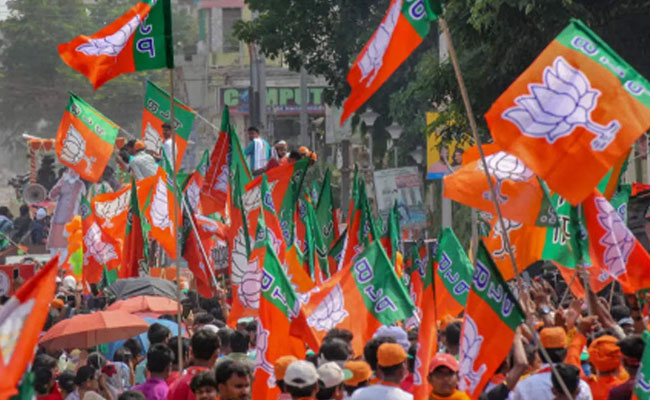
Bengaluru: The Bharatiya Janata Party on Monday staged protests against Karnataka Animal Husbandry Minister K Venkatesh's statement that if buffaloes can be slaughtered, why not cows.
The party also condemned the Congress government in the state for increasing power tariff by ₹2.89 per unit, which happened at a time when the government introduced 'Gruha Jyothi' scheme offering 200 units of electricity free.
Referring to the Karnataka Prevention of Slaughter and Preservation of Cattle Act, which is also known as anti-cow slaughter law, Venkatesh had said on Saturday in Mysuru that the government will revisit the law.
His argument was that the previous BJP government had promulgated the law, which allowed slaughter of buffaloes. Responding to a question on the difficulties faced by farmers in managing aged cows, the minister shared his own example where he had to get an earthmover to bury his dead cow.
The protests took place in Bengaluru, Chikkaballapura, Mysuru, Davangere and a few other parts of the state.
In Mysuru, the BJP workers raised slogans against the Congress government for its decision to revisit the anti-cow slaughter law.
They also held placards which read, "BJP demands the Congress government to continue the anti-cow slaughter law."
The protestors alleged that the Congress has conflicting policies, where it is giving electricity free while on the other it has hiked the power tariff.
Let the Truth be known. If you read VB and like VB, please be a VB Supporter and Help us deliver the Truth to one and all.
The Latest: Kuwait blames Iran for drone strikes as Trump casts doubt on ceasefire
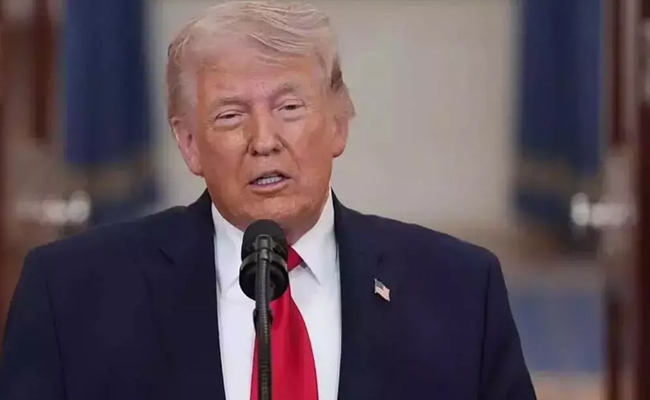
Dubai (AP): US President Donald Trump appeared to cast doubt on the effectiveness of the two-week ceasefire over Iran's continued chokehold over the Strait of Hormuz, while Kuwait accused Iran and its proxies of launching drone attacks targeting it on Thursday despite the ceasefire.
Iran's paramilitary Revolutionary Guard denied launching attacks on Persian Gulf states after Kuwait's announcement.
Israeli Prime Minister Benjamin Netanyahu offered a potential boost to ceasefire efforts in the region when he said he had approved direct talks with Lebanon. The Lebanese government has not responded as of Friday morning.
The announcement came after Israel's pounding of Beirut Wednesday killed more than 300 people. The negotiations are expected next week in Washington, according to a person familiar with the matter.
Questions remained over what will happen to Iran's stockpile of enriched uranium at the heart of tensions, how and when normal traffic will resume through the Strait of Hormuz, and what happens to Iran's ability to launch future missile attacks and support armed proxies in the region.
Talks between the United States and Iran on a resolution to the conflict are expected to start Saturday in Islamabad, with the White House saying Vice President JD Vance would lead the US delegation.
Here is the latest:
Air defence fire and explosions heard in Iran
=============================
Multiple times overnight into Friday morning, people around Iran's capital, Tehran, and other parts of the country said they heard what sounded like air defence fire and explosions.
However, Iran's government did not acknowledge any attack during that period.
After past exchanges of fire with Israel, similar incidents happened as troops remained on edge.
Japan releases more oil reserves
======================
Japan said it will release an additional 20 days' worth of oil reserves in May, in a second round to address supply uncertainty over the war in the Middle East.
Japanese Prime Minister Sanae Takaichi said the planned release of the government reserves will start in early May, after an earlier release last month.
Japan started releasing about 50 days' worth of oil reserves in March, including from those held by the state, the private sector and oil-producing Gulf nations.
As of April 6, Japan had 230 days' worth oil reserves, including 143 days' worth in government stockpiles, according to the Natural Resources and Energy Agency.
Takaichi said her government is working to secure oil imports via routes that do not include the Strait of Hormuz, while Japan seeks to diversify suppliers.
Pakistan to issue visas on arrival ahead of talks
===============================
Pakistan said Friday it would issue visas on arrival for those travelling to Islamabad for the Iran-US talks, signalling the interest in the world's media in the event.