BJP wins 3 of 6 Karnataka legislative council seats
Bengaluru, June 13: Karnataka's opposition BJP won three of the six legislative council seats in the June 8 biennial election held in the three Teachers and three Graduates constituencies across the state, said the Election Commission on Wednesday.
The Janata Dal-Secular (JD-S) won two and the Congress one after vote count of paper ballots cast in the state's 30 districts where the respective constituencies were formed after delimitation.
"The BJP won the South-East Teachers constituency, South-West Graduates and Bangalore Graduates constituencies, while the JD-S won from South-West Teachers and South Teachers constituencies and Congress from North-East Graduates constituency," said the poll panel on its website.
BJP contestant Y.A. Narayanaswamy won the South-East Teachers seat with 8,479 votes, defeating JD-S nominee Ramesh Babu who polled 6,607 votes.
Similarly, BJP candidate Aayunuru Manjunatha won from South-West Graduates seat, securing a whopping 25,210 votes as against 16,157 votes by S.P. Dinesh of Congress.
BJP nominee A. Devegowda won the Bangalore Graduates seat, polling 17,702 votes and defeating Ramoji Gowda of Congress who got 12,838 votes.
JD-S candidate S.H. Bhoje Gowda won the South-West Teachers seat with 8,677 votes defeating BJP's Ganesh Karnik who polled 5,812 votes.
JD-S contestant Marithibbe Gowda won the South Teachers seat with 11,022 votes as against 6,805 votes by M. Lakshmamma of Congress.
Congress contest B. Chandrashekhar won the North-East Graduates seat with 18,768 votes as against 18,447 votes polled by BJP's K.B. Srinivas.
Let the Truth be known. If you read VB and like VB, please be a VB Supporter and Help us deliver the Truth to one and all.
Dy CM Shivakumar confident of Congress win in Karnataka bypolls
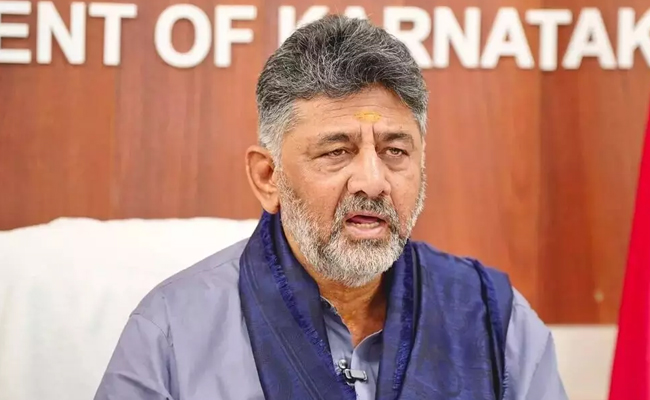
Bengaluru (PTI): Karnataka Deputy Chief Minister D K Shivakumar on Saturday expressed confidence that the ruling Congress will secure a decisive victory in the Assembly bypolls scheduled for April 9 in the Bagalkote and Davanagere South constituencies, citing a favourable ground response to the party’s guarantee schemes.
These are ‘Shakti’, ‘Gruha Lakshmi’, ‘Gruha Jyoti’, ‘Yuva Nidhi’ and ‘Anna Bhagya’.
The bypolls were necessitated by the demise of sitting Congress MLAs Shamanur Shivashankarappa and H Y Meti, who represented Davanagere South and Bagalkote constituencies, respectively.
The Congress has fielded Shivashankarappa’s grandson, Samarth Shamanur, in Davanagere South and Umesh Meti in Bagalkote. They are locked in direct contests with BJP candidates T Dasakariyappa and Veerabhadrayya Charantimath.
“Both Bagalkote and Davanagere are very positive. Congress workers are doing an excellent job, going door to door and convincing people about the guarantee schemes,” Shivakumar told reporters here.
He said even voters who had earlier supported the BJP were now inclined towards the Congress.
“Even those who voted for the BJP earlier are saying they will vote for Congress. People want the guarantees to continue and are expressing difficulties due to rising prices,” he said.
Expressing confidence of an improved electoral performance, he added, “There is a strong sense that we will win with a bigger margin than before.”
Shivakumar also said he would travel to Kerala for two days and resume campaigning thereafter. “I am going to Kerala for two days. After returning, we will continue the campaign from Davanagere,” he said.
Referring to the shortage of LPG, including auto LPG, in the state, Shivakumar blamed the BJP-led government and called for immediate intervention by the Centre.
“The LPG shortage is due to the BJP. Auto drivers and those in the transport sector are facing difficulties,” he claimed.
“This is something the central government has to address. It must formulate proper policies and take precautionary measures,” he said, adding that the BJP should apologise to the public.
“They should come forward and apologise to the people for the inconvenience caused and resolve the issues they have created,” he said.