BJP's toppling game is to show that grand alliance will fail: DCM Parameshwar
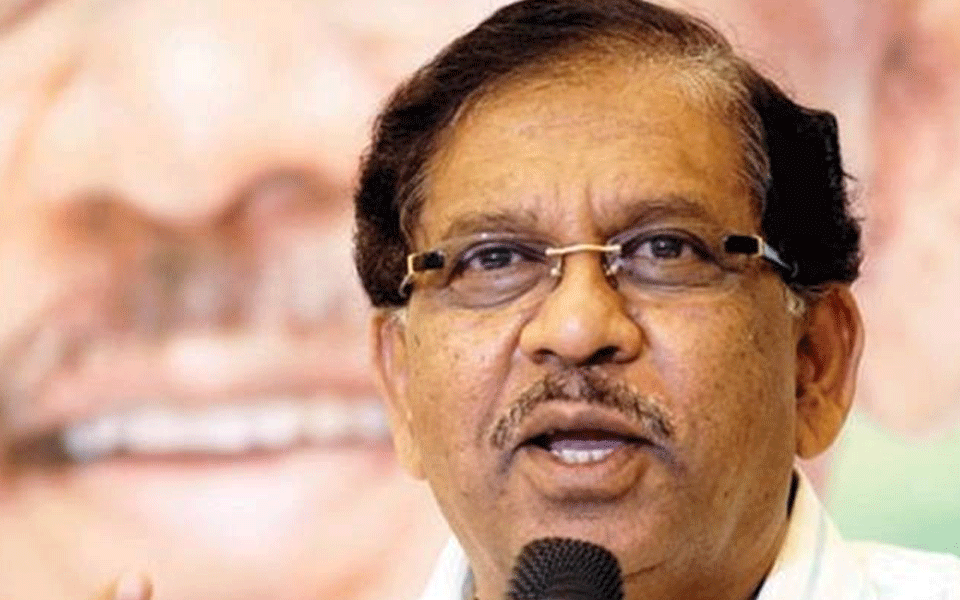
Bengaluru, Jan 16: Karnataka Deputy Chief Minister G Parameshwar on Wednesday alleged that the BJP has a bigger plan behind the its moves "to topple" the coalition government in the state as it wants to show that any grand alliance against it at the centre will meet the same fate.
The coalition government in Karnataka suffered the first major setback when two MLAs, an independent and a member of the Karnataka Pragnyavantara Janata Paksha, Tuesday withdrew support to the government.
There was no immediate threat to the government with the withdrawal of support but speculation was rise that many other disgruntled Congress MLAs could follow suit by resigning from the Assembly, though the party has maintained that its flock is intact.
"There is a bigger scheme in destabilising the coalition government in Karnataka because when we took oath, the oath ceremony was attended by most of the non-BJP friends and leaders. That was a kind of Mahagathbandhan (grand alliance)," Parameshwara told reporters on the sidelines of a function.
He said the BJP "took the stand to pull down the government" despite knowing well that its attempt would fail.
The deputy chief minister said, "Now if these two parties are not successful, the alliance is not successful in Karnataka, the message would be that yes this (grand) alliance is going to fail. Maybe they (BJP) are trying to do that. This is another thing which we have been discussing."
On the alleged discontent in Congress, Parameshwara said whenever there is an expansion, some people aspiring for ministerial posts express their feelings in different ways when they don't get the opportunity.
"But after some time they will also understand that everybody cannot become minister. We also try to accommodate them in different ways," Parameshwara said.
"The BJP saw an opportunity in the disgruntled MLAs to topple the government," the deputy chief minister said.
In the 224-member Assembly, BJP has 104 members, Congress-79, JDS 37, BSP, KPJP and Independent one each, besides Speaker.
Let the Truth be known. If you read VB and like VB, please be a VB Supporter and Help us deliver the Truth to one and all.
Rickelton's ton in vain as SRH beat MI by 6 wickets
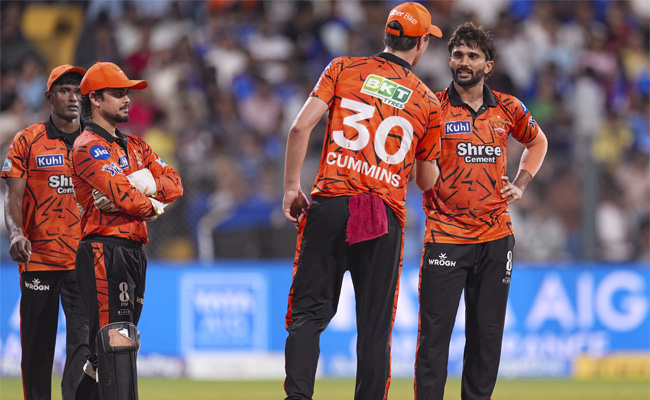
Mumbai (PTI): Ryan Rickelton's whirlwind unbeaten ton was overshadowed by Heinrich Klaasen's unbeaten 65 as Sunrisers Hyderabad defeated Mumbai Indians by six wickets in an IPL match here on Wednesday.
Chasing an imposing 244-run target, Travis Head (76 off 30) and Abhishek Sharma (45 off 24) shared 129 runs for the opening wicket to set the platform for SRH.
Klaasen (65 not out off 30 balls) then displayed his all-round hitting abilities to guide SRH home with the help of Nitish Kumar Reddy (21) and Salil Arora (30 not out off 10) in 18.4 overs.
Earlier, Rickelton's knock powered MI to 243 for five.
MI rode on a 93-run stand between Rickelton (123 not out off 55 balls) and Will Jacks (46 off 22) in 7.1 overs for the opening stand to power the side.
MI skipper Hardik Pandya scored a valuable 31 off 15 balls before being dismissed.
Praful Hinge (2/54), Eshan Malinga (1/29), Sakib Hasan (1/39) and Nitish Kumar Reddy (1/31) were the wicket-takers for SRH.
Brief Scores:
Mumbai Indian: 243 for 5 in 20 overs (Ryan Rickelton 123 not out; Praful Hinge 2/54).
Sunrisers Hyderabad: 249 for 4 in 18.4 overs (Travis Head 76, Heinrich Klaasen 65 not out; AM Ghazanfar 2/51).