“Bleeding on the road, I begged for help but no one came”: Bengaluru woman recounts husband’s death
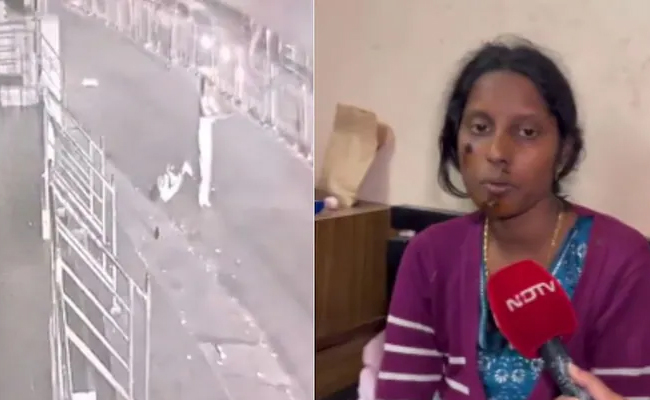
Bengaluru: A woman in Bengaluru has shared a painful account of how her husband died after they were repeatedly denied medical help and ignored by passersby during a medical emergency, NDTV reported.
The victim, 34-year-old Venkataramanan, a garage mechanic from Balaji Nagar, developed severe chest pain around 3.30 am. His wife immediately took him on a motorcycle in search of medical help.
"He complained about chest pain, and we went to the first hospital. However, the doctor was not on duty. At the second hospital, we were told he had a stroke and to go to another hospital. When we called for ambulance services, they did not respond properly. Humanity failed, but we did our bit by donating his eye." NDTV quoted his wife as saying.
According to the report, after being turned away twice, the couple met with an accident on the road. CCTV footage later showed the woman, covered in blood, pleading with folded hands as vehicles passed by, but no one stopped to help.
ALSO READ: Actress Shilpa Shetty's restaurant booked for breaching operating hours
The wait ended after several minutes when a cab driver stopped and rushed Venkataramanan to a nearby hospital. Doctors there declared him dead on arrival.
As per the report, the family decided to donate Venkataramanan’s eyes, giving sight to others even in death.
Venkataraman's mother, who had lost her last surviving child, had no words to express herself: "I have no words. I do not know what to say. My son is gone."
"The government should understand a health emergency. My daughter is left with two children. Who will look after them?" asked his mother-in-law. His wife, mother, and two children, a five-year-old son and an 18-month-old daughter now survive Venkataramanan.
The incident has once again raised serious questions about emergency healthcare access, ambulance response, and public apathy in the city.
Let the Truth be known. If you read VB and like VB, please be a VB Supporter and Help us deliver the Truth to one and all.
EAM Jaishankar meets Jamaican PM, gifts over 10 BHISHM Cubes
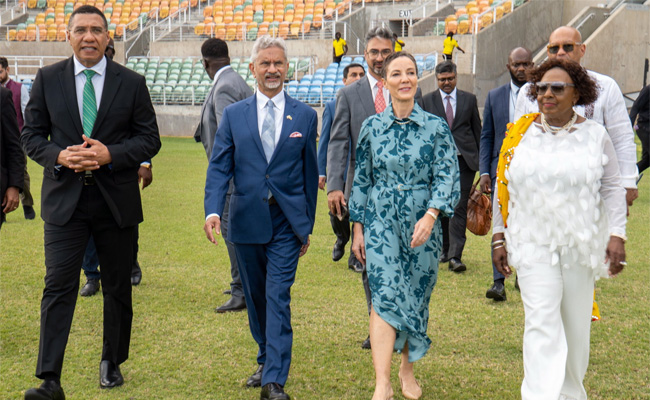
Kingston (PTI): External Affairs Minister S Jaishankar on Monday met Jamaican Prime Minister Andrew Holness and discussed ways to further deepen "political, economic and people-to-people cooperation."
Jaishankar also conveyed greetings from Prime Minister Narendra Modi to Holness.
"Pleased to call on Prime Minister @AndrewHolnessJM in Kingston. Conveyed the greetings of PM @narendramodi," Jaishankar posted on X.
"Discussed deepening our political, economic and people-to-people cooperation. Value his commitment towards further strengthening India-Jamaica relations," the post further read.
Also, the external affairs minister handed over 10 BHISHM (Bharat Health Initiative for Sahyog Hita & Maitri) Cubes as a gift to Jamaica.
"Formally handed over 10 BHISHM Cubes as a gift from India to Jamaica, in the presence of PM @AndrewHolnessJM, Health Minister @christufton and FM @kaminajsmith," Jaishankar posted on X.
"The BHISHM Cube mobile hospital system, designed for rapid deployment, will help Jamaica during disasters and emergencies. The gift of these cubes is a statement of friendship, a commitment to disaster preparedness, and an outcome of innovation," the post said.
Jaishankar arrived in Kingston on Saturday evening, marking the first leg of his nine-day tour of Jamaica, Suriname, and Trinidad and Tobago, aimed at further strengthening India's strategic and cultural ties with the Caribbean nations.
Earlier in the day, he interacted with the Indian diaspora and discussed India's ongoing transformation in infrastructure, human development and technology-driven governance and entrepreneurship with them.
He also highlighted the cricket bond between both countries as India gifted a scoreboard to Jamaica.
A scoreboard was dedicated at Sabina Park in Kingston. It is the home of the Jamaica cricket team and is the only Test cricket ground in the Caribbean island nation.
The minister expressed hope that the new scoreboard would witness many memorable innings, including those symbolising the enduring friendship between the two countries.
Cricket has long been a strong cultural bridge between India and Jamaica, which is part of the West Indies cricket team.
Jamaican players, including Chris Gayle, Courtney Walsh and Michael Holding, have played a major role in shaping the legacy of West Indies cricket in the international arena, contributing to its dominance in earlier decades and its continued global appeal.