Cabinet decides to rechristen Mumbai-Karnataka region comprising 7 districts as 'Kittur Karnataka'

Bengaluru, Nov 8: The Karnataka Cabinet on Monday decided to rechristen "Mumbai-Karnataka" region consisting of seven districts as "Kittur Karnataka"
"The Cabinet has decided to rechristen the Mumbai-Karnataka region consisting of Uttara Kannada, Belagavi, Dharwad, Vijayapura, Bagalkote, Gadag and Haveri districts as Kittur Karnataka," said Law and Parliamentary Affairs Minister J C Maduswamy.
"It was decided to rechristen as we didn't want to refer to the region as Bombay-Karnataka or Mumbai-Karnataka," he said.
Renaming the region that was under the erstwhile Bombay presidency before Independence has been a long-standing demand of the pro-Kannada organisations.
The name Kittur is after a historical taluk in Belagavi district that was ruled by Rani Chennamma (1778 1829), who had fought against the British before Jhansi Rani Laxmibai did.
The previous B S Yediyurappa government in 2019 renamed Hyderabad-Karnataka region that was previously ruled by Nizams of Hyderabad as Kalyana-Karnataka.
Also, the Cabinet today gave its approval to the new sand policy.
"In the policy, we have made stages like gram panchayat, riverbed, sea... Also, we have mentioned who are all permitted under the policy to extract sand," said Madhuswamy.
Briefing reporters after the Cabinet meeting here, he said under the policy, sand in gram panchayat would be sold at Rs 300 per metric tonne, while riverbed sand is fixed at Rs 700 per metric tonne to be sold at urban, inter-districts and other areas, and a separate authority would be constituted with enforcement and monitoring authorities.
"The policy is aimed at making sand easily available in the State at lesser prices," he said. The traditional method of extracting sand by diving into the sea would be allowed on small scale in the non-SEZ area, but there is restriction on usage of machinery because it is against the law of the country.
Gram panchayats have been authorised to give sand at discounted rate for rural housing and government sponsored schemes, he added.
The Cabinet has also approved amendments to Karnataka Minor Mineral Concession Rules, 1994, under which the lease period for both minor and major minerals mined in a particular area would be the same, which is about 50 years.
"Along with major minerals, some minor minerals are also being mined in the same areas in several parts of the State. The Centre gives a 50-year lease for major minerals, but for minor minerals the State used to give for 20 or 30 years. So we are now changing it... whatever mining is done in a particular area, it will be for 50 years in line with with the major mining policy," said the Minister.
The other Cabinet decisions include: To constitute a committee headed by a retired High Court Judge and consisting of two technical experts; and to examine pre-tender notification of government tenders worth more than Rs 50 crore.
"Only after committee's approvals, the tenders can be floated...this is mainly aimed at maintaining transparency. We request the committee to scrutinise and give nod to the works in 15 days," said Madhuswamy.
The other decisions include: Approval for Rs 399.8-crore KSAFE-II action plan by the fire department that includes fire infrastructure, increasing fire stations among others; administrative approval for constructing vented dams for west flowing rivers; bifurcating Dharwad Milk Union to create a separate milk union for Haveri, and to bifurcate Kolar; and Chikkaballapur Milk Unions.
Let the Truth be known. If you read VB and like VB, please be a VB Supporter and Help us deliver the Truth to one and all.
Surjewala slams Pratap Simha’s ‘vile’ remarks on CM Siddaramaiah, demands apology from BJP
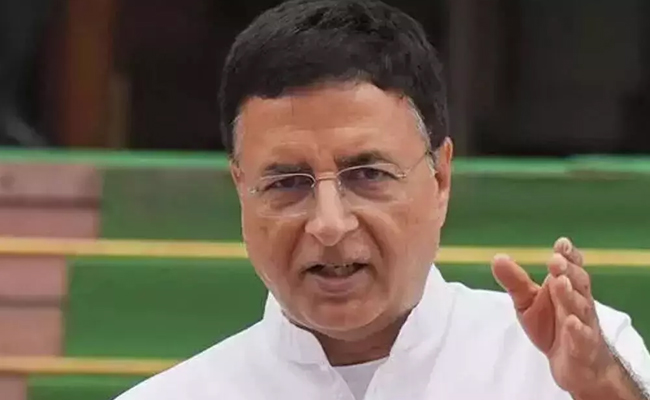
Bengaluru (PTI): Congress general secretary and Karnataka in-charge Randeep Singh Surjewala on Saturday launched a sharp attack on the BJP over alleged disparaging remarks made by former Mysuru-Kodagu MP Pratap Simha against Chief Minister Siddaramaiah during an assembly bypoll campaign in Bagalkote.
Simha made the remarks while campaigning for BJP candidate Veerabhadrayya Charantimath, triggering a political row ahead of the by-elections scheduled for April 9.
Congress has fielded Umesh Meti, son of former MLA late M Y Meti, whose death necessitated the bye-election.
"Pratap Simha's vile remarks about Chief Minister Siddaramaiah in Bagalkot have exposed the BJP's despicable politics once again," Surjewala said in a social media post.
Alleging a larger political design, he added, "It is increasingly evident that Pratap Simha’s outburst is driven by desperation," and accused the BJP of using such remarks to target backward classes, Scheduled Castes, and minorities.
The Rajya Sabha member further claimed that the incident reflects a pattern within the party. "This is not one man's madness—it is the BJP’s political culture," he said, adding that the remarks were aimed at "denigrating leaders from marginalised communities".
Referring to past incidents, Surjewala said, "CM Siddaramaiah and his deputy D K Shivakumar have received death threats in the past, including one from BJP leaders who warned that their bodies would be stuffed into a refrigerator."
The Congress leader also criticised the BJP’s bypoll campaign strategy, alleging "internal contradictions".
He pointed to the party’s use of expelled MLA Basanagouda Patil Yatnal in campaigning despite earlier disciplinary action against him, accusing the BJP of resorting to "abuses and indignities" against opposition leaders.
Surjewala demanded immediate action from the BJP leadership, including Prime Minister Narendra Modi, BJP national president Nitin Nabin, state president B Y Vijayendra, and Leader of Opposition R Ashoka.
He said they must tender a public apology to Kannadigas, particularly to OBCs, SCs, and minorities, over the remarks, and urged the party to expel Simha if it does not repudiate his statements.
Surjewala also called for legal action, demanding that an FIR be registered against Simha and that strict measures be taken.
Warning of "political consequences", he said the electorate in the bypoll-bound constituencies would respond decisively if the BJP failed to apologise, asserting that voters would "teach the BJP a befitting lesson" in the elections.
There has been no immediate reaction from the saffron party yet.