CBCI 37th GBM: Catholic body reaffirms commitment to India's constitutional values
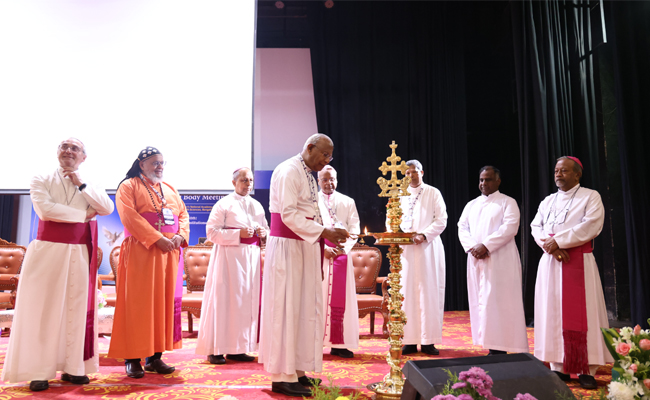
Bengaluru: The 37th General Body Meeting (GBM) of the Catholic Bishops’ Conference of India (CBCI) was inaugurated on February 4, 2026, at St John’s National Academy of Health Sciences in Bengaluru by Archbishop Leopoldo Girelli, Apostolic Nuncio to India and Nepal.
Organised under the theme “Faith and the Nation: The Church’s Witness to India’s Constitutional Vision,” the gathering reflects the CBCI motto “United in Witness.”
Grounded in the Gospel and inspired by the love of Christ, the CBCI continues its mission of strengthening faith, fostering unity among India’s diverse communities, and promoting justice, peace, and social harmony.
More than 200 bishops representing 174 dioceses from across the country have assembled for prayer, reflection, and deliberation on matters of national and ecclesial importance. The General Body Meeting began at 9.00 a.m. with a solemn Eucharistic Celebration, during which Rev. Dr. Mathew Koyickal, Deputy Secretary General of the CBCI, welcomed the participants.
The principal celebrant, Archbishop Leopoldo Girelli, in his homily, called upon the bishops to be the light and salt of the earth, enriched with the fruits of the Holy Spirit. He urged the shepherds of the Church to remain joyful, kind, faithful, and humble servants in the Lord’s mission, witnessing Christ’s human love through outreach to the poor and the marginalized.
The Eucharistic celebration was concelebrated by senior Church leaders, including Archbishop Mar Andrews Thazhath, President of the CBCI; Cardinal Filip Neri Ferrao, President of the CCBI; His Beatitude Mar Raphael Thattil, Major Archbishop of the Syro-Malabar Church; Cardinal Baselios Cleemis, Major Archbishop of the Syro-Malankara Church; Cardinal Oswald Gracias, Archbishop Emeritus of Bombay; Archbishop George Antonysamy, Vice-President I; Archbishop Joseph Mar Thomas, Vice-President II; and Archbishop Anil Joseph Thomas Couto, Secretary General of the CBCI.
The inaugural session commenced at 11.00 a.m. with the ceremonial lighting of the lamp, invoking God’s blessings on the deliberations. The Archbishop of Bangalore, the host of the meeting, welcomed the gathering and noted that the chosen theme reflects the Church’s deep-rooted commitment to the values enshrined in the Constitution of India. Archbishop George Antonysamy read out the message of the Holy Father, Pope Leo XIV.
In his inaugural address, Archbishop Leopoldo Girelli conveyed the Apostolic Blessings of the Holy Father and observed that the ideals expressed in the Preamble of the Constitution of India resonate strongly with the Church’s social teachings. He noted that despite contemporary challenges, the Church continues to serve the nation through humane development and by contributing to the moral conscience of society, urging Church leaders to seek new ways to live and practise faith in harmony with constitutional values.
Delivering the Presidential Address, Archbishop Mar Andrews Thazhath stated that the Church stands at a critical moment where conscience is being tested and faith is increasingly examined in the public sphere. He described the theme as both a profound spiritual confession and a public responsibility, calling upon bishops to be missionaries of hope and empowerment.
Referring to emerging technologies, particularly Artificial Intelligence, he stressed the need to humanise technology and ensure that the human person remains at the centre, urging the Church to become “digital missionaries.” He also emphasised the importance of deepening the synodal journey, forming leaders for public life, and empowering the laity, youth, and women.
The Biennial Report of the CBCI, covering the period from February 2024 to January 2026, was presented by Archbishop Anil J.T. Couto. On the occasion, thirty-one newly appointed bishops were felicitated by the Apostolic Nuncio with a shawl and memento, followed by a solemn observance of silence in memory of bishops who had passed away.
Messages from Cardinal Claudio Gugerotti, Prefect of the Dicastery for the Oriental Churches, and Cardinal Luis Antonio G. Tagle, Pro-Prefect of the Dicastery for Evangelization, were read out. The session concluded with a vote of thanks proposed by Archbishop Joseph Mar Thomas, Vice-President II of the CBCI, after which Rev. Fr. Jesudoss Rajamanickam, Director of St John’s National Academy of Health Sciences, briefed the participants on guidelines for their stay on the campus.
Let the Truth be known. If you read VB and like VB, please be a VB Supporter and Help us deliver the Truth to one and all.
Fire erupts at plastic factory in Ahmedabad; no casualties

Ahmedabad (PTI): A fire broke out at a plastic granules and mould manufacturing factory in Gujarat's Ahmedabad on Sunday morning, an official said.
No casualties were reported in the incident, he said.
The blaze erupted around 8 am at Processo Plast Enterprise in the Bapunagar area, Ahmedabad Municipal Corporation's Additional Chief Officer (fire) Mihir Rana told PTI.
Thick plumes of smoke were seen billowing into the sky, visible from a considerable distance in the area.
"The unit closed after the night shift and the fire broke out in the morning in the ground floor's storage facility section due to unidentified reasons," Rana said.
Nine fire tenders and several other firefighting vehicles were rushed to the spot, and the blaze was brought under control by 11 am, he said.
Firefighters prevented the blaze from spreading to the first floor. However, machinery and plastic materials were damaged on the ground floor, he said, adding that the exact cause of the blaze was under investigation.