Karnataka CM pick: Ahead of official announcement, Siddaramaiah's supporters break into celebration
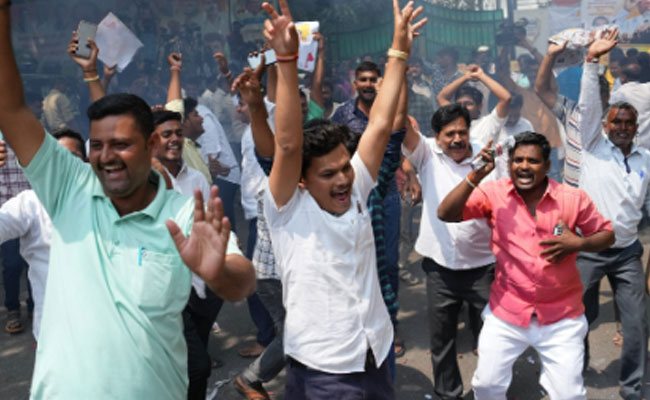
Bengaluru (PTI): Ahead of a formal announcement that Congress veteran Siddaramaiah will be Karnataka's next Chief Minister, his supporters broke into celebrations here and at his native village in Mysuru district on Thursday morning.
Siddaramaiah will be the next CM of Karnataka and DK Shivakumar his deputy, Congress sources in Delhi said today after the party arrived at a consensus on government formation in the state following hectic parleys.
The swearing-in ceremony will be held in Bengaluru on May 20.
Siddaramaiah's supporters shouted slogans in his favour as the news came out that he would take oath as the CM on May 20.
The residents of Siddaramanahundi, the native village of Siddaramaiah were, in fact, jubilant since Wednesday following reports that their leader would become the chief minister again.
The villagers set off crackers, raised slogans hailing Siddaramaiah and distributed sweets.
His brother Sidde Gowda was confident that Siddaramaiah will be chosen for the top post.
"There's a guarantee that Siddaramaiah will become Chief Minister. He has done good for the people. He introduced 'Anna Bhagya' scheme giving free rice to the poor people," Sidde Gowda told reporters in Siddaramanahundi on Wednesday.
Meanwhile, arrangements were afoot at the Kanteerava stadium in the city where the swearing-in ceremony will take place.
Security has been stepped up near the residence of the Leader of Opposition in the outgoing Assembly here and in and around the stadium where the ceremony will take place.
According to party sources, AICC President Mallikarjun Kharge along with other stakeholders held parleys past midnight to hammer out a solution between Siddaramaiah and Shivakumar -- the two chief ministerial aspirants.
A Congress Legislature Party meeting has been called by Shivakumar, the party's state unit chief, here this evening. The decision will be announced there.
The Karnataka Pradesh Congress Committee chief has written to all legislators, asking them to attend the meeting of newly-elected MLAs, MLCs and MPs at the Indira Gandhi Bhavan on Queen's Road at 7 pm.
Let the Truth be known. If you read VB and like VB, please be a VB Supporter and Help us deliver the Truth to one and all.
Pro-chancellor of St Aloysius University, Fr Melwin J Pinto SJ passes away at 63
_vb_92.jpeg)
Mangaluru: Fr Melwin J Pinto SJ, Pro-chancellor of St Aloysius University Rector of St Aloysius Institutions, and Vice President of Mangalore Jesuit Educational Society (MJES), breathed his last on Friday, April 10. He was 63.
Born in 1963, Fr Melwin Pinto completed his schooling and college education at St Aloysius before joining the Jesuit order on June 20, 1981. He was ordained as a Jesuit priest on April 14, 1997.
Over the years, he held several academic qualifications, including an MA in English, a Master’s degree in Education, and diplomas in psychology and counselling as well as school administration.
He began his career in education as headmaster of St Joseph’s Primary School and High School in Hassan, serving between 1996 and 1999.
He later founded St Joseph’s Indian PU College and served as its principal until 2007. He subsequently served as headmaster of St Aloysius High School, Mangaluru, from 2007 to 2011, and later as principal of St Joseph’s PU College, Hassan, until 2012.
Fr Melwin Pinto also worked with Vatican Communications and Radio in Rome, contributing to its English desk for Asia and Indian languages.
He later served as superior and director of Fatima Retreat House in Valencia for two years from May 2017, before being appointed as superior of the Jesuit study home ‘Vidyaniketan’ in Dharwad.
He was also closely associated with the development of St Aloysius Institutions and played a key role in securing the status of a Deemed-to-be University. His contribution to the education sector and efforts towards innovation were widely acknowledged. He was known for maintaining close relations with people from all sections of society.
Legislative Council MLA Ivan D’Souza, in a statement, said the demise of Fr Melwin J Pinto was a huge loss to the educational and religious fields and had created a significant void in society.
Dakshina Kannada District in-charge Minister Dinesh Gundu Rao also expressed grief, stating that his service and contributions to education would always be remembered.
Details regarding the funeral are yet to be announced.