Chandrayaan-3 rover confirms presence of sulphur on lunar surface,search for Hydrogen underway: ISRO
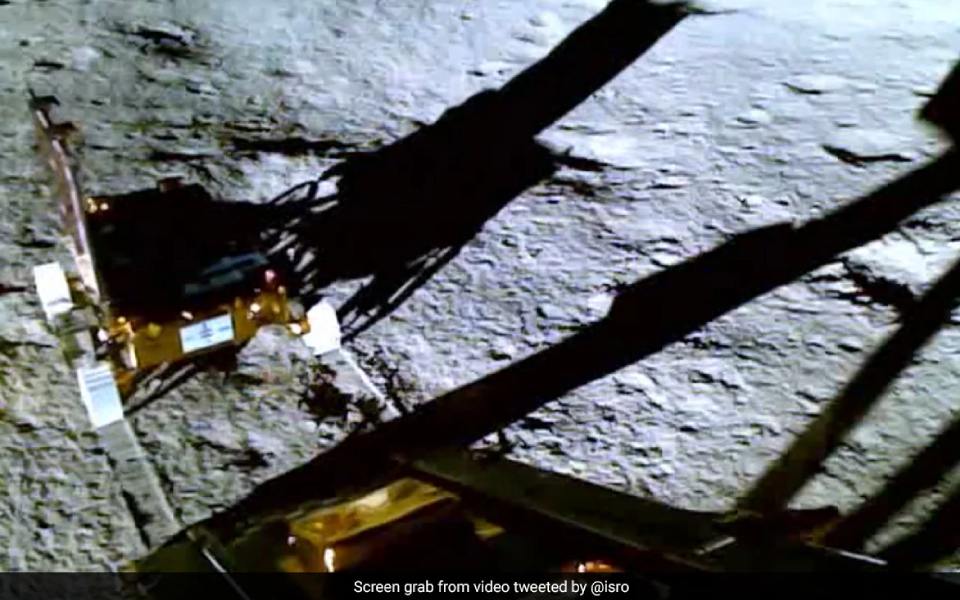
Bengaluru, Aug 29: The Laser-Induced Breakdown Spectroscope instrument onboard 'Pragyan' rover of Chandrayaan-3 has unambiguously confirmed the presence of sulphur on the lunar surface near south pole, through first-ever in-situ measurements, ISRO said on Tuesday.
It also said the instrument also detected aluminium, calcium, iron, chromium, titanium, manganese, silicon and oxygen, as expected.
"The Laser-Induced Breakdown Spectroscopy (LIBS) instrument onboard Chandrayaan-3 Rover has made the first-ever in-situ measurements on the elemental composition of the lunar surface near the south pole. These in-situ measurements confirm the presence of Sulphur (S) in the region unambiguously, something that was not feasible by the instruments onboard the orbiters," the space agency said in a statement.
According to ISRO, LIBS is a scientific technique that analyses the composition of materials by exposing them to intense laser pulses.
"A high-energy laser pulse is focused onto the surface of a material, such as a rock or soil. The laser pulse generates an extremely hot and localised plasma. The collected plasma light is spectrally resolved and detected by detectors such as Charge Coupled Devices. Since each element emits a characteristic set of wavelengths of light when it's in a plasma state, the elemental composition of the material is determined," it said.
Preliminary analyses have unveiled the presence of Aluminum (Al), Sulphur (S), Calcium (Ca), Iron (Fe), Chromium (Cr), and Titanium (Ti) on the lunar surface. Further measurements have revealed the presence of manganese (Mn), silicon (Si), and oxygen (O), it said.
"Thorough investigation regarding the presence of Hydrogen is underway," ISRO said.
LIBS instrument is developed at the Laboratory for Electro-Optics Systems at Peenya Industrial Estate, Bengaluru where the first India satellite was fabricated in 1975.
India on August 23 scripted history as ISRO's ambitious third Moon mission Chandrayaan-3's Lander Module (LM) touched down on the lunar surface, making it only the fourth country to accomplish the feat, and first to reach the uncharted south pole of Earth's only natural satellite.
Prime Minister Narendra Modi on Saturday announced the decision to name the spot where Chandrayaan-3 Vikram lander made soft landing as 'Shiv Shakti Point' and the site where the Chandrayaan-2 lander crash-landed on the Moon's surface in 2019 would be known as "Tiranga Point".
Also, August 23, the day the Chandrayaan-3 lander touched down on the lunar surface, would be celebrated as National Space Day', Modi had said.
Chandrayaan-3 Mission:
— ISRO (@isro) August 29, 2023
In-situ scientific experiments continue .....
Laser-Induced Breakdown Spectroscope (LIBS) instrument onboard the Rover unambiguously confirms the presence of Sulphur (S) in the lunar surface near the south pole, through first-ever in-situ measurements.… pic.twitter.com/vDQmByWcSL
Let the Truth be known. If you read VB and like VB, please be a VB Supporter and Help us deliver the Truth to one and all.
Rickelton's ton in vain as SRH beat MI by 6 wickets
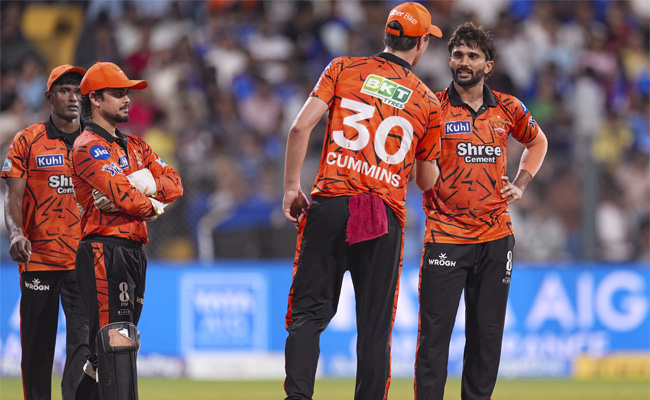
Mumbai (PTI): Ryan Rickelton's whirlwind unbeaten ton was overshadowed by Heinrich Klaasen's unbeaten 65 as Sunrisers Hyderabad defeated Mumbai Indians by six wickets in an IPL match here on Wednesday.
Chasing an imposing 244-run target, Travis Head (76 off 30) and Abhishek Sharma (45 off 24) shared 129 runs for the opening wicket to set the platform for SRH.
Klaasen (65 not out off 30 balls) then displayed his all-round hitting abilities to guide SRH home with the help of Nitish Kumar Reddy (21) and Salil Arora (30 not out off 10) in 18.4 overs.
Earlier, Rickelton's knock powered MI to 243 for five.
MI rode on a 93-run stand between Rickelton (123 not out off 55 balls) and Will Jacks (46 off 22) in 7.1 overs for the opening stand to power the side.
MI skipper Hardik Pandya scored a valuable 31 off 15 balls before being dismissed.
Praful Hinge (2/54), Eshan Malinga (1/29), Sakib Hasan (1/39) and Nitish Kumar Reddy (1/31) were the wicket-takers for SRH.
Brief Scores:
Mumbai Indian: 243 for 5 in 20 overs (Ryan Rickelton 123 not out; Praful Hinge 2/54).
Sunrisers Hyderabad: 249 for 4 in 18.4 overs (Travis Head 76, Heinrich Klaasen 65 not out; AM Ghazanfar 2/51).