Civil society organisations jointly file complaint to election commission against BJP in Karnataka
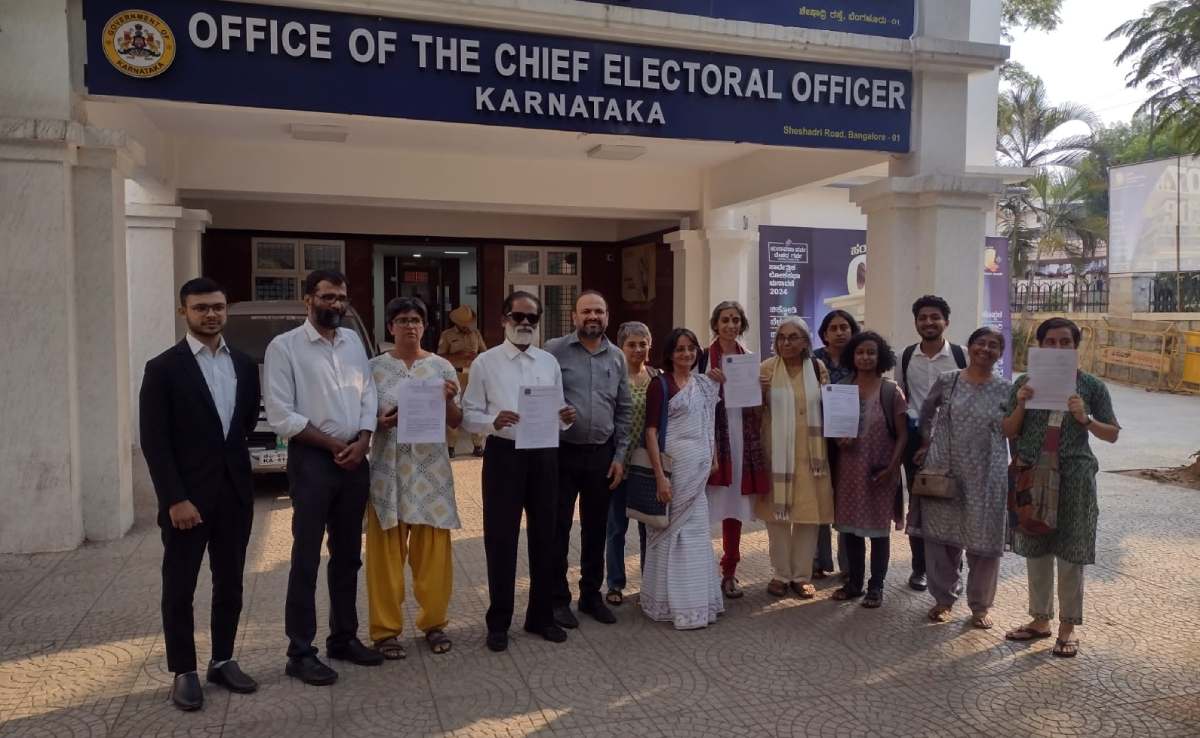
On 06.05.2024, a delegation of concerned citizens and members of various civil society organisations met the Chief Election Officer, Karnataka to file a complaint against Bharatiya Janata Party, Karnataka. The complaint demanded action against BJP Karnataka for violation of Representation of People’s Act. 1951, Model Code of Contact (MCC) and sections 153A, 505 (1) (c ) and 505 (2) by spreading fake news and hate speech through their X handle and through newspaper advertisements.
The video posted on the BJP Karnataka X handle clearly implies that the Muslim community is “eating” all the funds at the cost of other communities, and that the Muslim community is pushing out the other communities. The very manner in which the Muslim community is portrayed as being “bad” is a shocking and blatant attack against the community.Similarly the advertisement spreads fake news that Muslims are being given reservation on the basis of religion, when they are given reservations for being a member of a socially and educationally backward class as per Article 15(4) of the constitution.
It further stated that BJP Karnataka, in putting out the video and the advertisement had violated Section 123 (3A) of the Representation of People’s Act, 1951 by seeking votes on the ground of religion. By attempting to promote hatred among the Muslim and SC/ST/OBC communities, their actions also attracted IPC sections 153(A)1(a), IPC 505(2).The video is in clear violation of the Model Code of Conduct for the Lok Sabha elections 2024 as contained in the Handbook for Candidates Edition 2023 issued by the Election Commission of India and the Compendium of Instructions on the Model Code of Conduct 2024.
The delegation urged the Chief Election Officer, Karnataka to exercise their authority under Article 324 of the Indian Constitution and immediately initiate the following measures:
1. Immediately file an FIR against BJP Karnataka Social Media In-charge; JP Nadda, BJP National President; Amit Malaviya, BJP National Social Media In-charge and BY Vijayendra, State President BJP Karnataka.
2. Direct that the BJP Karnataka X handle not be permitted to post for a minimum of 48 hours.
3. Direct the BJP Karnataka to immediately delete the aforementioned post on their X handle.
4. Take strict action against BJP’s star campaigner, Mr. Narendra Modi, and ban him from campaigning for 48 hours with respect to the aforementioned newspaper advertisement.
5. Direct the BJP Karnataka to issue an apology forthwith with regard to the false claims made in the newspaper advertisement on 05.05.2024. Further, direct that the apology be of the same size as the advertisement.
It is important to note that the Election Commission has promptly initiated action against the KC Rao, President of the Bharatha Rashtra Samiti (https://elections24.eci.gov.in/docs/AhtgLNsZsm.pdf ) and Congress leader Randeep Surjewala ( https://elections24.eci.gov.in/docs/U4pbNwetPL.pdf ) for similar violations. The delegation urged the Election Commission to be equally prompt and strict with the violations committed by the Karnataka Bharatiya Janata Party as well.
The CEO, Karnataka informed the delegation that an FIR has already been filed in the matter and the Commission was working with X to bring the video down.
Representatives from Bahutva Karnataka, All India Lawyers Association for Justice (AILAJ), Campaign Against Hate Speech (CAHS), All India Democratic Women’s Association (AIDWA), Naaveddu Nilladiddare, People’s Union for Civil Liberties (PUCL), were part of the delegation.
Let the Truth be known. If you read VB and like VB, please be a VB Supporter and Help us deliver the Truth to one and all.
11-year-old dies by suicide after sexual assault in Bareilly; accused arrested

Bareilly (UP) (PTI): A 26-year-old man has been arrested for allegedly sexually assaulting an 11-year-old girl, who later died by suicide due to trauma, police said on Wednesday.
The post-mortem report confirmed sexual assault and multiple injuries on the minor's body, including bite marks and nail scratches. The cause of death was found to be hanging, they said.
According to ASP (South) Anshika Verma, the incident came to light on 27 April, when the girl, a Class 8 student, was found hanging at her home in Deoria Abdullaganj village under the Mirganj police station area. Initially, the family reported the death as suicide and was reluctant to pursue police action.
"The autopsy report changed the course of the investigation. It confirmed sexual assault and noted severe physical trauma. The cause of death was confirmed as hanging," Verma said.
A breakthrough in the case came from the statement of the victim's younger sister, who told police that the accused, Zeeshan (26), a resident of the same village, frequently loitered near the minor's school and allegedly gave her small sums of money to keep his interactions with her a secret, she said.
Police said that on the day of the incident, the accused allegedly lured the minor and assaulted her. Distressed by the incident, the child later took her own life while her mother was away, police said.
"Based on technical surveillance, CCTV footage, and statements from the family, we established Zeeshan's involvement. He was arrested near the Mirganj weekly market on Tuesday," they said.