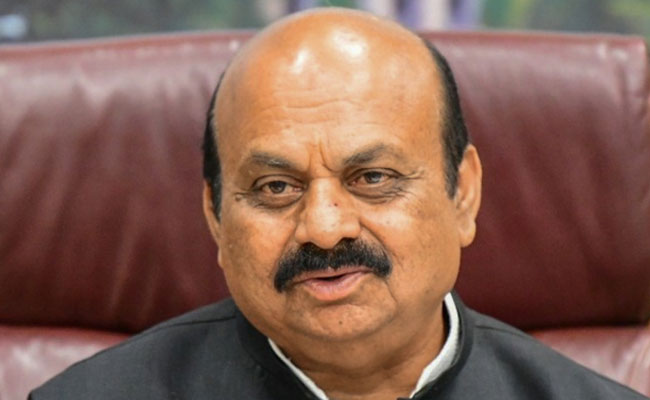
Bengaluru (PTI): Karnataka Chief Minister Basavaraj Bommai on Tuesday dismissed Congress' poll 'guarantees' as "bogus announcements", and said their leader Rahul Gandhi's visit to the poll-bound state will not have any impact.

He said, the people of Karnataka will not give any value to the former AICC President's words, after his recent controversial statements in London, regarding the state of democracy in the country.

During Rahul Gandhi's visit to Belagavi on Monday, the Congress announced its fourth 'guarantee' "YuvaNidhi' -- Rs 3,000 every month for graduate youth and Rs 1,500 for diploma holders (both in the age group of 18-25) for two years, 10 lakh jobs in five years and filling up of 2.5 lakh govt jobs within one year, in the event of the party coming to power in the State, where Assembly elections are due by May.

"Rahul Gandhi has come and gone several times (to Karnataka), he has done the Bharat Jodo Yatra also, but it has not made any effect. Monday's announcement was a bogus announcement, there is no impact," Bommai said in response to a question.

Speaking to reporters, he said, "there is a lot of difference between Rahul Gandhi's last visit and Monday's. His speech in London in between the two visits, against the country and regarding democracy, is being condemned across the country, including Karnataka. So people of Karnataka will not give any value to his words".

Hitting out at the Congress, calling its poll 'guarantee' card and "bogus card", the CM said, they have made similar promises in other states, but haven't fulfilled them till today.

"It is their track record. Whether it is Rajasthan or Chattisgarh or other states, they have not fulfilled the promises made. In Chattisgarh they had promised to give Rs 1,000 to every house, they didn't give it during the last four years, but in the last year they are giving.

They cheat people this way," he said, adding that it is not a guarantee card, but only a "visiting card, and it doesn't have any value".

The Congress party earlier announced three poll guarantees' 200 units of free power to all households (Gruha Jyoti), Rs 2,000 monthly assistance to the woman head of every family (Gruha Lakshmi), and 10 kg of rice free to every member of a BPL household (Anna Bhagya), in the event of the party coming to power.

Targeting Congress leader and former Chief Minister Siddaramaiah, Bommai said he has no moral right to speak on the issue of corruption.

"There are lots of charges against him, there is a complaint against him in Lokayukta, there are several charges against him including the Redo (denotification) case....Congress has collapsed everywhere across the country, here too it will collapse with him," he said.

Responding to a question, he further said, discussions are underway with legal experts to conduct a judicial inquiry into the "corruption cases" of Siddaramaiah's government, and a decision will be made in a few days. "Some of the 59 cases are entrusted to Lokayukta, rest will also be entrusted."

Let the Truth be known. If you read VB and like VB, please be a VB Supporter and Help us deliver the Truth to one and all.


Bengaluru (PTI): Union Minister of State Shobha Karandlaje on Friday urged Governor Thaawarchand Gehlot to withhold assent to the Karnataka Hate Speech and Hate Crimes (Prevention) Bill, 2025, terming the Bill "vague, overbroad, and susceptible to misuse".

She also requested him to reserve the Bill for the consideration of President Droupadi Murmu under Article 200 of the Constitution of India, in the larger interest of constitutional governance, democratic freedoms, and the rule of law.

The bill, passed by both houses of the legislature, will be sent to the Governor for his assent.

Taking to social media 'X', the minister said, "The Karnataka Hate Speech and Hate Crimes (Prevention) Bill 2025 hands the State sweeping authority to silence opposition voices, restrain the media, and intimidate the citizens who defend Karnataka's land, language, and Dharma. This isn't a hate speech prevention bill, it's rather a bill that prevents the right to speech." "We will not let Congress turn the law into a tool to choke free speech and democratic dissent," she added.

In a letter to the governor, Karandlaje said the objective of the Bill is to address hate speech and hate crimes. However, upon careful examination, it becomes evident that the Bill, in its present form, establishes a "State-controlled mechanism" for monitoring, assessing, and penalising speech, rather than narrowly addressing expression that poses a clear and imminent threat to public order.

"The structure of the Bill enables executive authorities to determine the permissibility of expression, thereby transforming the law into a tool capable of suppressing voices critical of the government. Such an approach undermines the constitutional guarantee of democratic dissent and free expression," she said.

Citing reference of article 19(1)(a) of the Constitution of India that guarantees freedom of speech and expression to every citizen, she said, "The Bill departs from these constitutional limits by employing broad, vague, and subjective expressions such as "disharmony," "ill-will," and "prejudicial interest," which are not precisely defined. These terms confer excessive discretion on the Executive, enabling arbitrary and selective enforcement, which is inconsistent with constitutional safeguards."

She said the constitutional infirmities of the present Bill must be examined in light of the Supreme Court's judgment in Shreya Singhal v. Union of India, (2015), wherein the Court held that any law regulating speech must be clear, narrowly tailored and free from vagueness.

The minister alleged that the Bill further authorises executive authorities and law-enforcement agencies to assess and act upon speech without adequate judicial oversight. Penal consequences are linked to executive assessment, thereby concentrating investigative and adjudicatory functions within the Executive.

"Such an arrangement erodes procedural safeguards and is inconsistent with constitutional principles governing the protection of fundamental rights," she alleged.

Karandlaje also pointed out the potential impact of the Bill on "historically marginalised" and "constitutionally protected" voices.

"The vague and expansive language of the legislation is capable of being invoked to silence Kannada language activists, women's organisations, representatives of Scheduled Castes and Scheduled Tribes, backward classes, minorities, journalists, student groups, and civil society organisations that raise issues of governance, social justice, or administrative accountability," she said.

Instead of empowering vulnerable communities, according to the minister, the Bill risks becoming an instrument to deter them from articulating grievances and participating meaningfully in public discourse, thereby defeating the very constitutional promise of equality, dignity, and inclusive democracy.

The minister alleged that the cumulative effect of the Bill is likely to create a "pervasive chilling effect" on public discourse, which is incompatible with democratic governance.

Pointing out that the Bill directly impacts fundamental rights guaranteed under Part III of the Constitution, she said, "In view of the serious constitutional questions it raises, this is a fit case for the exercise of constitutional discretion under Article 200. Reserving the Bill for the consideration of the President would enable a broader constitutional examination of its implications for civil liberties and the federal constitutional balance."