CM Bommai takes a dig at Congress, says he is proud of RSS ideals and patriotism
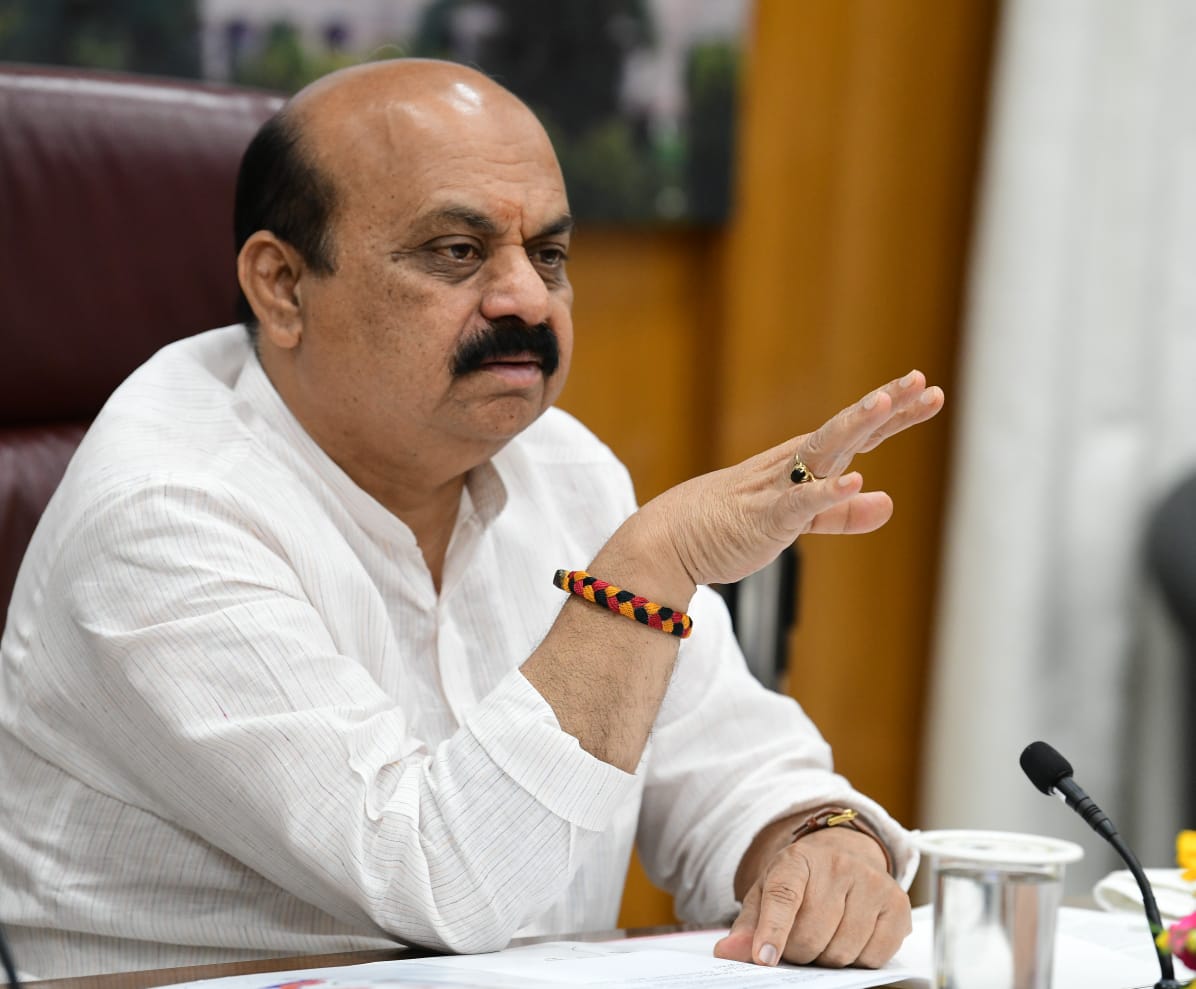
Bengaluru, Aug 15: Amid controversy over excluding first Prime Minister Jawaharlal Nehru in the Karnataka government's newspaper advertisement on freedom fighters, Chief Minister Basavaraj Bommai on Monday took a dig at the Congress and said he is proud of the RSS' ideals and bowed his head to its patriotism.
Clarifying that he and his government respects Nehru, using whose name Congress ruled the country for 65 years, he said and accused the grand old party of neglecting other national icons like B R Ambedkar and Lal Bahadur Shastri.
"In the government's advertisement yesterday, we had mentioned about some freedom fighters, who were even never heard of before with their photos, no one spoke good about it, instead of it, they (Congress) are sad that one of their leader's names was missing," Bommai said.
Speaking at a BJP event to commemorate 75th anniversary of India's independence, he said, "We haven't forgotten him and his works. We have respect for Nehru. In fact , there is a picture of him in that ad."
"Some one said, Bommai has become an RSS slave, I want to tell that I bow down my head to its (RSS) ideals and principles and that patriotism. I'm committed to build the country on those ideals and principles and I'm proud of it," he said.
The Congress on Sunday took strong exception to the exclusion of Nehru in the newspaper advertisement on freedom fighters and termed the BJP government's action "pathetic".
Former Karnataka chief minister Siddaramaiah had called Bommai an "RSS slave", while AICC general secretary and in-charge of the party affairs in the state Randeep Surjewala had said the BJP's hatred for the country's first prime minister had reached its zenith.
State BJP General Secretary N Ravi Kumar, had however, said Nehru's name was omitted "intentionally", as he was responsible for the partition of the country.
The Chief Minister further hit out at the Congress, accusing it of not allowing B R Ambedkar, the architect of the Indian Constitution, to come to Parliament, and neglecting his memory for years.
Further pointing out that the families of several national icons like Subash Chandra Bose, Mahatma Gandhi, Lal Bahadur Shastri, Ambedkar are today not in mainstream politics, without naming anyone, he said those people who got politically benefited because of the freedom struggle will have to answer about the ill things that exist today like- appeasement politics.
Stating that no one can change the history of the freedom struggle, Bommai said, "but those writing history have tried to change it for 75 years. Now the time has come to speak out the truth and make people know the truth. We have got freedom because of the sacrifice of thousands of unnamed youth, farmers, labourers."
This 75th anniversary of India's Independence should be dedicated to the unnamed freedom fighters of the country, he said.
Earlier in the day, in his address at the 76th Independence Day event at the Manekshaw Parade Ground here, the Chief Minister, taking a veiled dig at the Congress, pointed out at attempts to "forget" national icons like Ambedkar, Lal Bahadur Shastri and Abdul Ghaffar Khan among others.
He also said that all Prime Ministers so far and leaders of the country have contributed to India's progress in their own way, and there is no question of forgetting anyone.
Prime Minister Narendra Modi has set up a Prime Ministers' Museum in New Delhi to highlight each one's contribution, Bommai further said "If any Prime Minister had thought about making known the contributions of various PMs to the country it is Modi. There is no question of forgetting anyone here. Everyone has contributed in their own way. Only PMs have not contributed, there are several luminaries who have contributed."
Let the Truth be known. If you read VB and like VB, please be a VB Supporter and Help us deliver the Truth to one and all.
Rajnath to top commanders: Outmaneuver adversaries with strategic surprise
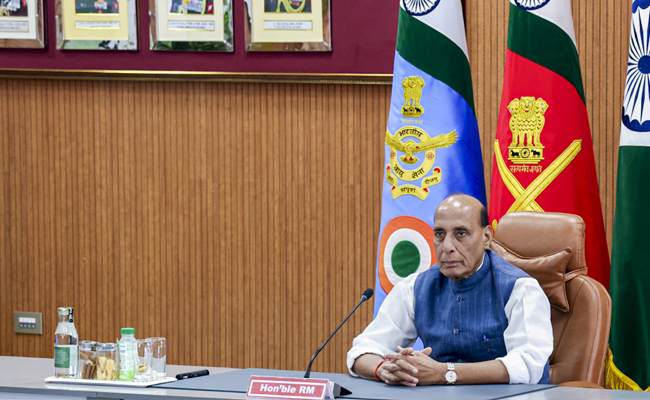
Jaipur/New Delhi (PTI): Defence Minister Rajnath Singh on Friday directed the top military commanders of the three services to integrate an "element of surprise" into modern warfare to outmaneuver India's adversaries and bolster strategic posture.
In his address at the joint commanders conference in Jaipur, Singh also described the Operation Sindoor as a testament to the "swift, precise, and joint response" of the Indian armed forces to safeguard national interests and called upon the military to remain ready to deal with any security challenges.
In their two-day deliberations, the commanders carried out a comprehensive review of the combat preparedness of the military in the wake of the evolving regional security situation.
Operation Sindoor was a demonstration of India's growing capabilities and a symbol of the nation's collective resolve and new military ethos, Singh said, a day after the first anniversary of Operation Sindoor.
He also unveiled a 'Joint Doctrine for Integrated Communication Architecture' that is aimed at strengthening doctrinal clarity, interoperability and integrated communications across the armed forces in future multidomain operations.
The joint commanders' conference, themed 'Military Capability in New Domains', brought together the top leadership of the defence ministry and the three services to deliberate on emerging security challenges and future readiness.
Comprehensive deliberations were held on future warfare, multidomain operations, technological transformation and joint capability development.
The conference witnessed extensive discussions on cognitive warfare, cyber resilience against evolving quantum and AI-enabled threats, military capability development in emerging domains, indigenous innovation and AI-enabled warfighting concepts.
It was attended by Chief of Defence Staff Gen Anil Chauhan, Chief of the Naval Staff Admiral Dinesh Kumar Tripathi, Chief of the Army Staff Gen Upendra Dwivedi, Chief of the Air Staff Air Chief Marshal AP Singh and Defence Secretary Rajesh Kumar Singh among others.
In his remarks, Singh asked the commanders to remain "future-ready" by learning from the operation as well as the current global security landscape.
He underscored the need to strengthen capabilities in artificial intelligence, autonomous systems, data analytics and secure communication networks to stay prepared in the rapidly evolving geopolitical security scenario. He emphasised that future conflicts will increasingly be shaped by hybrid threats, information dominance and operations conducted simultaneously across cyber, space, electromagnetic and cognitive domains, according to an official readout.
Highlighting the transformative impact of emerging technologies, Singh stressed on the importance of ensuring integrated national preparedness across all spectrums of conflict, it said.
Singh's remarks at the conference came a day after the first anniversary of Operation Sindoor.
The defence minister appreciated the progress achieved in enhancing jointness, integration and technological adoption across the three services, the readout noted.
Singh said that jointness constitutes a pivotal dimension within the transformative changes sweeping across the global defence sector.
"Future wars will not be won solely through weaponry, but through innovative thinking and enhanced synergy," he said.
The defence minister exhorted the commanders to cultivate the "element of surprise" to remain unpredictable to the nation's adversaries and secure a strategic edge in any given situation.
He, however, urged them to remain vigilant of the element of surprise of the enemy and always stay two steps ahead.
Singh also reiterated the Narendra Modi government's commitment to enhancing the capabilities of the defence forces through state-of-the-art weapons and platforms. He added that special focus is being laid on research in niche domains.
During the conference, he released a documentary film on Operation Sindoor.
The film reaffirms the nation's and defence forces' commitment to operational preparedness and decisive national response capabilities.
Demonstrations of advanced systems and platforms developed for intelligence fusion, operational planning and information management were also showcased during the conference reflecting growing integration of cutting-edge technologies into joint operational structures, according to the defence ministry.
The discussions will contribute significantly towards shaping India's future military transformation and integrated operational preparedness, it said.