CM Bommai wants Punjab-like food processing units in central Karnataka
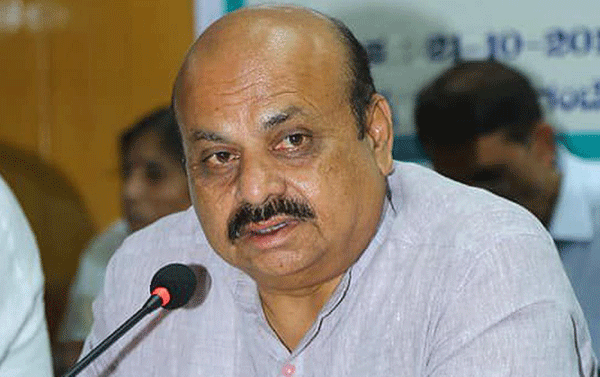
Bengaluru, Sep 29: Chief Minister Basavaraj Bommai on Wednesday mooted the idea of creation of a mini-Punjab in central Karnataka by growing a variety of horticultural crops in the region between Tungabhadra and Krishna rivers and setting up over a 100 food processing units there.
"The seven to eight-lakh hectare land between Tungabhadra and Krishna rivers can be utilised for a variety of horticulture crops where over 100 food processing units can be set up. It will be like a mini-Punjab which will give jobs through growing natural horticulture crops," Bommai said while sharing his thoughts on his vision for the State.
His talk was organised by the Karnataka Media Academy (KMA) on its 40th Foundation Day ceremony held through social media. Bommai released the logo of the KMA on the occasion.
The Chief Minister said Karnataka is blessed with 10 agro-climatic zones, making the State distinct from others.
The zones enable the State to grow a variety of crops, an advantage which must be utilised, he said.
"The State is also gifted with a number of rivers flowing from west to east to other States, which must be tapped and properly utilised," he said.
Also, the Chief Minister said he is planning to bring out a policy on the utilisation of the 350-km coastline for tourism and port development.
"This week, we will take a decision on inland and hinterland development. When 60 per cent of Indonesia's economy is growing due to its ports, we can also explore that possibility," he said.
Further, Bommai wanted to explore the temple, coastal and heritage tourism by improving the ports and airports.
Education is also an area of priority with emphasis on technical education in high schools and improving science and maths education in rural areas, he said.
"The Gross State Domestic Product (GSDP) is contributed by 30 per cent population which needs to be increased. In this regard, we want SC/ST/OBC and minorities and their women to become skilled workers and take part in economic activities," Bommai said.
Upgrading hospitals in districts, protection to the economically weaker sections and destitutes, employment-centric policy for job creation, art, culture, music and literature are also areas of focus, the Chief Minister added.
Let the Truth be known. If you read VB and like VB, please be a VB Supporter and Help us deliver the Truth to one and all.
Union government assumes full control over TV ratings, TRAI role curtailed: Report
New Delhi: The Union government has assumed full control over television audience measurement, removing the Telecom Regulatory Authority of India (TRAI) from oversight of the ratings system that underpins the country’s ₹36,000 crore television advertising market, according to a report published on Wednesday.
The report in Mint said the Ministry of Information and Broadcasting (MIB) now has exclusive authority over the framework governing how television ratings are measured and regulated. TRAI had been entrusted with oversight of TV ratings in 2012 during the UPA government’s tenure. TRAI is no longer mentioned in the relevant policy document, effectively vesting sole authority in the MIB.
The report said TRAI will continue to regulate other aspects of broadcasting, including channel pricing, advertising caps, interconnection and distribution norms, service quality and compliance standards. Its role in determining how ratings agencies track viewing behaviour has been withdrawn.
Television Rating Points (TRPs), which reflect viewership patterns, guide advertisers in deciding where to allocate spending across channels and time slots.
A government source quoted in the report said the ministry could modify TRAI’s decisions even when the regulator oversaw broadcasting.
A former CEO of Prasar Bharati told the newspaper that the MIB has historically regulated rating agencies through licensing and guidelines, and by holding them accountable under existing norms.
During its tenure overseeing ratings, TRAI had taken decisions affecting the broadcast sector, which included capping advertising time at 12 minutes per hour following complaints about excessive commercial breaks and it now remains unclear how these matters will be addressed under the revised arrangement.
Satya N. Gupta, former principal advisor at TRAI, was quoted as saying that merging regulatory functions with policy oversight and removing an independent regulator from the process was a retrograde step.
TRAI’s involvement in broadcasting had earlier attracted criticism as well. In 2012, its consultation paper on quantitative limits on television advertising was viewed by some as overlapping with the Advertising Standards Council of India’s code. Subsequent recommendations covering television audience measurement, ownership of news channels and issues such as paid news had also raised concerns among sections of the industry.
Television ratings have faced scrutiny in recent years, including during the controversy involving the Broadcast Audience Research Council (BARC), where officials of the ratings body were prosecuted over allegations of manipulation of viewership data.