CM Kumaraswamy promises to set up Kodagu Reconstruction Authority
Discussion with affected people
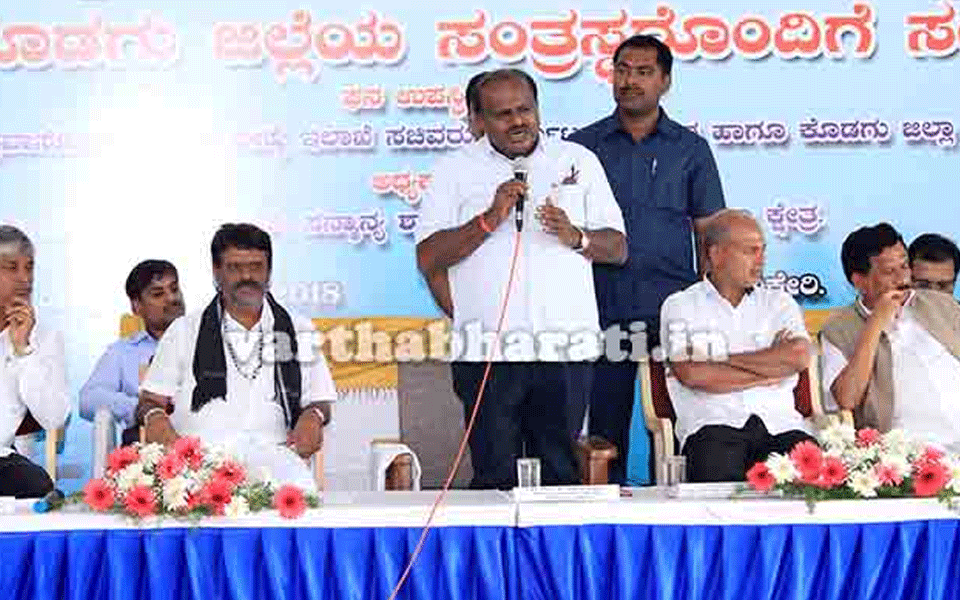
Madikeri, October 17: Chief Minister HD Kumaraswamy on Wednesday assured of taking necessary steps to constitute ‘Kodagu Reconstruction Authority’ to rehabilitate the affected people and reconstruct the entire district which was devastated in the natural disaster.
Participating in a discussion programme with the affected people, at Gandhi Maidan here, the CM said that the government was with the affected people. It was the duty and responsibility of the Coalition government to instill confidence among affected people and ensure permanent solution to their problem besides reconstructing the entire district. The government has already taken steps in this regard. The district minister and elected representatives from the district have demanded setting up of an Authority to reconstruct the damaged areas. Necessary steps would be taken to set up the authority, he said.
The MLAs of the district have appealed to construct houses at Rs 10 lakh each. Already, the government has disbursed Rs 1.03 lakh to each of the family which lost its house. Along with it, Rs 50,000 was being given for materials damage. Since it would take minimum seven to eight months to construct houses for those who lost houses, the government has decided to give Rs 10,000 per month for next ten months. Along with this, the government would spend Rs 6 lakh for construction of a house. Total, Rs 8.53 lakh would be spent for rehabilitating the affected people, he clarified.
Rs 50k to be credited to account
In order to respond to the problems of the affected people on humanitarian ground by keeping aside the NDRF norms, the government has decided to give Rs 50,000 immediate compensation to each of the affected family, for which Rs 6 crore was already released. The amount would be credited to the accounts of the beneficiaries in a couple of days. Now the government would spend Rs 6 lakh for constructing a house and if the beneficiaries came forward to construct the houses on their own along with their amount, they would be allowed to do it. There was no need to be panic. The government was committed to provide security to the family, he said appreciated the efforts of the elected representatives and officials of the district in handling the situation during natural disaster in the district.
Help through loan waiver scheme
Coffee growers and farmers have suffered a lot due to floods and natural disaster in the district. As per the NDRF norms, Rs 17,000 compensation could be given for each hectare. Was it possible to build the life in that amount? Now, the government has planned to extend the loan waiver scheme benefits to the coffee growers and farmers, he promised.
Banks are non-cooperative
If the nationalized banks cooperated with the government, the farmers would have benefitted with the loan waiver scheme. But though the heads of nationalized banks were asked to furnish the details of farm loans two months before, they have not provided the details. The banks have just been doing the work of serving notices. The Cabinet has approved the waiver of loan up to Rs 2 lakh. Even then, the nationalized banks were not cooperating with the government, he said.
Though the people of Kodagu were under distress, unlike other places, the farmers in the district have not taken extreme steps of committing suicide. He would oversee every rehabilitation work. He would also support the revival of tourism and hotel industry in the district, he said and appealed the people to celebrate the Dasara festival forgetting all bad incidents.


Let the Truth be known. If you read VB and like VB, please be a VB Supporter and Help us deliver the Truth to one and all.
Three Bangkok flyers arrested with Rs 4.53 crore hydroponic ganja at BLR airport

Bengaluru (PTI): Three passengers who arrived from Bangkok at the Kempegowda International Airport in Bengaluru on Wednesday were arrested with hydroponic ganja valued at Rs 4.53 crore, officials said.
The accused, whose identities have not been disclosed, were arrested under the Narcotic Drugs and Psychotropic Substances (NDPS) Act, they said.
In a post on X, Bengaluru Customs said it intercepted three passengers arriving from Bangkok and seized 12.96 kg of hydroponic ganja, valued at Rs 4.53 crore, concealed in their check-in baggage.
Further investigation is underway.