CM Siddaramaiah prosecution case: HC directs special court to defer its proceedings till August 29
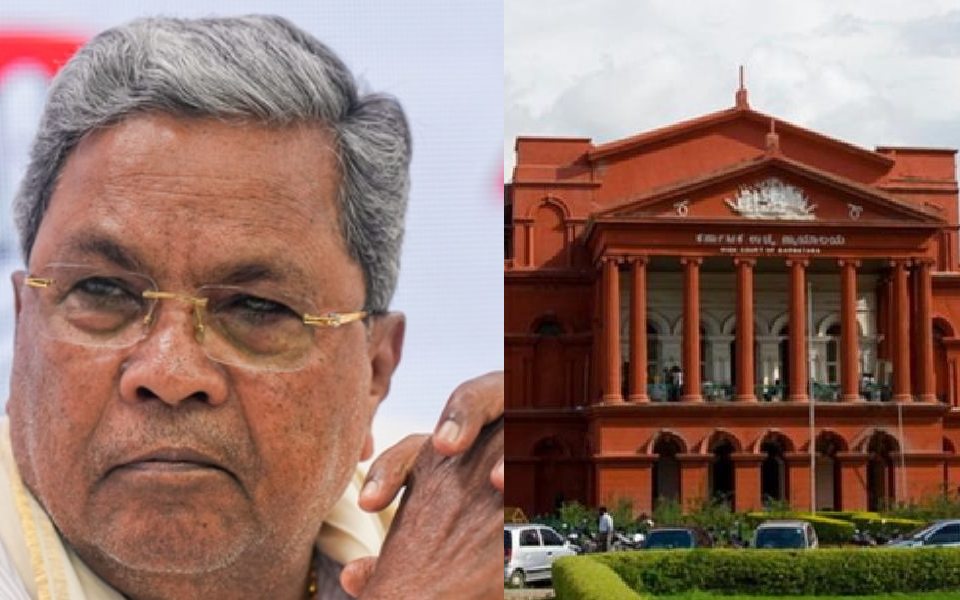
Bengaluru, Aug 19: The Karnataka High Court on Monday directed the special court for people's representatives, slated to hear complaints against Chief Minister Siddaramaiah in the alleged Mysuru Urban Development Authority (MUDA) site allotment 'scam', to defer its proceedings till the next date of hearing on August 29.
"No injunction has been granted," said Justice M Nagaprasanna, who heard a writ petition filed by the Chief Minister challenging the legality of the August 16 order of the Governor, who accorded sanction against him under Section 17A of the Prevention of Corruption Act, 1988, and Section 218 of the Bharatiya Nyaya Suraksha Sanhita, 2023.
In the petition, the Chief Minister submitted that the sanction order was issued without due application of mind, in violation of statutory mandates, and contrary to constitutional principles, including the advice of the Council of Ministers, which is binding under Article 163 of the Constitution of India.
ALSO READ: High Court grants interim relief to Siddaramaiah in land scam case, prosecution on hold
Siddaramaiah contended that the Governor’s decision is legally unsustainable, procedurally flawed, and motivated by extraneous considerations, and thus, he has preferred the writ petition seeking to quash the impugned order amongst other reliefs.
The Governor had issued the order after Pradeepkumar S P, T J Abraham and Snehamayi Krishna had submitted to him petitions requesting sanction for prosecution of the Chief Minister in connection with the alleged irregularities in the allotment of alternative sites to his wife Parvathi by MUDA.
Abraham and Krishna have moved the special court for public representatives, and the case was slated to come up on Tuesday and Wednesday.
“Since the matter is being heard by this court and the pleadings are yet to get complete, till the next date of hearing, the concerned court shall defer its proceedings,” Justice Nagaprasanna said.
Senior advocate and Congress spokesperson Abhishek Manu Singhvi and the Solicitor General of India Tushar Mehta appeared on behalf of the Chief Minister and Governor, respectively.
Let the Truth be known. If you read VB and like VB, please be a VB Supporter and Help us deliver the Truth to one and all.
Tribals, Scheduled Castes preserved India's identity and soul despite foreign invasions: Bhagwat
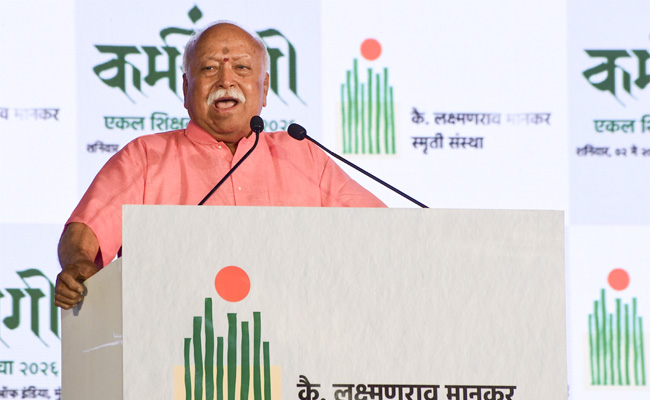
Mumbai (PTI): RSS chief Mohan Bhagwat has said that despite foreign invasions and hardships, tribal communities and Scheduled Castes preserved the country's identity and soul, stressing the need to integrate them into the mainstream development process.
He was speaking on Saturday at the Karmayogi awards ceremony in Mumbai, where Union Road Transport and Highways Minister Nitin Gadkari was also present.
"Human life is defined by giving back to the world, as we are all part of one great family. A person works and spends for the betterment of society, not as a favour, but out of duty. In serving others, we foster our own development. By helping others to thrive, we elevate ourselves and grow as human beings. This principle is the core value of this Indian land, commonly known as a Hindu society," Bhagwat said.
"This is the society's enduring ethos, which has survived for thousands of years. For various reasons, partly because of our indifference and partly because of foreign invasion, those who preserved this ethos paid a heavy price," he said.
The foreign invaders found that this ethos, this value system of the society is its soul and the key to keeping it alive. So they ensured that those who tried to preserve this soul would be uprooted and face extreme hardships, the Rashtriya Swayamsevak Sangh (RSS) chief noted.
But despite foreign invasions and hardships, tribal communities and Scheduled Castes preserved the country's identity and its soul, he said.
"Despite such adversities, the country's core identity remained intact among tribal communities and those belonging to SC and ST groups," he said, emphasising the need to integrate them into the mainstream development process while ensuring they receive equal access to services and facilities.
Referring to global developments, Bhagwat said the present world is "stumbling forward" and struggling to maintain balance, and asserted that India could emerge as a stabilising force.
The country must not only safeguard its own interests but also extend support to the world, he said.
"The world should get to see that the country is not only solving its own misery and sorrow but also helping the world to address similar issues," he said.
The RSS chief stressed that service to society is not a favour but a duty that contributes to one's own development.
Helping others grow also elevates individuals and strengthens the collective fabric of society, he said.
The so-called educated and developed sections have, over time, distanced themselves from these communities, Bhagwat pointed out, and called for the need to bridge this gap.
The identities preserved by these communities represent the true identity of Indian society, he said and underlined that without identity, existence itself is at risk.