CM Siddaramaiah blames PM Modi for soaring prices
Bengaluru, Apr 17 (PTI): Karnataka Chief Minister Siddaramaiah on Thursday slammed Prime Minister Narendra Modi over rising prices in the country.
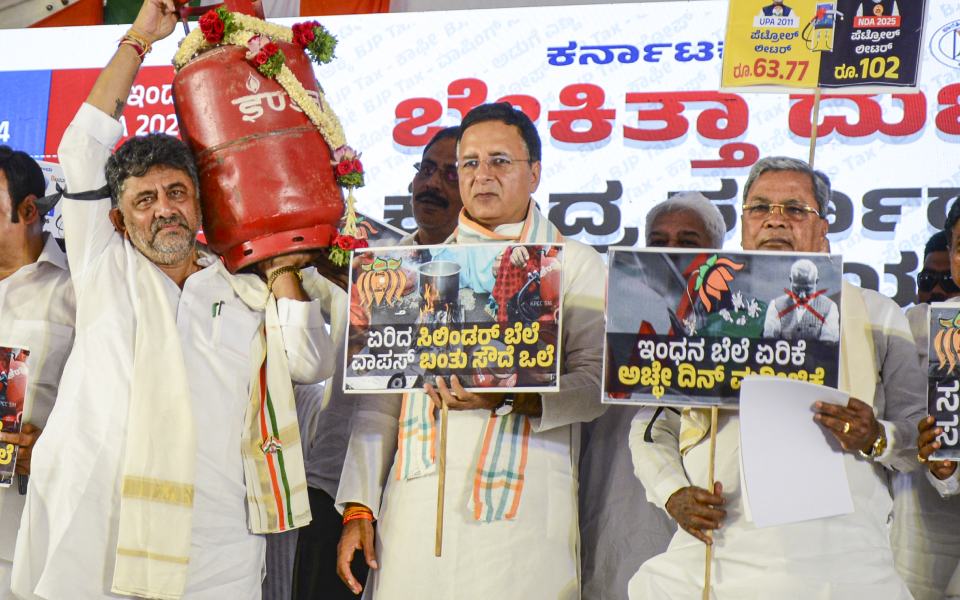
Apparently to counter the BJP’s ‘Janaakrosha Yatre’ (Public Anger March) in Karnataka, the ruling Congress in the state staged a protest against the Centre's policies at Freedom Park in the city.
Participating in the event, the chief minister questioned whether the ongoing price rise was Modi’s promised ‘Achchhe Din’ (Good Days) before coming to power in 2014.
Siddaramaiah accused the BJP of increasing petrol and diesel prices by Rs 2, and cooking gas by Rs 50 per cylinder refill.
"Narendra Modi is responsible for the price rise in the country. Didn’t he say, 'Achchhe Din Ayenge' (Good days will come)? Have those come?" he asked.
The CM said gold was priced at Rs 28,000 per 10 grams before 2014, and has now gone up to Rs 95,000 per 10 grams.
Similarly, silver was Rs 43,000 per kg during the UPA government, which has now crossed Rs 94,000 per kg.
"Each US dollar was Rs 59 before 2014, but now it is Rs 87 per USD. Mr Narendra Modi, you came to power promising that one dollar would equal one rupee. Who is responsible for this, Mr Modi? Isn’t this sucking the blood of the poor?" Siddaramaiah charged.
He added that cement was Rs 268 per 50 kg bag before 2014, but today it costs Rs 410.
Similarly, steel was Rs 19,000 per tonne, which is now Rs 73,000 per tonne. PVC pipes were priced at Rs 60 per unit, but have gone up to Rs 150, the chief minister claimed.
Taking a dig at the BJP for organising the ‘Janaakrosha Yatre’ in the state, accusing the ruling Congress of causing the price rise, Siddaramaiah said, "Ever since the BJP came to power at the Centre, it has been burdening people with price hikes. The shameless BJP and its ally JD(S) have no moral right to protest. Do they have self-esteem or shame?"
Deputy Chief Minister D K Shivakumar dismissed the BJP’s allegations of price rise.
He said the Congress party, which gave five guarantees (Gruha Jyoti, Gruha Lakshmi, Anna Bhagya, Yuva Nidhi, Shakti) to help the poor, could never work against them.
"If there is any pro-poor government, it is the Congress. The BJP is responsible for the price rise," Shivakumar claimed.
Congress general secretary and Karnataka in-charge Randeep Singh Surjewala alleged that the BJP-led central government has "burnt a hole in people’s pockets" by increasing petrol and diesel prices by Rs 2 per litre, and raising the cooking gas price by Rs 50 per cylinder.
He said cooking gas was cheaper during the UPA government because people were getting subsidies, which have now been abolished by the BJP government at the Centre.
"The BJP reduced the LPG subsidy from Rs 52,000 crore to Rs 10,600 crore—a 500 per cent cut. The Centre now collects Rs 9,050 crore more annually from people just by increasing cooking gas prices by Rs 50 per cylinder."
According to him, 181 crore refill cylinders are sold every year in India. With a Rs 50 increase per refill, consumers will pay an additional Rs 9,050 crore annually.
In Karnataka, 10.36 crore cylinders are sold every year, resulting in an additional burden of Rs 515 crore on Kannadigas, he said.
The Congress later sent a memorandum to the Prime Minister, signed by several party leaders, including Siddaramaiah, Shivakumar, and Surjewala.
The memorandum, submitted "against BJP-made Mahangai (price rise)", alleged that the Centre had imposed a burden of over Rs 50,000 crore annually on the people of India—Rs 5,000 crore of which falls on Karnataka alone.
They also urged the Prime Minister to "urgently roll back the Rs 50 hike in gas cylinder prices, and withdraw the Rs 2 increase in excise duty on petrol and diesel, to pass on the benefit of reduced crude oil prices (USD 62 per barrel) to the common people."
"The people of Karnataka, along with the rest of India, are deeply anguished and pained by the extortionist policies of the BJP-NDA government at the Centre, led by your good self. The surging inflation has broken the budgets of ordinary households," the memorandum read.
Let the Truth be known. If you read VB and like VB, please be a VB Supporter and Help us deliver the Truth to one and all.
Om Birla attends swearing-in of new B'desh PM, says India stands ready to support BNP govt
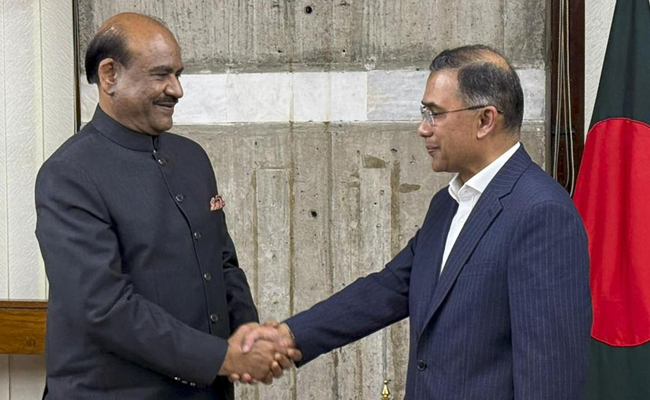
New Delhi (PTI): Lok Sabha Speaker Om Birla on Tuesday attended the swearing-in ceremony of new Bangladesh Prime Minister Tarique Rahman in Dhaka, and said India stands ready to support Bangladesh's endeavours to build a democratic, progressive and inclusive nation.
Separately, the speaker called on the new Bangladesh prime minister and conveyed the wishes of Prime Minister Narendra Modi.
He also handed over an invitation from Prime Minister Modi to Rahman to visit India, officials said here.
“Glad to attend the swearing-in ceremony of the new government of Bangladesh led by Prime Minister Tarique Rahman in Dhaka today. India stands ready to support Bangladesh’s endeavours to build a democratic, progressive and inclusive nation,” Birla posted on X.
Bangladesh High Commissioner to India, Riaz Hamidullah, said in a post on X, “Prime Minister Tarique Rahman conveys his greetings to India and PM Narendra Modi to the visiting India Lok Sabha Speaker Om Birla at a courtesy meet following the swearing-in of the new government.
“Speaker Birla conveyed wishes and an invitation to India. Both leaders expressed optimism to work together for the well-being of the people of Bangladesh and India, pursuing a people-centric menu of cooperation.”
Birla also met Maldives President Mohamed Muizzu, Bhutan Prime Minister Tshering Tobgay and other leaders on the sidelines of the event.
Led by Rahman, the Bangladesh Nationalist Party (BNP) swept to power with a two-thirds majority with 49.97 per cent votes and 209 seats in the polls held on February 12, results for which were declared on February 13.
The Jamaat-e-Islami, which was opposed to Bangladesh's independence from Pakistan in 1971, registered its best-ever performance with 31.76 per cent votes and 68 seats.
The National Citizen Party (NCP) secured the third-highest number of seats, six, and 3.05 per cent votes.
Bangladesh had invited Narendra Modi to the ceremony, but the prime minister could not attend the event as he was scheduled to hold talks with French President Emmanuel Macron in Mumbai on Tuesday.
On reaching Dhaka, Birla said the swearing-in of Rahman was an important moment that would strengthen people-to-people relations and shared democratic values between the two neighbours.
“Honoured to be in Dhaka representing India at the swearing-in ceremony of the new government led by Tarique Rahman as the prime minister. It's an important moment that will strengthen people-to-people ties and shared democratic values between our two nations,” Birla said.
Birla was accompanied by Foreign Secretary Vikram Misri and other officials.