CM Siddaramaiah challenges PM Modi's statements on Congress manifesto
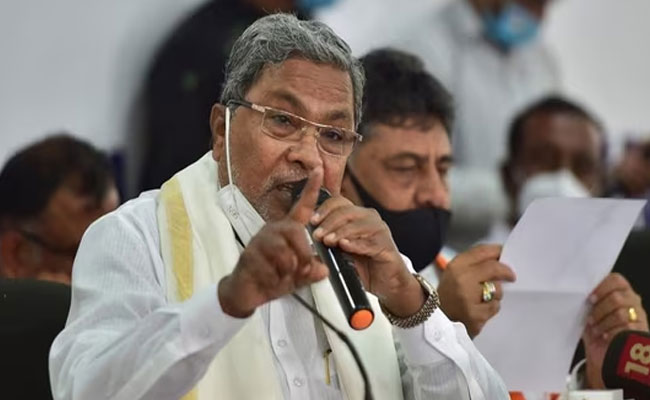
Bengaluru: Chief Minister Siddaramaiah has issued a strong response to Prime Minister Narendra Modi's recent comments regarding the Congress manifesto. Siddaramaiah welcomed Modi to Karnataka, referring to him as the "lord of lies," and urged him to introspect if he has a conscience. The CM posed several questions to Modi, demanding clarification on various statements made by him.
Siddaramaiah questioned Modi's assertion that the Congress party, if elected, would conduct a survey of the country's wealth and distribute it to Muslim families with seven children. He challenged Modi to provide evidence for this claim and asked for clarification on which page of the Congress manifesto this promise was made. He also demanded an apology from Modi if these accusations were found to be false.
Regarding the issue of inheritance tax, Siddaramaiah clarified that the Congress manifesto does not mention anything about imposing such a tax. He explained that while Sam Pitroda had mentioned the topic for discussion, it was not part of the party's official platform. Siddaramaiah pointed out that it was Finance Minister Nirmala Sitharaman, a colleague of Modi, who had initiated discussions on inheritance tax. He questioned whether Sitharaman would now be labeled a traitor.
Siddaramaiah also criticized Modi's government for reducing corporate tax rates, which he claimed resulted in a loss of revenue amounting to Rs 1.81 lakh crore. He accused the government of favoring corporate entities over the welfare of the poor.
The Chief Minister highlighted the Congress party's commitment to conducting a social and economic survey in the country to ensure equal distribution of wealth, as envisioned by Dr. Babasaheb Ambedkar. He accused Modi of distorting the Congress's goal of equitable wealth distribution and challenged him to openly declare if he opposes the constitutional ideals of economic and social democracy.
Siddaramaiah concluded by questioning Modi's policies on loan waivers for farmers and the privatization of public-owned enterprises. He accused Modi of favoring wealthy businessmen over the interests of farmers and the public.
Let the Truth be known. If you read VB and like VB, please be a VB Supporter and Help us deliver the Truth to one and all.
Karnataka power tussle: BJP leader calls Siddaramaiah 'Sultan for 15 days'
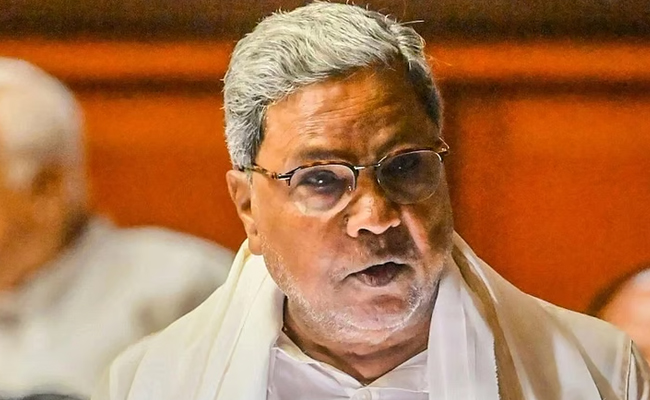
Bengaluru/Bagalkot (PTI): In the midst of the ongoing power tussle within the ruling Congress in Karnataka, senior BJP leader and MP Govind Karjol called CM Siddaramaiah "Pandrah din-ka-Sultan" (Sultan for 15 days), and said after that, he will not be the chief minister of the state.
Speculation has once again surfaced within the Congress party and political circles about a possible decision on leadership change and cabinet reshuffle after May 4, once the results for Assembly elections in four states and one union territory, along with bypolls to two Assembly constituencies in Karnataka, are announced.
"With the fight for the CM chair in the Congress, there seems to be no administration at Vidhana Soudha. The result for Siddaramaiah's CM chair fight will also be declared, along with election results for five states (four states and one union territory) and bypoll results for Bagalkot and Davanagere South Assembly seats in Karnataka," Karjol, a former Deputy CM, said.
Speaking to reporters here, he said, "As per today's information, Siddaramaiah is a Sardar for fifteen days, he is Pandrah din-ka-Sultan, after that Siddaramaiah will not be the chief minister of the state."
Stating that Shivakumar is ready to take up the top job, the MP said that this is the reason Siddaramaiah's supporters have gone to New Delhi to meet the Congress President.
"Already 40-odd legislators have lobbied in support of Siddaramaiah; about 50 are lobbying in support of Shivakumar. Amid this fight for the CM chair, the administration has completely collapsed," he said, urging the government to focus on addressing drinking water issues in various parts of the state amid summer by releasing at least Rs 50 crore per district.
PWD Minister Satish Jarkiholi on Monday met Congress President Mallikarjun Kharge and General Secretary (in charge of Karnataka) Randeep Surjewala in New Delhi and requested them to address the speculation regarding the change of leadership in Karnataka.
Subsequently, Social Welfare Minister H C Mahadevappa too met the party leadership in Delhi.
Both Jarkiholi and Mahadevappa are considered close to Siddaramaiah.
While MLAs and leaders who want Shivakumar to be elevated as CM have recently claimed they expect some "sweet news" by May 15, which is their leader's birthday.
Meanwhile, a team of 40 MLAs is preparing to visit New Delhi to press the Congress high command for a Cabinet reshuffle.
Speaking to reporters in Bengaluru, Leader of the Opposition in the Assembly R Ashoka hit out at the Congress leadership for indulging in "power tussle" instead of addressing the people's concerns. He called the government "anti-people" and "dead" to the people of the state.
With the fight for the CM chair, the ruling Congress in Karnataka seems to be shifting to Delhi. Congress MLAs are repeatedly touring Delhi, upset over the state leadership amid a power struggle between the CM and Deputy CM. This proves that there is no value for the state leadership," he said.
Pointing out that the Deputy CM Shivakumar was not present at the recent special cabinet meeting, which decided on internal reservation among SCs, the opposition leader said, "If the cabinet meeting was held purposely, despite knowing that Shivakumar was in Delhi, it proves that there are factions within the party"
"This government is dead in a way," he said, as he hit out at the Congress MLAs and Ministers, including Shivakumar, for doing "Delhi Yatras" instead of addressing drinking water issues in various parts of the state amid summer, picking up in the state.